Continuing the minimalist binge (cramming myself with lots and lots of very little), I’ve been listening tonight to a new performance of Tom Johnson’s insidious An Hour For Piano by R. Andrew Lee. It’s available for download on Lee’s blog, in either mp3 or (gasp) wav format. Thoughtfully, he reprints the program notes, which are meant to be read while listening to the music. If you’re one of those people who can’t help reading the notes while listening, you may think this is a boon. Remember, I said the piece is insidious.
It’s a fine performance, never mind Lee’s perfectionist quibble that he ran twenty seconds over the one-hour time limit. He got closer than Frederic Rzewski.
(Found via aworks.)
Filed under: Music by Ben.H
No Comments »
Etudes Boreales for Piano
Tuesday 8 September 2009
The piano etudes are really more like percussion pieces, the player using beaters and making noises on the piano construction. … Kirstein found the piece unplayable; it was only Michael Pugliese, a virtuoso percussionist, who found the way to play these “impossible” pieces.
— James Pritchett, The Music of John Cage (1996), p.199.
Last Tuesday night I left home and walked twenty minutes down the road to a cafe to hear the pianist Mark Knoop perform John Cage’s Etudes Boreales (1978) for piano. I was reminded of that story of the Los Angeles Philharmonic’s percussionists or whoever taking thirty rehearsals to muddle their way through Varèse’s Ionisation (1933), whereas now it’s a staple of student percussion ensembles.
It is indeed, like all of Cage’s Etudes, a fiendishly difficult set of pieces. Having never heard this particular set of four pieces I can’t compare how well Knoop performed it compared to other musicians. It sounded fine to me, and he didn’t appear to be struggling with getting the right beater to the right part of the piano in the right time, nor was he playing particularly slowly.
Interestingly, the music in these piano parts is significantly more sparse than in the other etudes. Cage was apparently mindful of the practicalities of performing these pieces, even if they did seem impossible at first. The idea behind all the etudes was not to defeat the musician, but allow them to accomplish something never attempted before. To paraphrase Morton Feldman: now that the Etudes are so simple, there’s so much to do.
Filed under: Music by Ben.H
No Comments »
The mystery of Julius Eastman’s Creation
Thursday 3 September 2009
UPDATE: Mystery solved.
When a forgotten talent is rediscovered, it’s sobering to realise how little time it takes for the biographical details of an artist to become as elusive and conjectural as those of a Jacobean playwright.
The fate of the composer Julius Eastman, not yet twenty years dead, is an extreme but illustrative example. Mary Jane Leach has been on a quest for ten years to gather up whatever scattered fragments of his work have survived. Devoid of context, the stray odds and ends can be frustratingly hard to fit into place.
Having heard Stay On It on the Internet Archive, I searched around and found a recording of another Eastman composition called Creation. According to the program notes, the recording is from a broadcast on KPFA in 1973, it “appears to be an aleatoric piece for voice, instrumental ensemble, and some prerecorded sounds”, and was written in 1954. If this last point is true, the piece is remarkably advanced for its time, particularly as Eastman would have been 14 when he wrote it*.
The program was repeated in 1974, and again the piece is called Creation by Julius Eastman. In the list of known works by Eastman, no such piece is mentioned. It seems unlikely that a hitherto-unknown piece, regardless of when it was composed, has been hiding in plain sight on the web. Perhaps the piece was mistitled in the broadcast: Thruway and The Moon’s Silent Modulation, both from 1970, are the only two on the list whose descriptions could possibly fit the recording. The former exists in a recording ten minutes longer than this 1973 broadcast, the latter lists no surviving recording or score.
I’ll have to become a researcher myself, just to find out for certain what this piece actually is.
* The 1954 date also seems incorrect when one of the singers quotes “The Girl From Ipanema“, although this particular song may not be specifically cited in Eastman’s score.
Filed under: Music by Ben.H
3 Comments »
Melodica!
Tuesday 1 September 2009
Daniel Wolf, of Renewable Music and Winter Album fame, has compiled a new survey of present-day composers who have written music for the melodica (or multiples thereof). Composers include Jon Brenner, Stephen Chase, Kieran Daly, Paul A. Epstein, Graham Flett, Aaron Hynds, Jukka-Pekka Kervinen, Kondo Kohei, Nomura Makoto, and Ushijima Akiko. There may be some new additions over the next few days.
My own piece, Redundens 1m, continues the ever-growing series of Redundens pieces. A mirror of the PDF will be added to the page shortly, and maybe an mp3 of a MIDI realisation (although good melodica soundfonts are hard to find). In the meantime enjoy the collection.
Filed under: Music by Ben.H
No Comments »
What’s On Top Of The Pile?
Saturday 29 August 2009
Julius Eastman, Stay On It (Ne(x)tworks live in concert at The Stone)
I’ve been having a little binge on minimalist music lately, and happened to find this 2007 performance of an essential piece by Julius Eastman – a tragic, quasi-mythical figure in the New York music scene. Stay On It starts out in a jaunty, upbeat fashion typical of much repetitive music… but then it starts to fall apart. And then something else happens. And then another something else, and then… It’s a great piece of music, and a neat reminder that in 1973 some composers were already finding minimalism old hat.
Filed under: Music by Ben.H
2 Comments »
Call Me Mister Langley
Monday 24 August 2009
For only about the second time in five years, I’m writing something out in conventional music notation for a real, live musicians. I’m trying to use a music notation program but I’m finding it a particularly frustrating experience. First of all, there’s the learning curve you get with every new piece of software, but that’s to be expected.
What’s really vexed me is how the software brings the contradiction, between what makes sense to humans and what makes sense to computers, to a crisis. I just want to write down a fairly simple succession of sounds, without any particular constant beat. It’s simple to enter this into a MIDI sequencer and have the computer play it back without a hitch, but if I convert it straight to sheet music it will look like a jumbled mess.
On the other hand, it would be simple for me to write the music out by hand, and the musician could immediately understand what was going on, but the software can’t intuitively grasp concepts and becomes hopelessly confused. It needs a regular, steady beat, and needs to know how many beats will be in each bar before it begins to fill them with notes and silences.
This is like trying to draw parabolae with an Etch-a-Sketch.
Filed under: Music by Ben.H
No Comments »
Azerbaijan unclear on concepts of Eurovision, Europe
Tuesday 18 August 2009
Pace Terry Wogan, Eurovision is not always a vote-for-your-neighbour contest. A total of just 43 people in Eurovision newcomer Azerbaijan voted for neighbouring country and traditional rival Armenia. How do we know? Because officials from the Azerbaijani National Security Ministry are rounding them up:
“They wanted an explanation for why I voted for Armenia. They said it was a matter of national security,” Nasirli said. “They were trying to put psychological pressure on me, saying things like, ‘You have no sense of ethnic pride. How come you voted for Armenia?’ They made me write out an explanation, and then they let me go.”
Disappointing news. It makes one yearn for the simpler, more innocent days of yore, when Eurovision points were allocated on the decisions of government-appointed judges, without all this pesky voting messing things up.
Filed under: Music, Stupidity, Television by Ben.H
No Comments »
Great Performances
Saturday 15 August 2009
Good news, everyone! I’ve fixed the dodgy music files in The Listening Room. It turns out that some of the pieces had been enocoded as mp3s at 48kHz instead of 44.1kHz, leading to Van Halen-like shenanigans. Everything should sound crystal-clear now.
Also, you may have noticed the little blue ‘listen’ buttons popping up on the blog. I’ve started using that Delicio.us play tagger thing which lets you listen to any mp3 on the site at the click of a mouse (or two clicks, if you have a Flash blocker installed). These have also been included on the music pages, so you can hear anything you want at the merest whim.
Filed under: Music, Self-promotion by Ben.H
No Comments »
This is the New Music! Callington
Saturday 8 August 2009
New mp3s ready for download or streaming.
This way of working was a conscious attempt at “formalizing” a disorientation of memory… In this regularity, there is a suggestion that what we hear is functional and directional, but we soon realize that this is an illusion; a bit like walking the streets of Berlin — where all the buildings look alike, even if they’re not.
— Morton Feldman, “Crippled Symmetry”
 The set of pieces that make up Callington began with the vision of an image I couldn’t make real. For some years now I’ve been interested in using means of visual processing to make music, with limited success. In this case, I’d been imagining the music of a spectrogram, itself made up of a montage of spectrograms of different musics, laid over each other with continuously varying degrees of transparency.
Not too surprisingly, my attempts to make music from such an image have so far all been unsuccessful. The few image-to-sound converters I have worked with interpret spectrographic information (intensity of frequency over time) in ways that make an actual spectrogram sound clumsy and dull. As an alternative, I patched together a system of filters and mixers to simulate the sort of effect I imagined the spectrograms would create.
The entirety of Callington is based upon five source sounds, each of a similar nature and roughly similar length. Only four of these source elements are used in any one piece. For each subsequent piece (Callington 2A, Callington 3A, etc) one of the sources is substituted, until all five possible combinations of four sources are used. Each piece is thus designed to differ as little as possible from its neighbours.
Each subsequent iteration of the source material (Callington 1B, Callington 1C, etc) is an imitation of its predecessor, using a different technological approach to mimic the previous section as best it can (full details here). Each section is thus a failed attempt to maintain a uniform identity throughout the entire piece.
The many small differences can be said to be caused by ‘mishearings’ as the music is translated from one format to another. This consistency is carried over into all the pieces, each sharing three of its four source materials with the others. The main noticeable difference between sections is in timbre. The outer sections have complex timbres and dynamics, whereas the inner sections reduce this material to a uniform timbral simplicity.
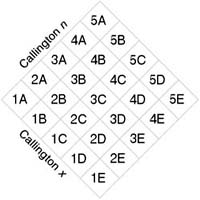 The twenty-five sections can be played individually or juxtaposed in a variety of ways. In particular, two ways present themselves as obvious arrangements. In Callington x, each successive iteration of the same source material is played (e.g. Callington 1A, 1B, 1C, 1D, 1E). The other, Callington n, groups common treatments of the different sets of material (e.g. Callington 1A, 2A, 3A, 4A, 5A). Other permutations, of course, are possible.
The multi-movement versions can be played from these m3u playlists:
Callington 1 Callington A
Callington 2 Callington B
Callington 3 Callington C
Callington 4 Callington D
Callington 5 Callington E
The entire set, along with detailed composition notes, can be downloaded from its page on the music website, or heard in streaming audio at The Listening Room.

Filed under: Music by Ben.H
No Comments »
Filler By Proxy LXXII: You Passed Too Bad Gas!
Monday 3 August 2009

Hooray! StSanders, the genius who gave the world so many excellent shreds of the world’s finest guitar heroes, has raised the stakes in a new video that’s gonna make the people sway and rock and clap their hands to the beat. Hooray!
Because YouTube kept taking them down, the complete gallery of shreds can now be found here.
Filed under: Filler By Proxy, Music, Stupidity by Ben.H
No Comments »
Filler By Proxy LXXI: So It’s Come To This, A Post About Cats
Sunday 2 August 2009
These videos have been doing the rounds, but I feel obliged to link to them because of my obsession with reworking Schoenberg’s Opus 11. An exemplar of how the internet wastes your time, Cory Arcangel has produced a performance of Schoenberg’s Three Piano Pieces on his website. The angle? It’s made up entirely of snippets of YouTube videos of cats on piano keyboards.
It’s not quite an infinite number of monkeys, but…
first I downloaded every video of a cat playing piano I could find on Youtube. I ended up with about 170 videos. Then I extracted the audio from each, pasted these files end to end, and then pasted this huge file onto the end of an audio file of Glenn Gould playing op11. I loaded this file into Comparisonics. Comparisonics, a strange free program I found while surfing one night…
Full details, and the videos, on his website.
Filed under: Filler By Proxy, Music by Ben.H
No Comments »
The Composer and His Audience
Friday 31 July 2009
I was just listening to an old radio broadcast commemorating the death of Harry Partch in 1974, and learned that he shared a particular trait with another eccentric composer, Kaikhosru Shapurji Sorabji. Sorabji lived in a castle in Dorset, with a sign on the gate reading:
Visitors Unwelcome.
Roman Catholic Nuns in Full Habit May Enter Without An Appointment.
Partch kept an equal yet opposite sign on his front door:
Occupant is a Heathen Chinee. Missionaries at this door will face the Dowager Empress and another Boxer Rebellion. Please do not disturb 11.00 am to 2.00 pm. Missionaries – never.
Filed under: Music by Ben.H
No Comments »
He’s got a million of them
Tuesday 28 July 2009
Among the memorials and tributes to Merce Cunningham, I’ve seen yet another pithy quote from Morton Feldman which I didn’t know about before. I don’t know where this one comes from, but it’s in a description of the unusual way Cunningham often worked with artists and composers he knew well.
His works may have a score, but it’s made separately from the choreography; the same can go for the set. Elements meant to work together in performance are created independently by a cohort of trusted collaborators. Composer Morton Feldman explained the process like this: “Suppose your daughter is getting married and her wedding dress won’t be ready until the morning of the wedding, but it’s by Dior.”
Filed under: Music by Ben.H
No Comments »
Merce Cunningham
Monday 27 July 2009
There’s a rumor Merce’ll stop. Ten years ago, London critic said he was too old. He himself says he’s just getting a running start. Annalie Newman says he’s like wine: he improves with age.
— John Cage, “Where Are We Eating? and What Are We Eating? (Thirty-eight Variations on a Theme by Alison Knowles)”, 1975.
If I’m asked to name the greatest gigs I’ve been to, the first one that comes to mind is the performance of Merce Cunningham’s Ocean at the Roundhouse in 2006. Now I’m kicking myself for not going out of my way to see more of Cunningham’s choreography – it’s highly unlikely the time it would have taken was better spent.
Merce Cunningham died yesterday at the age of ninety. As a music snob I’ve always thought of him first as John Cage’s partner, but even then neither Cage’s life or work can be considered independently of Cunningham’s. It seems like there are so few artists of their kind these days, who are so truly fearless and adventurous, and less interested in grandstanding over how “provocative” and “radical” they claim themselves to be.
Just last month Cunningham announced his plans to preserve the legacy of his dance company and his work. Hopefully his death did not come too soon for these plans to be carried out.
Filed under: Music by Ben.H
No Comments »
Stockhausen: The Cosmic Conspiracy
Friday 24 July 2009
What about my symphony No. 3? I forgot to write…simple, like that–therefore recently, I commissioned Ken Friedman to write my Symphony No. 3.
— Nam June Paik, “My Ten Symphonies” in Source: Music of the Avant Garde, Number 11, 1973/74.
___________

My BELOW-LEFT Symphony was here.
Someone must have torn it off.
Now will no one ever hear it?
Stockhausen
March 15th 2003
___________
Someone must have torn it off.
Now will no one ever hear it?
Stockhausen
March 15th 2003
___________

Sigmar Polke, “Higher beings ordered: paint the right upper corner black!”, 1969.
___________
For beings from the planets of the Sirius system, “everything is music, or the art of co-ordination and harmony of vibrations. . . . The art is very highly developed there, and every composition on Sirius is related to the rhythms of nature . . . the seasons, the rhythms of the stars.”
— Karlheinz Stockhausen, Towards a Cosmic Music, 1989.
Other snippets of vitally important information then came to me through a couple of revelatory dreams. Crazy dreams, from which it emerged that not only did I come from Sirius itself, but that, in fact, I completed my musical education there.
— Karlheinz Stockhausen, in Mya Tannenbaum, Conversations with Stockhausen, 1987.
___________
Ken Friedman gladly wrote Nam June Paik’s 3rd Symphony, but reported that the score was lost at the rehearsal in Saugus, during the San Fernando earthquake of 1971. The earthquake itself constituted the finale of the piece.