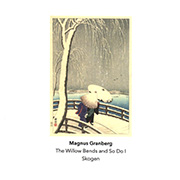
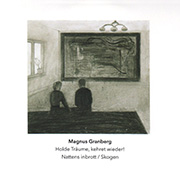
 Magnus Granberg: The Willow Bends And So Do I; Holde Träume, Kehret Wieder! [Another Timbre]. The two most recent Granberg releases on Another Timbre give you both the truth and the lie behind the observation of “always different; always the same”. When Holde Träume, Kehret Wieder! came out last year I lost track of it in the shuffle of events at the time, then was spurred to recover it when The Willow Bends And So Do I cam out. Can I tell them apart? At least as well as I know my Bach(s). Would it matter? No. I needed a better context, so I listened to these in succession variously with some of his older works, such as 2012’s Despairs Had Governed Me Too Long and 2013’s Would Fall from the Sky, Would Wither and Die. Granberg’s compositions typically play out over 45 to 60 minutes, so they don’t lend themselves readily to comparison testing. From this perspective, Despairs sounds more withdrawn and furtive than before, Fall testing how far it can act out without risking the overall form. Over the years, Granberg and the core group of musicians he has worked with have developed a clarity of purpose in playing these works, still highly sensitive to the delicate environment each piece creates, while being confident enough to speak out when needed.
Holde Träume, Kehret Wieder! was composed in 2021 and is presented here in two versions, a septet performed by Skogen and a version played by the quartet Nattens Inbrott. Both were recorded in the same studio in Stockholm in November that year; both ensembles include Granberg himself and percussionist Erik Carlsson. Granberg’s signature prepared piano, common to almost all the recordings of his music I’ve heard so far, plays a slow and fairly steady succession of isolated sounds which act as vertebrae around which each piece is built. He draws upon other music for his material, ranging from old pop songs to Schubert, but any direct reference is sublimated through slowness and by pooling resources between the musicians who often play on the threshold between pitch and non-pitch. Sounds are shared and exchanged through a loose but organised dialogue (I’m still think about Guðmundur Steinn Gunnarsson here). I’m going to venture that the flavour of each piece comes from the rarefied sentimentality captured in the source material, even as its appearance has been transcended. Holde Träume focuses on stillness and texture, falling into sections defined by the amount of surface activity. The quartet version is all acoustic; the septet adds the electroacoustic elements of amplified objects, friction. The septet take is still transparent, not much less empty, but with an expanded range of low sounds and faint noise. The Willow Bends And So Do I was composed in 2024, with Skogen appearing here as a nonet with some new members. Melody, in its own strange way, is present throughout and the piece progresses through its sixty minutes in a continous form, with changes across the piece made by periodic alterations to melodic patterns and shifting roles for timbre with each instrument. Musicians exchange foreground and background roles, producing an intricate counterpoint. The dynamics are gentle but firm throughout, without any semblance of reticence. It captures the experience I recall of hearing them play live. Speaking of which, I may even leave the house to hear Skogen again this weekend, a 13-piece band playing Granberg’s 2023 piece Trouble, Had it All My Days.
Filed under: Music, Reviews by Ben.H
Tags: Magnus Granberg
No Comments »
Two more long-ass piano pieces
Sunday 23 November 2025
 Linda Catlin Smith: The Complete Piano Solos (1989-2023), Volume One: The Plains [Redshift]. The promised edition of Linda Catlin Smith’s piano music begins at the end with her most recent work for the solo instrument. The Plains is an hour-plus excursion in a single movement, composed at the request of the pianist heard here, Cheryl Duvall. (Duvall has previously appeared on Dark Flower, a set of Smith’s solo and ensemble pieces.) This is an unusual piece for Smith, marking a new and potentially disturbing direction in her work. She has composed long works before (an opera, the multi-movement violin and percussion duet Dirt Road) but in comparison The Plains are unadorned, even barren. It begins with a single note held for fifteen seconds, then a single chord is reiterated in a monotonous vamp. The vamp eventually opens up into more diverse forms, with changes in chords and rhythm until the idea is more implicit than heard. There are sectional changes throughout the work, but everything sounds at first as background, an accompaniment to a melodic line that always seems imminent but never appears. New developments are always muted, more apparent in retrospect, obscured by the music remaining steadily in the lower middle register. When something melodic finally appears, it’s as a slow figure in the bass. We’re about halfway through before any higher-pitched notes make their presence felt. I assume that Smith and Duvall each worked on this piece with the aim of making it as resolutely unobtrusive as possible and thus, like on a long journey through open landscape, impress with an unyielding image despite any surface variations along the way. Duvall gives attention to the smallest differences in dynamics and voicing to produce a wide landscape in low relief. That landscape is not so much forbidding as indifferent, much like the one evoked Kory Reeder’s string quartet Homestead, alien to European experience and where the pleasures to be taken from it are not immediately obvious to a newcomer. Three more albums of Smith’s piano music are in preparation, and Duvall has been commissioning hour-long pieces from other Canadian composers. Point of order: those are hills on the cover.
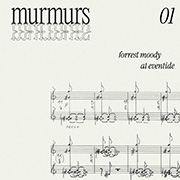 Forrest Moody: at eventide [Murmurs]. Moody himself is the pianist for this seventy-minute solo composition. This is all I know of his stuff as a composer (he has played on some of Eden Lonsdale’s ensemble pieces). I don’t want to call at eventide an obsessive work, so let’s just say that Moody is very thorough here. The beginning of the score on the front cover gives you an idea: closely-positioned chords with an emphasis on overtones, secco. Any feeling of flow from one chord to the next is blocked by the dead stop between one chord and the next. Industrious use of the pedals control the release and choke of lingering tones, giving at times some uncanny filtering effects to the chords. The piano is close-miked, so the soft thudding of the dampers and pedals throughout the work add a tensioning counterpoint to the steady succession of string sounds. As with the Smith piece, it starts out with a narrow range of pitch; unlike Smith, Moody doggedly stays within this frequency band, rarely ventilating the close atmosphere with an occasional bass note or a slow run of single notes that ascend into the treble. As with many other long works, it settles into its own sense of time and thus creates a space in which it may be contemplated on its own terms, but with its determination to dwell upon the same spot for so long it can become enervating. Moody’s musical ideas do start to soften up in the latter half, once in a while at least, and so some development of character does arise of its own accord. Despite this, once those ideas have been illustrated, it does feel like he runs out of things to say: the piece benefits from being long, but nothing about it seems to insist that it must be this particular length. Except perhaps, for the sake of endurance, that we follow Moody with every step as he pursues this line of interrogation; not necessarily obsessive, just thorough.
Filed under: Music, Reviews by Ben.H
Tags: Forrest Moody, Linda Catlin Smith
No Comments »
Liza Lim: String Creatures
Sunday 26 October 2025
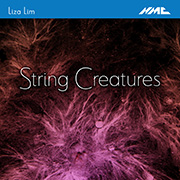 Liza Lim: String Creatures [NMC]. I’m just back from vacation and feel like apologizing for not writing about this album as soon as it came out last month. Even for listeners familiar with Liza Lim’s work, String Creatures is a revelatory and at times astonishing insight into her transformative music. The four pieces presented centre on perfomances by the JACK Quartet in Melbourne last year and were composed between 2014 and 2022. The title work that leads the set is a large quartet that would seem to dominate the album, at first: it grabs your attention from the first moment with its opening violin aria played in a sour and resonant baritone, an uncanny effect achieved by tuning the bottom string an octave lower. Lim has fashioned a unique and remarkably coherent language for string instruments, achieved through a synthesis of eclectic influences and empirical experimentation. Extended techniques are likely as not to be drawn from other cultures such as folk fiddling (Hardanger and Bluegrass) as from the postwar avant-garde. The most extraordinary thing about String Creatures is that, even with its dazzling array of new sounds and extremes of colouration, it always feels like the effects are a natural means to an end, producing a complex expressive statement on the relationship between physical activity and emotional need: a Romantic disquisition made through a renewed, corporeal language.
On that corporeality: I remember many, many years ago attending a public workshop of Lim’s early string quartet Hell. After the first run-through, she told the musicians they were playing the notes too well. Where her score called for notes to be played hard, or faint, or off-pitch, she really wanted the physical impact to be heard and felt, removing the quartet from being a sophisticated ensemble and towards becoming an organic complex, all sound as a product of friction and breath. With the JACK Quartet, Lim pushed this line of thinking much further: “Lim asked the players to learn rope tricks and to literally tie each other’s hands to their instruments, exploring the sounds that resulted as the musicians struggled free.” Having learned the music inside-out, as it were, it follows that JACK’s playing of these challenging pieces is entirely fluid and eloquent, speaking in strange intonation, nasal falsetto and harsh gutturals with a discursive flow as though it were their mother tongue.
So there are strings and there are strings: JACK cellist Jay Campbell plays solo on an ocean beyond earth, on two instruments; or rather between two instruments. Each string on his cello is attached by a rosined thread to a string on a retuned violin; pulling on a thread sets off faint resonances between the two instruments. It’s a still, otherworldly work that finds portent in its quietness, fitting the subject matter that inspired it, of interpreting a signal received from space. The perception is clear even as the outline is diffuse. The brief The Weaver’s Knot is a string quartet which compresses the activity of its argument into a single movement a little over five minutes long – it’s short but not small. For the final work, The Table of Knowledge, JACK is joined by Rohan Dasika on double bass. The deeper pedal tones play off against odd harmonics, creating a queasy, distorted form of exotica. The knowledge Lim alludes to can be discerned from the titles of each movement: Datura, Belladonna, Henbane, Cannabis. It’s a heady mix of the alluring and the repellent which has underlaid her music all the way back to her early chamber piece Garden of earthly desire, an embrace of the uneasy relationship between the physical and the spiritual that makes her otherwise esoteric idiom so compelling. The long final movement, “Flying”, transcends what has gone before it with a strange solo by Dasika, playing bass while holding a taut thread in his mouth, attached to the bass’s top string. His mouth acts as a resonator, producing a kind of overtone singing multiplied by the sympathetic vibrations of the instrument. As a final transformation, he music floats somewhere between bowed string and voice, never fully one nor the other, at once more than and less than human.
Filed under: Music, Reviews by Ben.H
Tags: Liza Lim
No Comments »
A moment’s pause
Tuesday 30 September 2025
 Huw Morgan: Melos [Sawyer Editions]. Life’s been a little crowded lately so I’ve been finding some breathing space. Huw Morgan’s Mostly Slow Organ Music recitals have been happening for a while now, featuring his own compositions amongst others. His Melos compositions have been spreading out across the country for ten years now: this album features organs from churches in Bristol, Dundee and Catford. They’re not exactly performances on the organ, but with the instrument; Morgan treats each iteration of the piece as a site-specific work, taking long samples of individual stops and composing them into a single chord that gradually transmorphs through electronic manipulation into a second chord. Extraneous sounds and impurities in the mechanism are preserved, and the sliding tones are too slow to be perceptible as the music’s subject. The result is a Zen-like drone, empty yet full, the well-composed sort that hold your attention without seeming to do anything. When you start to lock in on it you become fascinated by the near-imperceptible change in intonation and the multitude of sonic ramifications it brings about. Five versions are presented here, the shortest being eight minutes and the longest (twenty) being only an excerpt from a longer piece. Hopefully more recordings become generally available.
 Ben Richter: Dissolution Seedlings [Sawyer Editions]. The ensemble House on Fire consists of three musicians, at least in this instance; they play pianos, but also melodicas, a pump organ, percussion and a cello. Dissolution Seedlings is a nearly-hourlong work for this odd ensemble, divided into fourteen (“and a half”) movements. Offset against this information is the curious way the music dissipates its activity, marking out time more than passing through it. Richter speaks of rhizomes (more vegetal than anti-Oedipal) in his notes, but the piece struck me most as a way of finding music that endures past the point when all momentum has been exhausted. It reminded me a bit of Charlie Usher’s An assembly – a forty-five minute piece composed of a hundred-plus tiny fragments – but whereas that piece uses brevity as a means of negating substance, Dissolution Seedlings creates space and hesitates to fill it. Each movement is its own pause, where waiting is an end in itself. Small gestures emerge almost by default, and with each change of state from one section to the next, House on Fire does as much nothing as they can possibly sustain for the duration.
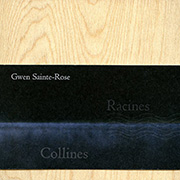 Gwen Sainte-Rose: Collines / Racines [By the Bluest of Seas]. No need for philosophising or head-scratching here. This is just Sainte-Rose straight up with a cello and a loop pedal. It’s bright and colourful and seems all so clean and simple, swear it’s all been done before but no direct comparison immediately comes to mind. That’s not the sort of thing you should be worrying about anyway when this is so pleasant to listen to. Sainte-Rose says she’s rhapsodising the Belgian landscape, but I think we can all invest these two long, drifty pieces with our own ideas of home.
 Marti Epstein: For Jack [Sawyer Editions]. The “Jack” referred to here is Jack Yarbrough, the pianist playing this long, solo work. Yarbrough’s been heard in a few other recent recordings, notably Timothy McCormack’s mine but for its sublimation, another work written for him. At that time, I wrote that “he has a gift for coaxing prolonged sounds out of his instrument”; that quality applied here too. Unlike the other pieces in this review, For Jack doesn’t exactly create mental spaces for contemplation, rather it crowds them out and then colours those spaces with its own, foreboding mood. For a long time, the piece dwells upon dark clouds of low chords, which ultimately burst out with sudden violence. Eventually, the mood breaks a little, opening into higher registers and more open sounds, but the chords are still dense and brooding until they finally fragment into slow counterpoint of higher single notes. My description makes it sound cheesy, but Epstein steers a steady course between cheap drama and cold process, making the progression seem intuitive and unforced. Yarbrough emphasises this with an interpretation which properly equates intuition with nature, merging the austere and forbidding with echoes of the pastoral.
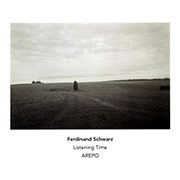 Ferdinand Schwarz: Listening Time [Another Timbre]. I don’t know anything about Schwarz and neither did the label proprietor before he heard this, it seems. A work for clarinet, electric guitar, accordion and cello, played by the AREPO ensemble, it’s an unexpectedly beguiling piece. Listening Time starts out self-effacing and innocuous but it grows on you after the first hearing. AREPO plays a single chord, its pace seemingly dictated by the clarinettist’s breath. Over each iteration, the chord spreads out a little but mostly it deepens, with subtle touches that hint at possible voice-leading. Without the need to “go” anywhere, composer and musicians settle into establishing where they already are and what that might entail. It’s a piece you need to listen into, much in the same way as the musicians of AREPO appear to. Schwarz describes as improvisation, petrified in time, and credits the AREPO musicians jointly with composition. The ensemble sounds perfectly matched to the piece, producing softly luminous sound as a single complex instrument, with the idiosyncrasies of the individual instruments sublimated into a greater whole.
Filed under: Music, Reviews by Ben.H
Tags: Ben Richter, Ferdinand Schwarz, Gwen Sainte-Rose, Huw Morgan, Marti Epstein
No Comments »
The return of 840 and a bonus Music We’d Like To Hear
Thursday 25 September 2025
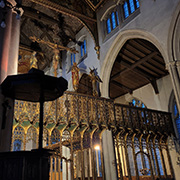 The 840 concerts in London were part of the long-vanished pre-Covid world and one which I had thought was gone for good, so it was a welcome surprise to see it resurrected with minimal fanfare after a five-year-plus hiatus. Can one go home again? Not exactly, as the concert last Saturday had relocated from their once-regular Islington haunt to St Cyprian’s, Clarence Gate. Otherwise, nothing seemed to have changed, with a programme that retained the same quietly reserved and very slightly precious mood that has become the series distinctive style. As usual, the instrumental forces were modest: works for two violinists and for piano duets. The gig began with the most prickly piece of the night, Marc Sabat’s Three Chorales for Harry Partch, a duet for retuned violin and viola. The earliest of his compositions, it draws on his career as a violinist and his study of microtonality to view Partch’s own use of microtonality under a microscope, creating a work of buzzing, vibrating slow-motion slewing, all subtones and doublestops. The two string players were Amalia Young and Anne Yin Han (apologies for not knowing which one played viola), who showed serious intent whether playing Sabat or arrangements of Diego Ortiz’s viol Recercades. The Ortiz pieces were interspersed through the night, having been arranged for violins by concert series curator Alex Nikiporenko. Co-curator Christian Drew indirectly echoed these pieces with his violin duet 17th Century Music, which struck me as a loose but airy collection of gestures toward the baroque era, minus the drive. (This is at least the second, possibly the third piece I’ve heard whose title riffs on Laurence Crane’s 20th Century Music – strange how influences can spread.) Darius Paymai’s sonnerie, air was another of the new pieces written for this concert and took a similar approach to Drew, this time giving Satie the languid treatment. The strongest of the new works was Nikiporenko’s Thread, an affecting violin duet that gained effect through taking intimate personal and sentimental inspiration to produce music that was securely woven together yet always translucent. The two pianists were Jay Austin Keys and Fernando Yada, who presented a suitably sensuous interpretation of Linda Catlin Smith’s Velvet which seemed to focus on the immediacy of touch ahead of overall shape, and a suitably dense version of Egidija Medekšaitė’s Textile 1 which reduced differentiation in the ever-changing small differences of interplay into a tight, seamless surface. The final work combined violins and pianos, James Creed’s Plain Song using sustained tones from an e-bow on the piano strings over which the musicians would sparingly add one or two notes to harmonise on the faint outline of a song.
Creed also began the evening’s music, earlier at St Mary At Hill, at a free matinee concert given by Music We’d Like To Hear as part of London’s Open House weekend. Some curious punters who attended were quietly bemused by the works presented, a typically eclectic mix combining rarefied sublimities and literal piles of junk. Creed’s piece Lomond was written about five years ago but used the same method of Plain Song, this time producing faint traces of Loch Lomond out of the piano strings’ resonance. This time, the concept behind the work seemed to hold the piece together better. The programme was curated by Laurence Crane (q.v.) and featured the “GSMD Experimental Music Workshop and guests”, including Tim Parkinson and Angharad Davies. A scene from Parkinson’s opera Time with People (written about here earlier) was presented, performers crouched over small piles of aforementioned rubbish and producing a surprisingly broad palette of sounds from them as they muttered stop-start in unison. It made the following performance of Pauline Oliveros’s Rock Piece sound strangely monochromatic by comparison. John Lely’s Symphony No. 3: The Parsons Code for Melodic Contour is a near-unison work of blunted melodic obstinacy; the occasional deviations out of tune should undermine its solidity but instead just make it seem more threatening. Conversely, a rerun of Amber Priestley’s woozy derive Did not feel very well at skool (31/1/1977) became insidious by its dissipation, with the musicians scattered around the hall brewing up a thin but ominous musical miasma.
Filed under: Music, Reviews by Ben.H
Tags: Alex Nikiporenko, Amber Priestley, Christian Drew, Darius Paymai, Egidija Medekšaitė, James Creed, John Lely, Linda Catlin Smith, Marc Sabat, Pauline Oliveros, Tim Parkinson
No Comments »
What Is Going On
Monday 22 September 2025
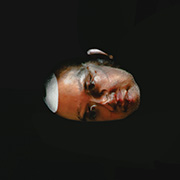 Olly Sellwood: Charlene from Big Data and other stories [Surface Press]. Up front is Peter Falconer’s narration, backed by the duo of Eva Zöllner and Heather Roche on accordion and clarinet. Falconer makes for an engaging raconteur, giving each of these half-dozen five-minute vignettes much-needed expressiveness and lucidity, despite the tricksy overdriven autotune threatening to smother him and make him hop about like a marionette. The Zöllner-Roche Duo are delightfully agile, seemingly unencumbered by tech and switching on a dime from one caricature to the next and hitting their dramatic marks with pinpoint accuracy. In the background, the music is composed by Olly Sellwood and the texts are written by Rose Biggin and Keir Cooper. I am not a fan of this sort of thing: the whole exercise is shot through with that particular British style of apologetic jokiness that makes a virtue out of pulling its punches, which I find irritating. I haven’t gone back to check but I would be surprised if Falconer doesn’t actually say “mustn’t grumble” at some point. Much of the zeitgeist (the autotune, the tales of frustration with automated customer help lines) is five minutes ago, but the whole thing is almost entirely redeemed by many of Biggin’s and Cooper’s stories turning in upon themselves from the absurd to the oblique, becoming more interesting as they make less sense. And Sellwood’s instrumental writing maintains the humour without resorting to stunts, accordion and clarinet providing lively backgrounds and interested commentary, somehow sounding more than the sum of their parts.
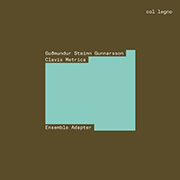 Guðmundur Steinn Gunnarsson: Clavis Metrica [Col Legno]. The latest dispatch from planet Gunnarsson reveals more details while deepening the mystery of this singular oeuvre of compositions. As when learning a new language, the moment-by-moment activity seems inscrutable and at first undifferentiated, but patterns start to appear; those patterns in turn present a new challenge to the listener. Clavis Metrica is a vividly recorded work from 2022 performed by Ensemble Adapter, a group of four musicians without direct participation of the composer. A large-scale work comprised of eighteen sections, featuring flute, clarinet, harp and the signature array of rattles, whistles and harmonicas, it gives you the opportunity to immerse yourself in the sounds and discern a suggested outline of the intricacies of their ebb and flow, fighting the impulse to analyse everything like an ethnomusicologist. Listening to this, some things came to mind. First, stop hearing those rattles and whistles as extraneous texture. Second, reading into the background of the piece made me realise that I had missed something that should have been obvious to me from the start. Gunnarsson’s use of mobile, animated notation had a motivation beyond openness of structure and detailing; it’s about rules which are understood without being codified. Writing about Clavis Metrica, Gunnarsson discusses his experience of Icelandic versification and how it is felt through poetry, folk balladry and debate. This summary is a rough approximation of certain points, all to do with the pervasiveness of verbal poetic meter through lived experience of spoken communication, exchanged through a system of rules applied with greater or lesser formality. I’d somehow neglected this despite my introduction to Gunnarsson coming from hearing his orchestral piece Sporgýla all those years ago. The fluidity of structure, the informality of the instruments, with each piece he’s trying to achieve a heightened form of conversation. The only downside to this release is that it’s on the very serious Col Legno label so you don’t get the funky cover art that adorned Gunnarsson’s previous releases.
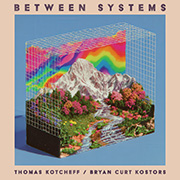 Thomas Kotcheff & Bryan Curt Kostors: Between Systems [Post Tonal]. Disgusting. Old farts will remember the new millennium’s brief fad for “remixing” Steve Reich, an exercise as fatuous as wallpapering the Eiffel Tower. As another sign that things have only gotten worse, pianist Thomas Kotcheff has teamed up with Bryan Curt Kostors on modular synths and various electronica to produce a set of chill-out mixes of pieces by Morton Feldman and John Cage. The Feldman pieces are brief solo piano works from the early Fifties: all five Nature Pieces are played, some with “Beats”. The piano is “Glitched”. Sounds are backmasked, harmonic layers are expanded and each piece’s “growing energy” and “climax” are heavily underlined with various safety colours for the benefit of those too thick to hear much of anything when subjected to the original. I’ve never felt so confident that I’m not a fuddy-duddy as when I say that this sucks; not because it’s trying something new but because that new thing is a dull parody of clueless newness for its own sake. Not just that it’s uninspired, but it’s airily dismissive of the actual music they’re interpreting, as though Feldman and Cage are blank canvases for Kotcheff and Kostors’s doodling. (The sleeve notes come with “Track Narratives” which detail the process used to treat each track, reading much like the menu at a pretentious eatery describing how they’ve seasoned your pulled pork. I’ve also learned that “Nature Piece 4 is among Feldman’s most popular works”.) For the rest of the album, the pair appear to have run out of ideas and settle into treating all the resonant pauses between Intermission 3 and Intermission 5 as free space to fuss and fidget about in like an unwitting toddler at Wigmore Hall. They do the same fidgeting for two Cage pieces: with tedious inevitably, they are Dream and In A Landscape, a pair of works subjected to so much midwittery over the years I have come to almost hate them.
Kotcheff made a fine recording of Rzewski’s Songs of Insurrection not too long ago, which just makes things worse as he should know better. This LP isn’t out till next week so I don’t have a link to where you can buy it; instead I’ve link to the promo for last week’s launch party in LA. We’re asked to “think of Tony Bennett’s rendition of The Beatles’ “Eleanor Rigby””, although I don’t recall Bennett attempting to beatbox on it. The programme also credits Celine Dion with writing “The Power of Love”.
Filed under: Music, Reviews by Ben.H
Tags: Guðmundur Steinn Gunnarsson, John Cage, Morton Feldman, Olly Sellwood
1 Comment »
End Of Summer Noise Round-Up 2025
Sunday 7 September 2025
It’s strange to reflect that listening to all the records below has given me a pleasant feeling of nostalgia. Not that any of this music is old-fashioned as such, although it could be true that the musicians are rediscovering a prior generation and assimilating the lessons of that time into modern practice: it goes around in cycles, never quite the same each time. I think it’s that there’s a kind of exuberance found in a lot of this stuff that had been tamped down in previous decades, with freewheeling exploration that’s unconcerned with accidentally revisiting what has been done before, caught up in the feeling of doing something new. This taps into reminiscences of youth, when the inner creative world suggested boundless potential.
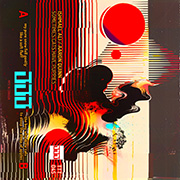 Ishmael Ali / Aaron Quinn: Sometimes Cats Have Puppies [Tripticks Tapes]. A lot of free improv is like jam bands: good ones can be fun when heard live but don’t feel rewarding when heard on record. This duo plays cello and guitar, an unusual combination which doesn’t seem too promising but redeems itself because it never really sounds like what it is. Not that they attempt to disguise themselves; Ali goes for depths of timbre on his cello and Quinn sticks mostly to pointillistic effects with minimal noodling. They are also beset by samplers to disrupt their comfort zone and use digital synthesis to noisy and occasionally startling effect. This is all recorded from a live date so the spontaneity is on-point and the inventiveness of their sounds makes up for the lack of form.
 Javier Areal Vélez: Trifasica [Strlac]. A guitarist makes the move from their tired old axe to pure laptoppery. This is all Max/MSP and Ableton Live, apparently, coded with a partly-automated sequencer that adds a hefty element of generative composition to each of the brief essays. You can listen out for signs of guitarist influence, which you’ll mainly hear in the percussive stuttering (no, not like Oval). The sounds get chopped into fragments of irregular rhythm, occasionally letting something more than a beat seep through and wash over the barrage of loops. It’s a promising start; the blunt loops could get wearying after a while but keeping it down to five tracks in eleven minutes should be OK.
 Gaudenz Badrutt: Palace [Bruit]. This has started to grow on me, thanks to the depths of its conceptual premise and construction. A two-movement composition of collaged sounds and music compiled across several years, Palace combines music (Badrutt playing Ives, Cortot playing Chopin), electronic noise, personal recordings including Badrutt’s young daughter) with heavy processing to create what aspires to be “symphonic density”. Like an Alvin Curran collage but with an emphasis on mood and overall effect over detail, Palace hits first as a work of textural ambience, one which never gets cluttered or opaque, then starts to reveal its fleeting moments little by little.
 Ilia Belorukov & Lauri Hyvärinen: Fix it if it ain’t Broken [Nunc]. Hyvärinen, recently heard on the cutting set of electric guitar duos with Jukka Kääriäinen Pulled Apart by Horses, pairs up with Belorukov’s modular synth. The shredding is more literal than usual, with Hyvärinen making extensive use of sampling pedals to feed his guitar into various mangling digital effects while Belorukov produces slabs of quasi-analogue noise. At times the guitar seems to act as a foil to the synth, or the two trade different flavours of electronic distortion, but in the final track Hyvärinen gets his revenge as the two take turns exchanging blows.
 Ilia Belorukov / Nenad Marković: Signs of Suspicious Activity [Hera Corp.]. Belorukov’s modular synth again, this time with… trumpet. Marković is an equal match to the task, upsetting the balance by providing the white noise through various mutes to run interference on Belorukov’s loosey-goosey rambling on the opening track. Later they fall in together to produce some brooding, densely coloured scenes, but never get sombre enough to dispel the idea that one of them could take off at any moment, with either overdriven analogue feedback or a maundering semi-vocal line. The end duet is particularly fine, spinning out a wonky elegy where it’s never entirely clear which instrument is which.
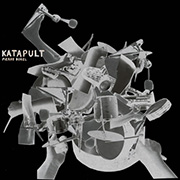 Pierre Borel: Katapult [Umlaut]. A set of jerky improvs for sax and drums, except that Borel’s been working intensively on playing both instruments at once. This one’s a bit of an outlier as there are no electronics involved, but I figure one-man-band counts as noise. A set of rules (left hand, right hand, etc.) guide how each instrument is to be deployed, a stricture placed upon an already limited combination that forces Borel into a more structured way of more thoroughly exploring what reduced potential exists. It gains seriousness as each piece drills down into the subtleties hidden inside such a simplistic formula, making for a curious little LP that’s not as fucking horrible as you first feared.
 Jorge Espinal: Bombos y cencerros [Buh]. Guitarist Espinal plays bass drum, cowbell and sampler all simultaneously (not again!) with his usual axe. The samples are mostly percussion, both latin and drum machine, with all the pieces having a strong emphasis on overlaid incongruous rhythms (yes, again). Despite my unfortunate phrasing, this is not a derivative set of pieces, even as they twist ideas of “Latin” into alien thuds and burbles. The polyrhythmic idea is so distorted into something new that anyone ignorant of Latin American music (raises hand) won’t suspect it’s there. While that’s going on, Espinal sneaks in some witty blunt-fingered take-offs of more fluid guitar-pickers, but I won’t saddle him with the sobriquet of the Peruvian Eugene Chadbourne. Unless he also makes dick jokes.
 Beat Keller & Jukka Kääriäinen: Birds of All Kinds [Bokashi]. Kääriäinen, recently heard on the cutting set of electric guitar duos with Lauri Hyvärinen Pulled Apart by Horses, pairs up with Keller on second guitar. I know Keller only from his set of small, enigmatic string trios on Wandelweiser so it’s nice to hear he can make noise with the best of them. These are short, atmospheric live improvisations which nevetheless don’t stint on technique. Both use their guitars and effects as conduits, to direct and shape the sound they send flowing down the line to their amps. As the title suggests, plenty of feedback and harmonics but used as a jumping-off point to create something new. The thorough workouts are contained within short tracks to aid concentration. They’re not averse to getting rowdy at times, and occasionally will pluck notes on the strings.
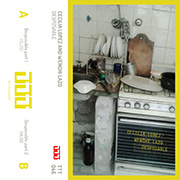 Cecilia Lopez and Wenchi Lazo: Desposable [Tripticks Tapes]. Some more weirdo synth noodling and what sound like electronically drenched drums but are apparently produced on a drum machine. The synth patches chatter away amongst themselves, held together by a drum machine that drifts out of noise and into something uncanny; it sounds that way probably because the drum patches eschew the usual kick bass and hi-hats for resonant but trebly snares and traps, with occasional excursions into off-grid rolls. After a while it all coalesces into sort of a riff that sustains the momentum, before falling apart again as the musicians switch roles. The flip side offers am alternative take on the same, with the difference being on how long it takes to get into the groove.
 J.L. Maire / Alfredo Costa Monteiro: Estelas [Hera Corp.]. Monteiro’s earlier solo work Suspension pour une perte was relentlessly sombre, an impression initially sustained here by the invocation of tombs and monuments. For this album he works with Maire on analogue synth with electronics and opens up the soundworld to greater effect. This is a pair of fearsome soundscapes, sufficient variety in coloration and texture to make them all the more momentous. The reverb is heavy but provides a sense of space and distance, the first track in particular sustaining monumental presence with an added chill of foreboding. The second piece is arguably looser, adding greater diversity of sounds to produce more drama at the expense of consistency.
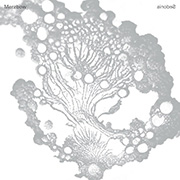 Merzbow: Sedonis [Signal Noise]. I’ve heard of this guy. For my whole life spent in Ugly Music, Merzbow has been ubiquitous to the point of inevitability and so, much like trouble, I’ve never bothered to seek it out, figuring it would come to me sooner or later. Thankfully this has never happened until now and I’m glad it’s Merzbow who found me first. Someone’s gonna pipe up and say it’s not a patch on some of his other 9000 albums but I really liked it. He’s got protean, impulsive noisemaking down to a finely balanced skill, with Sedonis serving up dense sonic tableaux that are simultaneously bombastic and intricate. The multilayering overwhelms you with complexity and information overload, instead of bludgeoning you with excess.
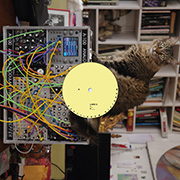 Mauricio Moquillaza: Mauricio Moquillaza [Buh]. Ey up, it’s another Peruvian. The Buh label has been sending me these so expect to read more about them in the future. Haven’t looked up anything about Moquillaza’s background but this is his first solo release. Four works for modular synth which ease back and forth in a disconcertingly nonchalant fashion from energetic sequencer burbles to washes of abrasive noise. By the last track, when he almost fully embraces space rock which has been implied all along, it feels less like settling into a comfort zone and more like finding a new destination. It all sounds very experienced and polished, but apparently each track is a single take.
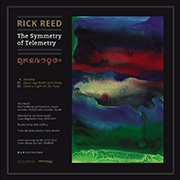 Rick Reed: The Symmetry of Telemetry [Elevator Bath / Sedimental]. I’m told Reed is a veteran of the Austin experimental scene in Texas and there’s an old-school feeling to the three electronic works presented here. Composed around 2020 using Buchlas and Moogs, the sounds have fuzzy edges not heard in typical digital soundfiles. Reed uses a subdued colour palette throughout (don’t let his artwork on the cover foll you) and everything sounds a bit muted and distant. Seemingly going for ambient mood, yet each piece progresses according to a pulse that’s a little too neat, which stunts the effect. Each of the two longer works ends with snatches of radio speech mixed into the background, making the whole exercise sound a little tired.
 Tetrao Tetrix: Nyctalopia [Bruit]. Gaudenz Badrutt returns, joined by Jean-Luc Guionnet on alto sax and Frantz Loriot on viola (huh?). It’s improv I guess, with some ground rules and a focus on the quality of sound over matters of phrasing, structure or texture. The most notable aspect is the presence of silence, pervasive throughout and implicit as a ingredient to the mix even when all three are playing. This what transforms each of the six tracks away from the sound of musicians playing to that of electroacoustic composition, particularly in the earlier parts where the three work together as a single force. By the end the overall intention remains, but the emphasis shifts to each playing for themselves, which in this context feels like losing control.
Filed under: Music, Reviews by Ben.H
Tags: Aaron Quinn, Alfredo Costa Monteiro, Beat Keller, Cecilia Lopez, Frantz Loriot, Gaudenz Badrutt, Ilia Belorukov, Ishmael Ali, J.L. Maire, Javier Areal Vélez, Jean-Luc Guionnet, Jorge Espinal, Jukka Kääriäinen, Lauri Hyvärinen, Mauricio Moquillaza, Merzbow, Nenad Marković, Pierre Borel, Rick Reed, Tetrao Tetrix, Wenchi Lazo
No Comments »
Weeks with and without voices: Frey, Gombert
Sunday 31 August 2025
 Jürg Frey: Voices [Neu]. For over twenty years now, the Exaudi vocal ensemble has combined exemplary technique with esoteric repertoire and adventurous interperative chops. Director and co-founder James Weeks leads the ensemble through a collection of Jürg Frey’s choral works, an aspect of Frey’s music that has had scant representation on record so far, probably because most of them were composed for Exaudi. All the pieces here are for unaccompanied voices. It’s tempting to call Frey’s approach to grouped voices as descontructive, ignoring the negative connotations that word can evoke, but that sense of taking music apart in different ways to examine how it works its effects on us pervades from one piece to the next. The opening work Out of Chorales begins with repeated chords on single words, isolated by short silences. In successive short movements the number of voices drops away from eight to four, then three, before returning to eight for the final movement, alternating between staggered vocal lines and rhythmic unison. Polyphonie der Wörter is the earlier work here, from 1998, allowing each singer free choice of text from a list of words, set to sequences of unresolved cadences. Any semantic sense from the words are obscured by multiplicity. Frey’s earlier style comes through, with suspended passages of wordless drones sung by the female voices, and one extended silence. Despite this dry formal structure and content, Exaudi transform the piece into something haunting and mysterious. (The singing was all recorded inside Temple Church in London, adding to the ambience.) Shadow and Echo and Jade could well be Frey’s most demonstrative work yet, with two groups of four voices each starting out by trading tones in near monotony, breaking into isolated fragments and then finally unfolding into glorious, radiant chords. The two final works are both settings of Emily Dickinson: Blue Bird’s Tune is a shorter, seemingly more conventional work which displays Frey’s hitherto undiscovered knack for choral writing, creating a mood from nuanced but sober harmonies. A related skill can be heard in the polyphony of Landscape of Echoes, which again applies formal structures to produce an elusive form. The setting of Because I could not stop for Death may be the most ambitious work here, not least because Frey counterposes Dickinson’s text with another by Tang dynasty poet Bai Juyi on the constant renewal of nature amidst loss. Bai’s poem acts as a ground against the Dickinson setting, first as bass against solo soprano, leading into a slow, dreamlike polyphony that keeps a firm control on the verbal and harmonic material. The voices of Exaudi excel at these works which depend upon self-discipline and Frey builds a work of emotive and spiritual power by restraining subjectivity, finding enduring depths in the impersonal, in the manner of other art from outside the romantic tradition.
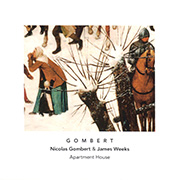 Nicolas Gombert & James Weeks: Gombert [Another Timbre]. Weeks is also a driving force behind this peculiar Gombert album, which apparently really is titled G O M B E R T and is not just a matter of typography. Despite presenting a selection of Gombert’s motets (and a chanson), there are no voices here. Instead, Weeks has arranged these pieces for chamber ensemble: flutes, clarinets, violin, violas and cello – strictly no muſyckinge. Later on, a trumpet appears. The ensemble is Apartment House, who play it as they would with their other contemporary commissions, clean and non-vibrato. What is Weeks trying to achieve with this? It’s not a “re-imagining” (ugh) of Gombert but a way of finding a means to hear Gombert for ourselves, by presenting his musical thinking to us plain. Shorn of verbal significance, historical baggage and churchy resonance, we get a new perspective of this complex but fluid polyphonic artistry. For added perspective, Weeks has composed his own interludes to create space between the arrangements. They are successful in that they don’t attempt to complement or contrast with Gombert, but to provide a pause. Deliberately reduced to little more than two alternating pivots, they announce themselves through the use of piano and the faint drone of a sine tone, with sparse instrumentation. Weeks refuses commentary and instead offers breathing space for reverie, before the polyphony resumes. The album was devised between Weeks and Another Timbre founder Simon Reynell, reflecting his taste for the lucid and unadorned: all detailing here is in its construction. As with Frey, the impersonal gains profundity when it engages with the listeners to reflect upon themselves, rather than be impressed by the artist’s personal sensitivity.
Filed under: Music, Reviews by Ben.H
Tags: James Weeks, Jürg Frey, Nicolas Gombert
No Comments »
Three Fusis
Monday 25 August 2025
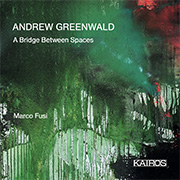 Andrew Greenwald: A Bridge Between Spaces [Kairos]. You wait ages for a solo viola d’amore album and then three come along at once. All three are by Marco Fusi and released on different labels so I checked for you and thankfully he hasn’t died. It’s not really true that these are strictly solo viola d’amore, not least because all the pieces on the Greenwald disc are for plain ol’ violin. At times you could be forgiven for thinking otherwise: Fusi digs deep into Greenwald’s A Thing Made Whole (heard previously as the opening of a larger cycle of works) to produce deep, rasping breaths and striated tones more associated with mediaeval instruments than the modern concert hall. In my earlier review, referring to Austin Wulliman’s interpretation of the piece, I blithely stated “I can’t imagine how their interpretations could be technically improved, given the consistency in their calm approach to the finicky scores.” Questions of technique aside, Fusi makes the piece an entirely different experience, dispelling any suggestion of spectralism by filling the tones with noisy urgency. The pacing is also urgent, with Fusi whipping through the piece in roughly two-thirds the time given by Wulliman, miked up close to catch every tiny extraneous sound.
Heard in this context, A Thing Made Whole becomes part of a new and different cycle, an intimate but confronting, even claustrophobic soliloquy of throaty harmonics and half-sounded pitch. A Thing is a Hole in a Thing it is Not (VIII) exemplifies the handsy approach Greenwald and Fusi take towards the violin, each bowed sound surrounded by clusters of taps and smudges against the instrument’s neck and body. It resembles the way Fusi and his composer collaborators treat the viola d’amore, as a resonant object more than a simple producer of notes. The opening piece on the album, the title work, is the most violinistic and, at least in the use of pitch, most conventional; it’s permeated with a nervy loquaciousness whose ticks and stutters which become the focus of close scrutiny in the subsequent, although earlier composed, works. (The contrasting Bourrée is a pregnant pause, seeming about a million miles away from the Back movement it echoes.) The solo works are set apart by Frames, the result of inspired improvisation between Fusi on violin and Greenwald on drumkit, the latter releasing the restrained voice of the former while sharing a percussive language, providing both grounding and ventilation to the more rarefied monologues.
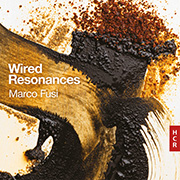 Wired Resonances [Huddersfield Contemporary Records]. Fusi’s collaborations with seven composers to produce works for solo viola d’amore are heard here, mostly recent plus one dating back to 2014. That older piece, Zeno Baldi’s Spikes, suffers from the extensive use of electronics which makes it all sound over-processed and less an extension of the instrument than attempt to dress up an unprepossessing subject. Five of the works use electronics, with Annie Hui-Hsin Hsieh’s Breathless having the same fault as the Spikes by using the viola d’amore as a means to an end without aparent regard for its particular characteristics. The electroacoustic works by Pierre Alexandre Tremblay and Barbara Nerness take place on a more equal footing, with Fusi performing in duet with the composer. Tremblay adds his own electric bass to his digital augmentations of Fusi’s playing, while Nerness spotlights and backdrops the viola d’amore with electronic treatments and field recordings. The most successful electronically-enhanced piece is Bára Gísladóttir’s ORF (en líka axir og önnur pyntingatæki), a characteristically audacious and pungent work with frailties and vulgarities set against discomfiting sound affects from suburbia. It’s not the only Gísladóttir piece which seems funny at first but gets more disturbing with further reflection – or the other way round, depending on your temperament. I’ll decide when I find out if they in fact have a suburbia in Iceland. Of the straight-up acoustic works, Giovanni Verrando’s Fourth Born Unicorn, rounded version is a brief Lachenmann-like study in the marginal sounds produced by a prepared viola d’amore, but Mary Bellamy’s Shivering Mountain is a substantial and comprehensive work that exploits the resilience of the instrument, with Fusi demonstrating how even the frailest sounds can persist, and revealing a surprising capability for richly coloured multiple stops.
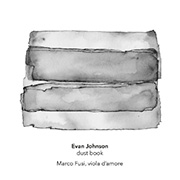 Evan Johnson: dust book [Another Timbre]. Speaking of exploiting the viola d’amore’s acoustic properties, Evan Johnson has Fusi pursue these qualities to their fullest, but in a very different direction. dust book is one long work in six sections, beginning and ending with interludes, each of which are longer than the sections they frame which should tip you off that we’ve strayed far from the conventional. On the first listen you’ll struggle to distinguish one section from another, because you’ll struggle to distinguish any sound at all from the background ambience of your home. Johnson’s predilection for redolent silences and small sounds are pushed to an extreme of sorts, spurred on by the viola d’amore’s dual nature of astringent timbre and surprising resonance. Fusi is given the task of microdosing the sonorous, concentrating everything into small flecks of sound. Some of Johnson’s compositions can enervate, but the tensions at play here arise from the level at detail set amongst the featureless expanse, mixing abundance with formal parsimony. It is ultimately about sound rather than about ideas about sound, contra the Sphinx-like pseudo-profundity found in, say Manfred Werder. Be reassured there’s no earrape with sudden outbursts, so you can safely listen to it cranked up and not miss anything. One section is labelled as “several canons”, as a challenge for the advanced listener.
Filed under: Music, Reviews by Ben.H
Tags: Andrew Greenwald, Annie Hui-Hsin Hsieh, Bára Gísladóttir, Barbara Nerness, Evan Johnson, Giovanni Verrando, Mary Bellamy, Pierre Alexandre Tremblay, Zeno Baldi
No Comments »
The Deceptive: Phillip Golub, Leo Chadburn
Sunday 10 August 2025
 Phillip Golub: Loop 7 [greyfade]. You may remember Phillip Golub’s earlier album Filters, in which four pieces titled Loop presented interlocking piano melodies with a recursive nature that resembled musical knots, loosened enough to allow each twist and turn to be observed but never ultimately traced to a resolution. Loop 7 stands alone here as a half-hour piece, suggesting something similar yet more elaborate. Befitting the subtle deviousness of Golub’s compositional thinking, it both is and isn’t. The long piano loops wind around each other in a lazy fashion, casually leading you back to where you’re sure you’ve already been, over and over. This time, the single Steinway is replaced by two Disklaviers retuned to a 22-note scale, adding to that woozy feeling of something being out of kilter despite sounding irrefutably correct. There’s also some subtle electronic processing, which you eventually start to notice, and two live musicians (Aaron Edgcomb on vibraphone and Ty Citerman on electric guitar) who you may not notice at all. Their almost imperceptible playing adds to the reverberant aura that shimmers around the pianos, making the music’s progress increasingly inexplicable. Seasoned punters will start getting flashbacks to “1/1” off Music For Airports and with good reason, each presenting the same imperturbable surface, only Golub’s is more playful than oblique.
 Leo Chadburn: The Primordial Pieces [Library Of Nothing]. In their manner of presentation, Chadburn’s compositions purport to be simple, but their apparent directness is deceptive. This suite of five pieces are reworkings of “sketches” Chadburn made some twenty years back, but the simplicity of their materials belie the insidious effects they produce on the listener. The outer pieces present pianist Ben Smith, playing ascending, scale-like figures over a background wash of synthesiser tones. A Secret, heard at the Music We’d Like To Hear fest last month, is presented here with electronics acting as a background wash -the importance of that role should not be de-emphasised. Its opening counterpart, The Reflecting Pool, is more florid, with grand chromatic flourishes underpinned by ominous drones that occasionally slip out of gear. The strings appear in the inner movements, each for four violins (Angharad Davies, Mira Benjamin, Chihiro Ono, Amalia Young), appearing first as feathered chord sustained and motivated by incidental tremoloes, then on their return as pure quivering, relieved only by a short spell of descending harmonics. The central piece is Smith alone on piano, a troubled labyrinth of unresolved arpeggiations of an unresolved chord, that varies only in intensity, flagging and then redoubling in its efforts until suddenly stopping dead. It’s the unstill centre for a nested cycle of pieces that could otherwise be carelessly mistaken as calming.
Filed under: Music, Reviews by Ben.H
Tags: Leo Chadburn, Phillip Golub
No Comments »
Music We’d Like To Hear, Summer 2025
Sunday 27 July 2025
I left the house for once, then twice, then three times for the Music We’d Like To Hear concerts at St Mary at Hill. It was their twentieth anniversary, which is both wonderful as they’ve provided such a consistently wonderful and important service to exposing new music in London, and a little sad that it hasn’t launched a small horde of imitators that have been able to last anywhere near as long (despite several noble efforts). The scant institutional support in a city the size of London is telling. Enough whingeing cos this is a celebration of music. The series began with repeat performances of works from the very first concert in 2005: Angharad Davies adroitly tackled Thomas Stiegler’s violin solo sonata facile (1993), an audacious work that employs the guttural avant-garde language of multi-stopped strings and aggressive glissandi, executed by holding the instrument upside-down between the knees and wrapping a rosined string around its neck. Beside the thick sonics, the piece plays off a cognitive dissonance of the apparent simplicity of its technique and the complexity of its results, while also realising that Davies is making the topsy-turvy approach look a lot easier than it is. Curator (forgive me) Tim Parkinson showed off his piano chops with a strangely evocative rendition of Markus Trunk’s Riten der Böotier (2005), a calm and austere set of miniatures that recall ancient Greek music – an entirely speculative concept. It was nice to hear a performance of Chiyoko Szlavnics’ string trio (violin violin cello) Freehand Poitras (2008), with its pure harmonic intervals expanding into combinations that seem to both perturb and resolve a drifting equilibrium. The evening ended with a live performance of Laurence Crane’s Events (1997), originally conceived for radio. It’s the most overt expression of the deadpan quirkiness that lurks within Crane’s music: a singer intones a small set of select nondescript facts related to the date 7 February 1997 – people’s birthdays, foreign exchange rates, weather forecasts – accompanied by a trio of clarinets and some small sounds from the piano. Melanie Pappenheim was the singer, reprising her role from the 1997 original broadcast; the clarinets sounded lovely, even as you wrestled with the idea of the material used to make the piece being informationally valid in one sense yet entirely null in another.
That’s about as nostalgic as things get in these concerts. The first gig also included two new works, with singer-guitarist Maddie Ashman premiering her reflective, folkish song cycle Otherworld and a piano trio by Chris Newman titled Things of Slight Interest, which is also folkish in its own way with his typically gruff but passive phrases piling up upon each other with apparent casualness, a particularly British mode of individualistic expression. For the second concert, Parkinson returned to the piano for a crisp interpretation of Tom Johnson’s late work Pairs and Pairs (2020), a charming piece despite its apparent reductiveness, ringing changes on complimentary pairs of dyads to produce exhaustive combinations of pitches by a method that is rigorously serial without sounding anything of the sort. Juliet Fraser gave luminous presentations of two slightly older works composed for her, Newton Armstrong’s The Book of the Sediments for voice and electronics, and Cassandra Miller’s Tracery: Hardanger. I’ve discussed both of these before (see links) but Fraser and Miller’s collaboration on Tracery continues to evolve over the years; this performance began with Miller’s one-time spoken guidance to Fraser on how to interpret the piece being made audible to the audience.
How a composer can prepare an audience as much as they can a musician is a subject too little explored. The performance of Niels Rønsholdt’s Song II, Melancholia III (2017) applied Miller’s principle in reverse. The piece is an extract from a larger work titled Until Nothing Left, scored originally for accordionist with various objects and the involvement of the audience. It appears the punters were not necessarily expected to contribute to the sound as such, as to contemplate their role in music-making. As a concert piece arranged for small ensemble and voice, shorn of its context of expectations of audience reflection, it came across as a diffuse narrative with a conventionally contemporary subjectivity of mild grievance. Piano with faint synth tones were the medium for Leo Chadburn’s pretty early work A Secret (2000), which was even milder in expression than the Rønsholdt but carried by tersely controlled material contained in a form that is simple but oblique. It makes an interesting comparison as part of his recent collection The Primordial Pieces, which I’ll write about separately soon. The big shock of the second evening was hearing Lily Greenham’s tape piece Traffic (1975), its cascading blizzards of tiny vocal shards sounding vivid, cutting and entirely contemporary even today, potentially moreso today than it did half a century ago, the acidity in its societal observation becoming more obvious as its zeitgeist has faded away, unable to be dismissed as “a trip”.
For the third evening, Angharad Davies and Tim Parkinson performed duet versions of pieces from Laura Steenberge’s Seven Poems (2024), an unusual work in that it differs from other music I’ve heard by her. On a smaller scale, with the ritualistic actions reduced to tasks that seem self-contained to their own means of making music, stripped of gestures that allude to a wider, unknowable meaning, the pieces became studies in playful process. In one, Davies and Parkinson rang toy bells muted by magnets, gradually unmuting them by tossing the magnets one by one over their shoulders, where they may or may not have hit various pots and pans scattered on the floor. In the other, the magnets are collected and thrown on top of large cardboard boxes where they may either roll away or clump together. The playfulness and modest means made it seem rather British. Bassoonist Dafne Vicente-Sandoval performed Alvin Lucier’s Same and Different (2021), a late entry in the elemental pieces he composed for soloist with pure sine tones. Off to one side in the church she played a single high pitch, using different fingerings to produce the same note, only never quite the same due to small variations in tone and intonation, producing a series of liminal episodes in texture and activity as each note interfered with the pure tone in slightly different ways. This still, ringing centre of the concert was given its own segment, unpaired with other works. The two Steenberge pieces were each partnered with a work by John McGuire, a composer repeatedly championed by this concert series. Twelve Circles (2022-24) is a solo piano work reminiscent in style to his monumental 48 Variations for Two Pianos (1976-80). In single notes, cycling through perfect fifths in alternating octaves, the music seems open and transparent but never sounds simplistic. The interlocking of cycles and their dependence on shifts in tempo creates an elastic, elusive texture in which the presence of a method is obvious but its workings cannot be anticipated, a satisfying combination of intellectual integrity and imaginative whimsy. Pianist Mark Knoop expertly managed the deceptively difficult contrapunctal implications in the frequent tempo changes, much as he and Roderick Chadwick had done with 48 Variations back in – gosh – 2017. Ensemble Plus Minus played McGuire’s double string trio Playground (2016-20), a work which trades off greater harmonic and instrumental colour for the more immediate pleasure of remorseless precision. The meshing of distinct but related material suggests an efficient approach to musical complexity, at odds with the admonishments for simplicity that usually accompanies “minimal” music and hints at why he may be considered unique (and overlooked): seeming to belong on a clearly defined turf that is yet shared with everyone and no-one.
Filed under: Music, Reviews by Ben.H
Tags: Alvin Lucier, Cassandra Miller, Chiyoko Szlavnics, Chris Newman, John McGuire, Laura Steenberge, Laurence Crane, Leo Chadburn, Lily Greenham, Maddie Ashman, Markus Trunk, Newton Armstrong, Niels Rønsholdt, Thomas Stiegler, Tom Johnson
1 Comment »
Cruel, But Unfair
Thursday 26 June 2025
I don’t like writing bad reviews, not least because it seems too easy and feels like I’m trying to pander to readers. The stuff I write about is typically worth considering and engaging with, even if the outcome proves to be negative. The writing’s slowed down a bit in the past year so there’s a backlog of worthy music, plus a bunch of stuff that I need to take off the listening pile so I can stop kidding myself I’m going to be motivated to think about it seriously. Here’s some mental housekeeping.
 Yan Jun; cut-off; FJE Trio: The Brunt; Kieran Daly: Two pieces for fixed media pitched instruments voice zero build; Takuma Kuragaki: cleave [Party Perfect!!!]. Party Perfect, why have you forsaken me with this string of clunkers? These albums annoy because they sound like audio documentation of performance art, where the sound is one of several essential components or entirely incidental. Yan Jun gives a great personal history of clandestine pop music CD distribution in communist China, as context for him rolling CDs across the floor. You don’t need to hear this. The FJE Trio is an electroacoustic improv gig by Joe Foster, Bryan Eubanks and Jean Paul Jennkins which we have to assume seemed cool if you were in the audience. Kieran Daly has put a lot of research into his pieces for intoning voice and guitar: it takes a lot of academic rigour to make music simultaneously grating and tedious, with any residual humour firmly beaten flat. Takuma Kuragaki’s casual scattering of occasional electronic clicks might be the exception here, as a second listening to individual tracks suggests a subversive artfulness behind the sterility.
 Neil Luck: Eden Box [Accidental]. I was sent this last year and meant to write about it, as Luck is part of this curious school of British composition which presumes to question the cultural and social underpinnings of contemporary music by taking an approach that continually flirts with mistaking demystification with self-deprecation. As concepts go, it’s a refreshingly tangled one, but then I lost my copy in a hard drive crash and hadn’t backed it up. Sorry, Mr Luck.
 Mary Kouyoumdjian: Witness [Phenotypic Recordings]. I’m old enough to remember when the Kronos Quartet were content to play music without having to make everything into A Project. Also old enough to be over the collecting of worthy and earnest recordings of authentic testimony and ethnography mixed in with movie music so we know how to feel about it. More documentary than art, and all the less powerful for it, as emotional depth is sacrified for appeals to veracity, with an emoting string quartet acting as a surrogate for our empathy.
 Teodora Stepančić: O A | F G [Another Timbre]. I’ve been waiting for the moment when Another Timbre releases some music that flies a little too close to the cold, distant sun – where the silences, hushed tones, reverential playing and exquisite delicacy finally lapse into something than can be summed up in a word as precious. This is an ideal candidate: two works for small ensembles played by Ordinary Affects with just enough extended pauses and repetitions to appear arch, mixed with just enough inconsitency in pacing and phrasing to appear indecisive.
 Giuliano d’Angiolini: )))((( [elsewhere]. Speaking of Another Timbre, I meant to write about Giuliano d’Angiolini’s 2020 album Antifona, a set of curious concert hall pieces for everything from piano to orchestra, but evidently I did not. Elsewhere has since put out the helpfully titled )))(((, a collection of three pieces for a combined total of forty-seven multitracked flutes plus six clarinets. Manuel Zurria is the flautist, assisted by Paolo Ravaglia on the reeds. I’ve wanted to make good for Antifona but I’ve listened to these flute pieces half a dozen times and I still can’t remember a thing about them. Mi dispiace, signiore d’Angiolini.
 Antoine Läng: Lâcher les chiens tant qu’on y est [Insub]. Every generation or so someone brings up with the idea of making an entire album with nothing but Jew’s harps and it always works out about the same.

Filed under: Music, Reviews by Ben.H
Tags: Antoine Läng, Bryan Eubanks, FJE Trio, Giuliano d’Angiolini, Jean Paul Jennkins, Joe Foster, Kieran Daly, Mary Kouyoumdjian, Neil Luck, Takuma Kuragaki, Teodora Stepančić, Yan Jun
No Comments »
Exhaustion, and more
Sunday 22 June 2025
 Insub Meta Orchestra: Exhaustion / Proliferation [Sawyer Editions]. It’s literally called Exhaustion: the first of two compositions by Cyril Bondi and d’incise composed for the Insub Meta Orchestra is superbly evocative. Like their other collabs with the Meta Orchestra, these pieces use systems for group organisation, building a diverse but strongly controlled array of potential events out of simple basic principles. As a description, that sounds dry as; in practice it defies and frustrates your expectations of tension and release as the two become confused, imbuing each piece with genuine emotional depth and complexity. Exhaustion provides an absolute minimum of action, operating in the manner of a late Beckett text where the words become more eloquent and poignant as their range becomes ever more constricted. Proliferation perversely creeps and crawls its way through a blind alley of minimal options. In their way, both pose conundrums for students of information theory, as while entropy seems to be the driving force behind each piece there is no perceptible transformation in the distortion, other than a sense of unease. A lot of these effects are down to the Orchestra, here an all-star grouping of 29 musicians who have developed an eloquent palette of small sounds, including some esoteric percussion, which add a surprising amount of colour and freshness so you can wallow in melancholy if you need to.
 d’incise: Incendies [Insub]. d’incise’s solo album is purely electronic and in its way is another meditation on entropy. The four pieces here are apparently made from analogue electronic signals repeatedly passed through various filters and effects until they have degraded into unstable, flickering blocks of sound. Each piece seems to resemble the others and each piece seems to carry a pulse, but the pulse is never steady or even apparent and the points of resemblance can never quite be pinned down. In each track, the framework and basic methodology are the same but once the process takes hold the material strays outside of any clearly defined bounds, creating curious aural phenomena as a kind of wild overgrowth. It recalls the better examples of glitchcore from the late Nineties, not in sound but in approach, where dogged inquisitiveness could lead you into labyrinths.
 Kory Reeder: Homestead [Another Timbre]. The strings of Apartment House play this new Reeder quartet, a very different beast from his 2021 piece Everywhere The Truth Rushes In. In four movements with an interlude, Homestead stretches out for nearly an hour: I’ve had issues with Reeder’s longer stuff before and this one half-confirms and half-refutes my prejudices. I described the previous quartet as “deceptively uniform” and this new one keeps up that approach by rubbing your nose in it. Long passages of homogeneity pass by like a bus journey across the prairie, or cornfields. Simplicity and directness are presented as a fact to be dealt with, neither reverentially beautified nor alienated into negative dialectics. At the same time, Reeder has advanced the more difficult aspects of his low-contrast aesthetics and made them the subject matter, as you consider the musical material as either too benign to be provocative or too persistent to be beguiling. Apartment House’s unvarnished rendering is appropriate for the edifice Reeder has constructed, as impassive as a small town: if you live in one it can be a peaceful haven or hell on earth. From here, it becomes a matter of asking the right questions.
Filed under: Music, Reviews by Ben.H
Tags: Cyril Bondi, d'incise, Kory Reeder
No Comments »
Pianos, etc.
Sunday 1 June 2025
 Timothy McCormack: mine but for its sublimation [Another Timbre]. (Don’t say Feldman don’t say Feldman don’t say Feldman) it’s an hour-long piece for piano with subdued dynamics that opens by obsessively interrogating a unresolved, ambiguous chord through changes in voicing and register and at first it seems a well-crafted study in tone and shading at least influenced, but more properly to say informed by… you know, that guy. As the piece progresses it takes on a greater character – independent, larger and more complex; perversely so as the musical continuity starts to break up. Pauses open up and resonances are allowed to linger until they start to become the material McCormack is working with. He understands that it’s not enough to preserve a mood through a piece’s entirety, but to sustain it in the listener’s mind by thwarting it, keeping things precarious. At several moments the music threatens to develop into something else, only to do so by falling away into near-silence. Chords are reduced to single harmonics, with sparse notes beating against the overtones. McCormack describes the work in terms of resonance, and in stages these resonances become more focused and sustained. The pianist is Jack Yarbrough, for whom the piece was written: he has a gift for coaxing prolonged sounds out of his instrument, with a pacing and a use of tonal colour that are deliberate without being calculating. Having achieved this state of otherworldliness, the piece goes further by stretching out resonance indefinitely, through the use of ebows on the strings; harmony condensed into an ominous, persistent hum. It all ends with a slow but brutal finality and I’m still knocked about by the way McCormack and Yarbrough have created a transformative piece out of chin-stroking acoustical considerations while also delivering an emotional thump.
 Bryn Harrison: Towards a slowing of the past [Another Timbre]. Harrison’s latest musical labyrinth comes with a twist. This forty-minute piece is for two pianos and comes out of the gate like a doubled version of his solo piece Vessels from way back when, but all too soon it suddenly rebounds on you in a psychedelic tape reversal. As if the unadulterated form wasn’t trippy enough. Each passage starts off afresh in what seems a call-and-response of pianos and backwards-pianos, but gradually the contributions from the electronics become more pervasive and insidious. The reversed resonances wash in from beneath the live pianists, always a bit lower and a bit slower, and then they start to take a shape of their own. By the second half, the reversed passages are calling the shots, leading the pianists into darker registers, slowed to a trancelike dirge. It’s a disturbing development, making explicit the seductive danger that has been implicit in Harrison’s previous works. The pianists here are Mark Knoop and Roderick Chadwick, both veterans at Harrison’s music and adept at pulling off the nimble counterpoint needed to make it work; for this piece they convey the image of two workers industriously tackling the job at hand, only to be sobered as the technical demands give way to something more oppressive.
 Ashlee Mack: green [Sawyer Editions]. I’ve been meaning to get around to the Sawyer Edition releases from early this year. Pianist Ashlee Mack plays four works by four composers, all of the quiescent school: each piece feels about the same in scope, regardless of length. Mack’s approach here highlights her interest in touch, using attentive dynamics and phrasing to say a lot, even where there could perhaps be more colour (might be down to the piano or the recording). Jeff Herriott’s piece green is passing seems made for such an interpretation, with its palette-dabs of single tones and small chords given substance as an abstraction, belying its relatively brief length. Eva-Maria Houben’s snow from 2023 is on the cusp between her just-enough and not-enough compositions, with a slow succession of single notes gaining a degree of momentum through each overlapping decay: Mack gives a nice sense of timing to lift the dry material off the page. Heard in this company, Marti Epstein’s Haven seems to owe too much to those preceding works; while it starts to add more to the mix to produce a certain expressive weight and dramatic shape, the effort is undermined by carrying on too long. The non-conformist in the pack is Ian Mikyska’s Distant bells; mist; stopping, which gets some slightly more robust dynamics and acts strangely by lapsing into periods of various ostinati. It could come across as fey if those gently reassuring moments didn’t come and go with such indifferent abruptness.
 Morton Feldman and Tobias Hume: Intermissions [Sawyer Editions]. I got instinctive prejudice against anything overtly “curated” so when I see an album that proposes a “dialogue” between Feldman’s early piano pieces and Hume’s pieces for viol circa 1600 I reflexively start cueing up individual tracks. The album begins with a silent track (30 seconds) and ends with one (60 seconds), with several other silent tracks in between. There are other pauses, at the start and end of tracks, too. Guy Vandromme’s interpretations of Feldman are nicely modern while still trying to be as small as possible; not timid, just not making a big deal of it, while keeping enough of the old capital-M modernist brittleness. Luciana Elizondo plays Hume on a viola da gamba and it all sounds fine to a rube like me. I don’t think we need to hear repeat performances of certain pieces, which are presumably sequenced in for the sake of continuity. As a whole, it passes along as a series of sporadic but consistent objections to the silence, which seems too mild an objective.
Filed under: Music, Reviews by Ben.H
Tags: Bryn Harrison, Eva-Maria Houben, Ian Mikyska, Jeff Herriott, Marti Epstein, Morton Feldman, Timothy McCormack, Tobias Hume
No Comments »
Catching up: Catherine Lamb, Jürg Frey
Saturday 24 May 2025
 Catherine Lamb: interius/exterius [Greyfade]. The most assured and balanced composition by Lamb to date, interius/exterius was composed in dialogue with the New York based Ghost Ensemble in 2022 and was recorded by them last year. It’s an all-acoustic piece for an ensemble of nine musicians, in which the strings are the dominant presence: viola, cello and two five-string double basses. As usual for Lamb, just intonation and its consequent microtonality form the basis for the piece, guiding the musicians to play specific pitches on the spectrum of overtones above a notional fundamental tone of 10 Hertz. The piece opens with a dense, dark thicket of interwoven (but not tangled) harmonies, with a complexity reminiscent of a La Monte Young drone. The rough and granular texture of bowed low strings are interleaved with pitches played on flute, oboe and accordion, but these instruments are subsumbed into the overall texture and work on the ear in the manner of overtones and beating frequencies, a sort of aural leavening. Contrast is provided by hammered dulcimer, echoed by a harp; with slow melody of single tones these two combine to function as a guide through the sonic labyrinth, resonating or contrasting with the aggregate of pitches.
The piece is structured to loosely alternate between compatible and incompatible harmonic intervals, hence the distinction of inward and outward movement reflected in the title; it provides a faint but ever-present sense of equilibrium as the musical fabric expands and contracts, between tension and rest. Throughout the work’s six movements, the overall balance moves steadily towards resolving into simpler, clearer harmonies with fewer pitches, each succeeding statement more succinct. The coda is all single-voice counterpoint, as dulcimer and harp alternate in solo. interius/exterius is unmistakably a Catherine Lamb composition, yet it’s the piece I’ve heard which most clearly reflects her study with James Tenney, as a clear organisational method behind the piece can be inferred from listening, even if it can’t be readily explained. The Ghost musicians do an excellent job of using subtleties of timbre to distinguish the material, the winds enhancing certain attributes of the strings, harp and dulcimer differentiated by attack.
 Jürg Frey: Longing Landscape [Another Timbre]. Three recent works by Frey, also benefitting from close work with an ensemble – in this case the Prague Quiet Music Collective. The first two pieces can be read as Frey pushing forwards into less certain territory: The sound never has walls combines clarinet, electric guitar, violin and double bass in a way which consciously fails to blend the disparate sounds. Although everything’s within the usual apparently quiescent atmosphere of slow pacing and soft dynamics, the piece becomes increasingly fragmented and discordant, as the guitar becomes jarringly hooked on repeating notes in crescendo. The Prague Quiet Musicians succeed in making each each of their contributions appear to cover a wide dynamic range. For Fleetingness, composed last year, they’re joined by members of asamisimasa, with the enlarged ensemble creating a strange type of Klangfarbenmelodie where small, strange sounds are juxtaposed in unusual ways with no apparent direction, set amongst detailed percussion work. The title piece is comparatively normal, with the same musicians heard on the opening track now pulling together into a moody, sinuously uncoiling melodic line. Hearing all three, it feels like Frey is reaching out into yet another direction on his musical progress, but hasn’t quite arrived yet.