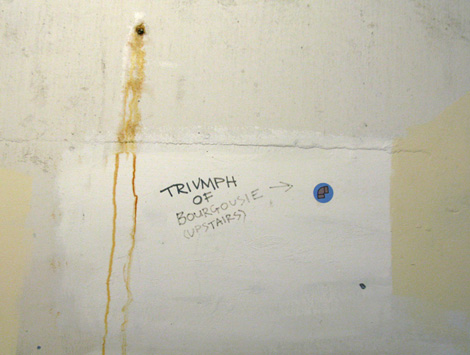
After an idea by Kraig Grady: what happens if you play every ambient album you can think of at the same time? I threw this mix together while Christmas dinner cooked and then decided it would be nice to have a video to match. EMNIOX is best viewed full screen with the lights out. It starts quietly and slowly builds steam.
Filed under: Art, Film, Music, Self-promotion by Ben.H
No Comments »
New Show! Like, For Real This Time! The Museum of Aphorisms and Platitudes
Wednesday 24 July 2019
 Ah yeah, remember that art show I was in last month? Well, apparently I wasn’t. That was some kind of mix-up in the listings when I was in fact due to appear in the next instalment of The Museum of Aphorisms and Platitudes, curated by Phil Edwards. It opens at Rubicon ARI in North Melbourne on 24 July (that’s right now) and runs until 10 August – full deets on the Rubicon ARI website. Sadly, I won’t be there to see this one either, but I plan to give it some more online exposure after the show closes. My piece is a small musical score with an online sound realisation, so if you can’t make it to Melbourne then you won’t completely miss out.
The MoP&A – The Museum of Platitudes and Aphorisms is part of a series of exhibitions and events that explore how individual artists and audiences explore their thinking about the presence of art in a studio or a gallery environment. It seems that there is a kind of peripheral vision that occurs in all artist’s practices that, once recognised, avoids or extends the awareness of the role of art and galleries in our lives. The aim of the project is to ask both makers and observers to reflect upon their own values in the experiences of making, encountering and looking at art. The role of the museum or gallery as the psychological architecture used to reflect upon accepted knowledge is also in review.
Filed under: Art, Music, Self-promotion by Ben.H
1 Comment »
New Show! The Museum of Aphorisms and Platitudes
Monday 17 June 2019
Anyone in Melbourne over the next month has the chance to see (and hear) a new work of mine at the group show The Museum of Aphorisms and Platitudes, curated by Phil Edwards. It opens at c3 Contemporary Art Space in The Abbotsford Convent on 19 June (6 to 8 pm for the launch). The show runs until 14 July – full deets on the c3 website. Lol nope it’s actually on at Rubicon ARI in July/August. Sadly, I won’t be there to see it, but I plan to give it some more online exposure after the show closes.
The MoP&A – The Museum of Platitudes and Aphorisms is part of a series of exhibitions and events that explore how individual artists and audiences explore their thinking about the presence of art in a studio or a gallery environment. It seems that there is a kind of peripheral vision that occurs in all artist’s practices that, once recognised, avoids or extends the awareness of the role of art and galleries in our lives. The aim of the project is to ask both makers and observers to reflect upon their own values in the experiences of making, encountering and looking at art. The role of the museum or gallery as the psychological architecture used to reflect upon accepted knowledge is also in review.
Filed under: Art, Music, Self-promotion by Ben.H
1 Comment »
Seeing, Hearing (2)
Tuesday 28 March 2017
To a shipboard acquaintance who thought the White Cliffs of Dover scarcely real, Eliot once replied, “Oh, they’re real enough,” a statement to which four meanings may be attached according as each of the four words in turn is stressed.
— Hugh Kenner, The Pound Era

There was a white painting in the Rauschenberg show at the Tate. I’d forgotten they were modular, made of multiple canvases. Stupid of me: the connections to Cage’s 4’33” became more obvious, both as music and as the second version of Cage’s score for the piece. Seeing, for the first time, those canvases placed side by side it struck me how much they had a presence as objects, not just surfaces. They looked pristine, untouched by time. Were they new? The card on the wall said just “Robert Rauschenberg Foundation, New York. On short term loan.”
Among the most radical aspects of the series is that these works were conceived as remakeable: Rauschenberg viewed them primarily as a concept and allowed for the physical artworks to be repainted and even refabricated from scratch without his direct involvement. Many of Rauschenberg’s friends and studio assistants… either repainted or fully refabricated various White Paintings at different points in the series’ history. Although such efforts were often undertaken to maintain the pristine surfaces considered essential to these works, refabrication was sometimes necessary because Rauschenberg had reused the original canvases as supports for new paintings and Combines.
Like a Duchamp readymade, we can look at a replica and not care about authenticity. Is it possible to remake a piece of music? (Two rooms over in the Tate, Factum I and Factum II hung side by side.) What makes music a form of art, if it is art at all? What does it share with other art-forms, that move them beyond considerations of craft?
Filed under: Art, Music by Ben.H
No Comments »
Seeing, Hearing (1)
Monday 27 March 2017
Lovely weather on the weekend so I went down to the Thames and finally went to see the Rauschenberg exhibition at Tate Modern. In that first room, the early Fifties, John Cage is pervasive. The next rooms, the combines, the silkscreens, I wonder what I’m looking at. You look at them and you get the overall image but it’s the objects that dominate your vision and your memory, whether in three or two dimensions. The goat, the tyre, JFK, an astronaut, a suitcase on a rope. And around it is painting, the painted gestures. Do we see the painting, or are they holding the objects in place?
Like in representational painting, there’s a hierarchy of perception, but here it’s not clear what is figure and what is ground. Are the objects acting on the viewer in the way that T. S. Eliot wanted the meaning of his poems to act on the reader, keeping the mind diverted and quiet while the art does its real work? Or is it just me, like when I’m waiting for that bit in the middle of Stockhausen’s Kontakte or the Beckett quotes in Berio’s Sinfonia? There are times when I’ve composed music and the material, all the harmony and voice-leading and inner structure and whatever, all become a vast supporting framework for a particular surface effect in the instrumental timbre or registration upon which the whole piece lives or dies.
I’m thinking again about Feldman’s use of what he called “patterns” in his late work, motifs he used and re-used as transparent vehicles for the instruments to project their sound without undue interference. The objects and their containing images merge. Then I’m back in that first Rauschenberg room at the Tate, where object and image are indivisible: the black painting, the white painting, the erased De Kooning, the tyre print. That integrity appeals to me the most, but I suspect grappling with messier realities is more necessary.
Filed under: Art, Music by Ben.H
No Comments »
Video meliora proboque, deteriora sequor.
Monday 4 January 2016
There’s a lot of stuff I need to write about but first I need to get this out of the way. I started re-reading Wyndham Lewis’ last novel, The Red Priest. I think Lewis is one of the great writers of the last century and, even though there are still two I haven’t read, The Red Priest must be the worst of his novels.
So why am I re-reading it, instead of something better? Because I don’t remember it. This in itself isn’t a problem for me: I’m not good at remembering details of books I like, either – especially the endings. The point is that I don’t remember why this particular book is bad, compared to his others.
Good art, music, writing, is too easily found: years, centuries of critical consensus offers them up, presses them upon you. Bad art is a personal discovery. Even when warned of its badness, like a Wet Paint sign, there is always the temptation to test for oneself. Meanwhile, we’ll take others’ word for it that Milton is a great poet and think we never need to hear another note of Mozart again.
Good art can also be a personal discovery, of course, but I always worry that I’m looking for something different, at the expense of finding something good. For years, my record library had large holes in it. Rummaging through second-hand vinyl I’d routinely pass up the chance to get, say, In C because I’d found an obscure album of Curtis Curtis-Smith. It’s all very well to buck the canon, but I found myself lost in marginalia.
Finding the good in the perhaps justly overlooked brings a fresh thrill to the mind, even if the discovery turns out to be grounded in ignorance and vanity. As T.S. Eliot sort-of said of Hamlet, people will claim it’s fascinating because it’s beautiful, when in fact they find it beautiful because it fascinates them. Eliot’s attitude seems the exact inverse of critical approach in this time of new-found abundance of information, when everything is ripe for rediscovery and reassessment.
An up-to-date critic would immediately point out that Eliot himself was an iconoclast, describing Hamlet as an artistic failure. What beauty isn’t flawed in some way? Lewis’ prose style can be grotesque, yet Fitzgerald’s stilted dialogue is given a pass. Fans of Fr. Rolfe will excuse his absurdities, but are those absurdities any worse than those accepted in D.H. Lawrence?
Perhaps the entire history of criticism is less concerned with finding the good than with finding the better than you think.
Filed under: Art, Music, Writing by Ben.H
No Comments »
Visible cracks, real and illusory
Sunday 15 November 2015
(Originally posted on 6 February 2008.)

As has been proved many times before, it is foolish to pass judgement on a work of art before seeing it for yourself. I finally saw Doris Salcedo’s Shibboleth at the Tate Modern.
There has been plenty of discussion about the artwork since it was first installed – what it means, how it was made, whether or not it’s any good – so much that it is impossible to not be aware of its existence, nor of what the work consists of. (It’s a crack running the length of the floor in the Tate’s Turbine Hall, growing wider and deeper as it descends from one end to the other.) You could picture the entire installation in your head, except for one little detail that I’ve never heard mentioned when people discuss their visits to see it. At close range, the crack is revealed to be an obvious fabrication, with no attempt to conceal the wire forms embedded in the concrete.

For the weekend crowds peering inside its depths, or hopping back and forth over it, Shibboleth may as well be invisible if its success depends on the interpretation given to it by the artist and the museum:
In particular, Salcedo is addressing a long legacy of racism and colonialism that underlies the modern world. ‘The history of racism’, Salcedo writes, ‘runs parallel to the history of modernity, and is its untold dark side’. … In breaking open the floor of the museum, Salcedo is exposing a fracture in modernity itself. Her work encourages us to confront uncomfortable truths about our history and about ourselves with absolute candidness, and without self-deception.

Even ignoring the fact that the history of racism runs parallel to the history of everything, it’s hard not to read this as a fatuous piece of funding-speak. You don’t have to doubt Salcedo’s personal background and beliefs that support her art to see that her public interpretation of her own art reduces Shibboleth to a one-liner, simplistic and ineffectual. The installation is as much a tourist attraction as the building that houses it. Salcedo may be “keen to remind us” of “the existence of a huge socially excluded underclass”, but Shibboleth, in this context, utterly fails to fulfil her intention.
(Strangely, for all her talk of schisms and exclusions, the only interpretations I’ve seen of the formative mesh in the crack have been either abstractly structural or overly symbolic. I would have thought it made an obvious point that apparently natural divisions in race or religion turn out under closer scrutiny to be artificial, human constructs. Then the art could at least function in its own way as a neat little metaphor, if little more.)
In fact, Salcedo makes out her installation to be less of a work of art than it really is, although its true power may be of a type she did not intend, or even recognise.

The immediate image conveyed by Shibboleth when seen plain, beguilingly forging its path of destruction through the crowds inevitably wandering the Turbine Hall, is not one of division but of entropy. Starting almost undetectable at the high end of the hall, it is allowed to progress, or rather deteriorate, along the floor unchecked until it has opened up into a real tripping hazard for visitors. The image of a cultural institution whose foundations have been permitted to shift, and so decay, is potent; but in the Western World of the early 21st century it speaks to a different dilemma than the artist intended.
The Tate’s claim that the crack “encourages us to confront uncomfortable truths about our history and about ourselves” isn’t exactly true. In truth, its presence embodies our culture’s current readiness to doubt itself, and to question its own origins, validity, and integrity – with little or no outside encouragement. The entropy was built into the system. This self-examination and picking apart of the social assumptions that underpin our culture could lead to renewal, or to disintegration. For a jaded society of sophisticates, the threat of destruction and disaster is extremely seductive. (As one reviewer says, “Salcedo’s cut is always varied and pleasurably violent. I’m not sure the pleasure is intended.”)

Salcedo’s professed aim to expose the dark side of modernity began within modernism itself in the immediate aftermath of the Second World War. In 1949, Charles Olson reflected on the inability of modernism to cope with the fragmentary nature of reality – it is no coincidence he coined the word “post-modern” two years later – and wrote in his poem “The Kingfishers”:
When the attentions change / the jungle
leaps in
even the stones are split
they riveFiled under: Art by Ben.H
No Comments »Triumph of the Bourgeoisie
Monday 27 July 2015
If you followed my Twitter feed you’d know I’ve been listening to James Saunders’ assigned #15 and I need to go hear it again right now lying down with the lights out. Blog post tomorrow.
Filed under: Art, London, Music by Ben.H
No Comments »Small melancholia, images and music
Tuesday 17 March 2015
I haven’t posted anything for a while, and just when I thought spring had come the cold and wet weather returned over the weekend. In keeping with the mood, here’s a little piece of music I made the other night and a few of the old photos I’ve been looking through this evening.
Filed under: Art, Music, Travel by Ben.H
No Comments »144 Pieces For Organ: The Movie
Wednesday 1 October 2014
I was going to write a blog post tonight but I started thinking about creating graphic representations of 144 Pieces For Organ – in Excel, of course.
Four of them are on YouTube now. Any resemblance to John Cage’s late prints is purely coincidental.
Filed under: Art, Film, Music by Ben.H
No Comments »End of the Summer Break
Saturday 28 June 2014
Hope you like the holiday snap. Back at last, with a quick update to say that the complete series of Real Characters and False Analogues videos is now online. Big announcements next week.
Filed under: Art, Film, Music by Ben.H
No Comments »Systems (1)
Thursday 5 June 2014
I’ve been thinking about generative systems a lot lately. Like, how can I make a series of videos to accompany these microtonal piano pieces I wrote years ago? I want combinations of intersecting colours relating to the harmonic relationships in each piece…
Or I want to make a series of short pieces for organ, written in a Microsoft Excel spreadsheet…
Each organ piece is 12 measures long (each measure a different tempo), using 12 organ stops, each stop playing 12 notes. 144 notes in each piece. Each measure begins with a note on different organ stop, all other notes can appear at any time in the piece. Moving from one pitch to the next is done by a crude approximation of flocking behaviour. Within these parameters, all outcomes are determined by chance.
I saw the Webdriver Torso videos last week and thought, “Damn, I wish I thought of that.” Then I read Greg Allen’s blog post about them and…
What you need is a system. To keep you going, to avoid artist’s block, to keep the pipeline filled.
I’ve never thought about artist’s block. That’s not an ego thing, it’s just that I hate inspiration. If I have to insert an aesthetic element into a piece then I consider it a failure. I’m thinking of that idea in mathematics of the elegant proof: that great richness of detail can be drawn from a relatively simple interaction of underlying principles. If the system’s good, there should be no need to fudge or tweak to keep things interesting.
Like that paragraph above describing the organ pieces. A brief set of instructions: the sentences are easily understood, the results produced are not easily imaginable. It would seem appropriate to write 144 of them, but I could break off the series at any time.
Filed under: Art, Film, Music by Ben.H
2 Comments »Thoughts at the front bar of the Hotel Lincoln, Carlton (with a schooner of Coopers Pale)
Tuesday 25 March 2014
I’ve been catching up with friends in Melbourne. We’re getting to the age where we can legitimately reminisce about good old times. Back Then it felt like an exciting time and place to be making music, art. Yeah yeah everyone feels their own little scene is special when they’re young, but what we were really talking about was that there seemed to be a big conversation going on. Doesn’t seem that way now. Is there a conservation still going on, and if so why aren’t we taking part in it?
Back in London, where is the conversation?
I always feel awkward about going back somewhere I know people. After an absence, they’ve moved on and I’m going to keep trying to put them back where they used to be. (This worry disappears as soon as we meet, of course.) Went to the Melbourne Now show at the Ian Potter Centre and enjoyed it for the wrong reasons, then met a friend for lunch. She disliked the show, finding it disappointing, superficial. I told her too much London art was even shallower. What had gotten me inspired was just seeing so many people back from the old Conversation still making stuff. Still not sure if this is a misguided thought.
Running with the pack is one thing, but what I miss is the feeling of competing against everyone at once – or at least of trying to hold up one’s own end of an ongoing discussion.
(Wanting to contribute to an interesting dialogue is the main impetus driving my work.)
Filed under: Art, Travel by Ben.H
1 Comment »End Of An Area
Monday 24 February 2014
Back in 2008 I wrote about the web site for Grey Area Art Space Inc. This was the artist-run space in Melbourne where I got my start in making exhibitions and giving performances. The collective and their exhibition space was wound up in early 1999, but the little website for the gallery just kept on going. At the time I wrote last it had stuck around for almost ten years unattended, log in and password long forgotten, almost entirely intact. “I wonder if it will last another ten years?” I asked at the time.
It turned out that the stray query I’d received in 2008 was the last time I was ever asked about exhibiting in a long-defunct space. I’d check up on the site every now and then to see if it was still there and it always was, until last weekend. After 15 years of uninterrupted rest it was finally cleared away on 31 January 2014, along with everything else hosted on the server.
If only I’d contacted them in November, I might have been able to preserve the web location in perpetuity. As I feel partly responsible for this I’ve uploaded a mirror onto my website, complete with the original tilde in the address. If you want a brief journey back in time please visit http://www.cookylamoo.com/~greyarea/.
Filed under: Art by Ben.H
No Comments »Experimental art and failure
Tuesday 4 February 2014
Had a discussion with some people last week about “experimental” music. I think everyone knows what this means, kind-of, sort-of, but lots of people don’t like it. Because I’m impressionable, whenever the term comes up I think of John Cage’s statement on the subject, from 1957: unfortunately I only ever remember the first part where he says he used to object to the term and forget that he immediately goes on to say he no longer does. He then goes on to talk about music being nothing but sounds and tells the story about the anechoic chamber again and I kind of blank on the rest of the talk. After that, all I’m left with is Cage’s initial objection, “that the experiments that had been made had taken place prior to the finished works, just as sketches are made before paintings and rehearsals precede performances.”
Surely every success is the consequence of a series of failures, and any “experimental” art presented to us is in fact the result of a successful experiment, to some extent. Really, I don’t have a problem with the term because everyone knows what it means, kind-of, sort-of, and we gotta use words when we talk to each other. My problem is this: I keep hearing people saying that a Good Thing about experimental art is that the failures can be as interesting as the successes. I really don’t think this is true.
Firstly, there is the objection already mentioned, that the failed experiment is not presented as the finished work – the finished work is a successful experiment made as a consequence of the failed experiment. But when people cite failures as being potentially productive as successes… does this ever actually happen? There are fortuitous accidents, but that’s a different matter. The “useful failure” seems to be a case of the arts borrowing a concept from science that doesn’t really fit. The most glaring difference is that scientists want their experiments to be replicated by others; artists do not. Artists don’t present a new work with the proviso that it’s actually no good and provide detailed instructions on how it was made, in the hope that someone else will use this method to make a better piece.
Given that artists keep it to themselves, do they ever make an experiment that fails in a way that turns out to be interesting? Again, I’m not talking about fortuitous accidents, I mean failure. An artist makes an experiment that fails, but that failure itself leads them to some sort of creative breakthrough (“not doing it that way” doesn’t count). Can anyone think of examples where this has happened?
Filed under: Art, Music by Ben.H
1 Comment »