My personal setbacks from coronavirus have been trivial compared to others. One of the disappointments has been the second missed chance to see Johnny Chang and Catherine Lamb’s Viola Torros Project performed live. Their double CD was one of the outstanding releases of 2018 and I was looking forward to hearing them at Counterflows in Glasgow this spring. As a small consolation, Cafe Oto’s Takuroku series has now given us Preliminary Study for V.T., a sketch exploring pre-mediaeval musical styles across Eurasia. While the Viola Torros pieces use spectral augmentation through reverberation, subtle feedback and voices, this Preliminary Study features just Chang and Lamb in a viola duet, recorded back in 2017 and reworked into a piece this year. It’s starker and more subdued, of course, closer to first principles that make it seem as much a distillation as an embryonic version of the music’s later, more developed forms. The interweaving violas play modes derived from Arabic, Byzantine and Indian music, all within a very narrow range of pitch and dynamics that brings attention to small changes in the grain of the instruments as much as their intonation. I did not give much attention to the musicological implications of the finished works at the time, as the material by that time had been transformed into a vehicle for broader timbral exploration. On the Takuroku recording, the material is heard more clearly, making it a useful addition to what I hope is a continuing series of V.T. works.
 I listened to Aisha Orazbayeva’s Music for Violin Alone a couple of months ago and have come back to it repeatedly since then. Her Takuroku release Slow Change continues in a similar vein of home recordings for solo violin. Two of Orazbayeva’s exploratory works sandwich one of Orlando Gibbons’ viol fantasies, which is here played with a deliberately light touch to produce and fluting, breathy tone; Gibbons’ Jacobean sense of impeccable order faintly outlined in what Cage would call “empty” sounds. The Fantasia carries over from the first piece, in which Orazbayeva plays with paper threaded between the strings, muting and distorting the notes. For the title piece, she has created her own answer to James Tenney’s Koan from her previous release, a gradually evolving tremolo whose sonic metamorphosis is brought about by imperceptibly guiding the bow from bridge to nut.
 It’s easy to describe features of Bruno Duplant’s music but he’s still hard to pin down. In his earlier Chamber and Field Works there are musicians and there are the environments they occupy, where each are present but neither makes demands of your attention. Each frames the other, with emergent properties. His Covid lockdown piece insaisissable(s) instant(s) is a piece about time, where time is an empty space upon which competing emotions and thoughts may intrude unbidden. There is a piano, sometimes, and the outside world can be heard, but at a distance. The piano’s silence becomes the subject, speaking of withdrawal indoors, moving back and forth between contemplation and impatience. As for ambience, the piece is measured out in regular domestic squeaks and thuds from around the room with a steady insistence of overfamiliarity that threatens incipient cabin fever. An electrical hum comes and goes, which may or may not help to relieve the tension. Who said this stuff is relaxing?
Filed under: Music, Reviews by Ben.H
Tags: Aisha Orazbayeva, Bruno Duplant, Takuroku, Viola Torros
No Comments »
Words and non-words, subjects and objects
Tuesday 21 July 2020
 I’ve been puzzled by Leo Chadburn’s pieces for speaking voice and ensemble: Freezywater dispassionately lists place-names that encircle the greater London area, The Indistinguishables pits a string quartet against a list of species of moth, recited with equally solemn blankness. The music is undemonstrative but fraught with the potential of escalating to the tragic, offering no readily apparent commentary on or illumination of the text, nor vice versa. Each achieves a semantic impasse that simultaneously invites and resists interpretation. Hearing them both, my mind kept protesting that there was less going on than met the ear.
Chadburn’s new record, The Subject / The Object, gives both ears and mind something more formidable to grapple with. The cool surface presented in those earlier chamber compositions has become more resistant here: The Subject / The Object can exist only as a recording, a fixed object, as it were. Instruments are reduced to voice and electronics, precisely machined into two halves of exactly twenty minutes each. The Subject is a sentence, underpainted with ominous synth rumbles that churn up the background. The spoken sentence continues in a single breath through an endless cascade of conjunctions and modifiers through which the subject slips without ever being pinned to a defintion. It’s an ingenious work of linguistic construction, vocal intonation and editing, that impresses your conciousness while the sounds get to work on the lower levels of your mind.
If it reminds you of Robert Ashley’s works for speaking voice, it might first be the resemblance in the editing that hooks you in, but really it’s the lure of a narrative thread that continually pulls you along even as you lose the sense of it. The voice is speaking and you listen, long after the words have ceased to register in your head. As with most of Ashley’s stories, I’m still not sure how it ends and if I were to go and hunt down the conclusion to find out what it all means then I’m sure I would be looking in the wrong place. The Object is the wordless counterpart, a necessary negative of multiple drones of vocalise. It plays the voice like a sampler with an empty memory, where void becomes meaning by default.
 When you’re writing a violin solo. YOU, A HACK: [bunch of notes on staves]. GEORGE BRECHT, AN ARTIST: [* polishing]. One night after too many drinks I announced to nobody in particular that Fluxus invented dank memes. Both are hellbent on stripping away context and explanation to find an irreducible, irrefutable non sequitur. It came back to me when happily listening through all fifty-seven minutes and forty-nine seconds of Luciano Maggiore & Louie Rice’s Synthesised voices and low frequencies to eat crisps with. The title tells you exactly what it is. The synthesised voices, though, they speak words; a barest minimum of semantic content – an exhaustive list of permutations of the words NO PA PA ON – rendered beyond any semblance of or desire for comprehensibility. Like a bad joke told well, it should be intolerable but for its frankness and savvy stupidity, with no prospect of nor attempt at a payoff. It is easy to forget that the truly impersonal is also guileless. As with Chadburn, the words dissolve into sound and produce music. Strange, but still music, of a type that reminds you that no music has any truly existential reason to exist at all. The blurb gives you the links to the websites they used to generate the piece, should you wish to make a copy for yourself. There’s no point to having one version of this, so why not have two?
Filed under: Music, Reviews by Ben.H
Tags: Leo Chadburn, Louie Rice, Luciano Maggiore, Takuroku
No Comments »
Takuroku Shooting Gallery
Tuesday 14 July 2020
Takuroku put out a batch of cool new stuff each week and I want to do them justice but I’m lazy. Will get more detailed on some of them later but for now:
Astral Social Club – ACID BARF. Neil Campbell dishes out a beat that just won’t quit despite it being subjected to every synth-pop indignity under the sun. The perverse will to endure becomes a gag that’s beaten into the ground and then beaten some more until it gets funny again.
Aylu – Frida. It starts out more normal than Astral Social Club but somewhere along the way it slips into madness and random goofiness made all the more winning after the straight beats have revealed themselves to be po-faced pop. Second guest appearance by pets.
Cam Deas – Rhythmic Landscapes. The blurb namedrops David Tudor’s Rainforest, which got my hopes up too high. In fact, it’s a nice set of field recordings of birds mixed in with overlapping patterns of percussion sounds. After a while it sounds too much like being on a verandah out in the country, sitting too close to the windchimes with a killer hangover.
Floris Vanhoof – Falala Falderiere Falderaldera. Nifty phasing electronics that jitter back and forth appealingly, interspersed with a frog pond that sounds just as electronic but isn’t, probably. It’s better than the title and I’m not dissing the electronics when I wish the frog track was longest.
Johnny R. Spykes – Less Effective Rhetoric. Plenty of action, but while sax and harsh electronics can be great fun in a pub they’re hell on the home listener. Most extreme is the mismatched stereo separation, except for one skronk recorded in low-bit mono.
Kazuhisa Uchihashi – Breathing Vegetables. Plenty of action, but at least we can have as much fun as Uchihashi is with obsessive pitch-bending, bouncy one-string guitar action and ditzy loops. The manic glee is infectious. There is a daxophone.
SHLIMP WARC – THGIE DRSOW. Acid Mothers Temple veterans Tatsuya Yoshida and Makoto Kawabata dust off some leftovers from a trio album only without Richard Pinhas, which helps brighten things up a little. Kerrazy drumming with ironic 80s guitar squalls and random keyboard barrages. Party like it’s 1994.
Naima Karlsson – [Vital Organs]: I. Heart Protector. A mere fifteen minutes, but one of the most substantial releases so far. A genuinely hypnotic piece for organ and electronics that retunes the listener’s awareness simply by breathing.
Ecka Mordecai – Critique + Prosper. A cellist and vocalist, Mordecai produces a set of personal recordings that aren’t so much introspective as self-possessed, letting the listener find their own space inside her sounds. I like to think this album was also made in a shed.
Otomo Yoshihide – 「Small Stone」. Frenetic atonal guitar soloing that unexpectedly cools into a clear-eyed reflection on the nature of protest, from the independence of public prosecutors in Japan to the independence of Hong Kong from China. A surprisingly moving sonic essay on the anxious balance between peace and vigilance.
Filed under: Music, Reviews by Ben.H
Tags: Takuroku
No Comments »
Home listening with Han Bennink, Yoni Silver and Xenia Pestova Bennett
Tuesday 7 July 2020
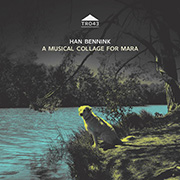 The variety on display at Takuroku continues to amaze. Here are three home recordings, made during and for the mitigation of Covid lockdown. Han Bennink’s Musical Collage for Mara captures the restless energy of his live percussion sets, jumping between casual tabletop drumming, interventions by a couple of pets, and household members rolling metal boules across the wooden floors. It’s like a set of snapshots of life in a very musical house, which gives it all a charming air of casual spontaneity. When things do settle down, it’s because something has grabbed Bennink’s attention, such as how many different timbres can be coaxed with a pair of brushes out of what I like to imagine is an upturned Quality Street tin.
 Yoni Silver takes it outside with his Sun and sky and garden breeze, a compelling contribution to the undervalued ‘men in sheds’ genre. Inside the makeshift musical temple in his backyard, he evokes a suburban bucolic idyll out of wind and string instruments, supplemented by his voice and various found objects. While Bennink takes action, Silver is contemplative, allowing the sounds of the surrounding birds and breezes to provide an outline for his music to shade in, building up a gently shimmering soundscape of a quiet, self-contained summer.
 Since we’re imagining that home recordings are glimpses into a musician’s home life, then Xenia Pestova Bennett‘s Atonal Electronic Chamber Music For Cats seems to fit right in here. Perhaps her house really is littered with superannuated electronic detritus; in any case, she’s made a succinct collection of pieces using old keyboards that have just reached that awkward age of sufficient cheesiness. (She kindly specifies for synth nerds exactly what she’s working with: Yamaha CS1X, Korg MonoSynth 2000, MicroKorg Synth Vocoder.) It’s always a kick to hear an album that’s as good as the title. Each piece sounds like a groovy bit of background music from an episode of Tomorrow’s World that goes just a leetle too far. It’s ridiculous fun, precisely because each pastiche is so well made, with affectionate care. Expect to see a massively overpriced vinyl edition for a future Record Store Day.
Filed under: Music, Reviews by Ben.H
Tags: Han Bennink, Takuroku, Xenia Pestova Bennett, Yoni Silver
1 Comment »
Isolation Pianos (2): Lisa Ullén, Bobby Mitchell, Frederic Rzewski
Tuesday 30 June 2020
 More odious comparisons: pianos, this time. This was going to get posted yesterday and include Alex White’s Transductions but I got a bit carried away about that one. I’m catching up on Takuroku’s weekly set of releases by musicians working in self-isolation over the past few months. Lisa Ullén’s Gold, 20-minute solo for prepared piano, was recorded in her living room on 1 June and I’ve just finished listening to it for a second time. Prepared piano is a difficult medium for musical expression; the overbearing timbres tend to push composers into resorting to extremes, either extravagant pyrotechnics or carefully isolated gems of sound. Ullén here stakes out a middle ground, and perhaps suffers for it. With paper threaded through the piano strings, she sets up a buzzing haze through which clear tones gradually emerge. From there, her concentration turns from timbral density to variety, picking out deliberate melodic fragments mixing muted and untreated piano notes. That middle ground of avoiding extremes makes it all feel a little safe, but then this piece isn’t about creating and resolving tension. It’s an extended study in contrasting timbres and textures, with the latter half cannily avoiding any perceptible shape to balance out the former.
 Pianist Bobby Mitchell has given Takuroku something that’s as close to trad as the series will presumably get, with a suite of pieces from Frederic Rzewski’s Songs of Insurrection. A veritable Old Master of virtuoso piano composition, Rzewski shows that his compositional and motivational spark are as vital as ever with this piano cycle composed in 2016, drawing material and inspiration from popular songs of World War II soldiers, partisans and civil rights protesters. The slightly rough-and-ready recording conditions suit the idiom perfectly and Mitchell gets stuck in with the right attitude, playing with an athelticism that always lands with feet planted firmly on the ground, with a tenderness that’s never soft-hearted. There’s a great unity of purpose here between composer and pianist, each unafraid to get into some dense passages without fear of getting the listener muddled. Right now, there’s no other legitimate way to get hold of a recording of this piece so it’s kind of essential for late Rzewski.
Filed under: Music, Reviews by Ben.H
Tags: Frederic Rzewski, Lisa Ullén, Takuroku
No Comments »
Takuroku Roundup No. 3
Friday 19 June 2020
 The new music from Takuroku just keeps coming. This is London’s Cafe Oto download-only label for a series of pieces recorded by artists around the world waiting out the Covid-19 lockdown. It’s turned into a superb indicator of just how much music is being made out there; a relatively small niche, in this case, has opened up to reveal a wide range of practices and approaches with a common defining trait of inventiveness and curiosity. Toshimaru Nakamura’s Nimb #62 is a shining example of his trademark no-input mixing board method, creating mutating feedback patterns that start out with an almost funky rhythm. Things settle down after a while into a steady wash of off-white noise, with subtle colourations that gradually darken into a low, ominous hum that keeps threatening to break out again into discordant beats.
 I’m trying to group things by superficial similarity here, as though I’m exercising some kind of critical skill for comparison. Ken Ikeda’s namaewamad@nai is another electronic work of similar dimensions, taking digital synth sounds and applying heavy dub effects to them. It’s a journey into a crepuscular netherworld, where King Tubby is half-morphed into Terry Riley. Drumlike sounds loop and overlap before dissovling into pulsing abstractions. Ikeda feeds sounds in to his effects box and them leaves them to slowly die away: it seems that much of the time we are listening only to the echoes of a sound that has long since passed. Like an overgrown ruin, it exerts a melancholy fascination, each sound forever beautifully fading away.
 It’s got to be hell being a drummer living in self-isolation. There are a few percussion-heavy releases here, but I’ll quickly pass over Ikuro Takahashi’s Friu. A promising opening of descending cymbal rolls turns into a suite of sound-sculpture-like studies of individual percussion instruments, followed by a long exercise with a see-sawing oscillator that just made me glad when it was over. Solo percussion albums are fraught with dangers like these, which makes Valentina Magaletti’s A Queer Anthology of Drums especially welcome. Eight short pieces that deftly combine percussion instruments with electronics (of the analog bleeps and field recording variety), each managing to quickly establish a different mood and, more importantly, a sense of space. The temptation to crowd out the stereo field with pyrotechnics is resisted in favour of a restrained but distinct palette of sounds that draws the listener into each miniature. It’s reminiscent of Will Guthrie’s much-loved People Pleaser album, but cast in a more reflective mood.
 I’ve just finished listening to Rie Nakajima’s Karu Kuru so I’ll talk about it now, too. It creates its own space, as well; as it needs to, for Nakajima’s toys and motorised objects to drift to and fro, making sound as they go. It’s a percussion album too, a loose arrangement of vignettes compiled into a single track. The sounds are mostly gentle, with the small contraptions accompanying her gestures giving the performance an almost whimsical air. It could all wander off into being twee, but Nakajima uses the machinery’s inherent indifference and the somewhat abstruse sonic capabilties of her array of objects to keep things focussed. Then there are darker elements, groaning friction sounds. The most intriguing section is at the beginning, where tiny chimes repeat an ascending major scale against a constant clockwork chatter. The incongruous juxtaposition of music and non-music at its most elemental implied something more than an exercise in musical craft was at stake, but this isn’t followed up.
Filed under: Music, Reviews by Ben.H
Tags: Ken Ikeda, Rie Nakajima, Takuroku, Toshimaru Nakamura, Valentina Magaletti
1 Comment »
Lockdown Roundup (2): Nick Ashwood and Laura Altman, Agnes Hvizdalek, Jacken Elswyth
Sunday 31 May 2020
 I’ve been busy while sequestered at home, but still listening, including some more new releases from the past few weeks. I’ve heard one record before involving Nick Ashwood, so it’s good to discover something new in his set of duets with Laura Altman. Battery was recorded inside a concrete bunker in a park near Hobart, Tasmania on a Sunday in March last year, with Ashwood playing acoustic guitar and Altman on clarinet with amplified objects. The three pieces here are expansive in scope but concentrated in their artistry: both musicians work together to create wonderfully detailed and mysterious sounds that can be both intimate and remote at the same time. The cheap electronics, prepared instruments and resonant recording space combine to transform the music into strange, ambient soundscapes. The players focus on tonal colouration and by the final track appear to be doing as little as possible to disrupt the space each sound opens up. The sense of place and altered reality is intensified by the presence of external sounds, especially when other people can faintly be heard nearby.
 The presence of others in these meditative moments becomes all the more poignant right now. It can also be heard in the latter stages of Agnes Hvizdalek’s Backstage, another release from Cafe Oto’s Covid-related Takuroku downloads label. Going by the release notes, Backstage appears to be a work for solo voice. Now knowing anything about Hvizdalek before now, my usual approach to experimental vocal music is to brace myself in fear of the worst. I was completely wrong-footed here and blown away by the experience. Hvizdalek’s piece is as much about silence as sound, a wordless reflection on isolation that hovers uneasily between darkness and light. Soft, disarming bursts of electronic-sounding clicks coexists with a refrigerant hum that drones in and out through the piece. Where Ashwood and Altman used their music to create a space that opens out to the world, Hvizdalek maps out a space that moves ever inward. Her voice articulates both a resistance to and an uneasy accommodation with pervasive ambient noise and the world outside the self.
 As something completely different, Jacken Elswyth’s Six Static Scenes would appear to be a set of direct musical statements. A set of song-length solos for banjo: what could be simpler? The appearances are deceptive. First of all, there are seven tracks, with one ‘scene’ broken into two contrasting parts. No obvious trickery here, with clear references to celebrated folk musicians and a consistent approach to traditional clawhammer technique. And yet… Scene 2, “after Dock Boggs” has an almost obsessive focus on a couple of triads – a very static scene – and gains a resonant halo of overtones from a wheezy-sounding shruti box. The following scene gains a drone in the form of a single tone held softly on a squeezebox. By this time, if you’re thinking Elswyth has made some sort of postmodern abstraction of Appalachiana, her picking becomes more elusive and fragmentary in that two-part fourth scene, setting her banjo in a mixture of drones that swirl together with a sinister calmness. The final scene gently extends a farewell cadence to five minutes, with a tenacity too subtle for the intellect.
Filed under: Music, Reviews by Ben.H
Tags: Agnes Hvizdalek, Jacken Elswyth, Laura Altman, Nick Ashwood, Takuroku
No Comments »
Lockdown Roundup: Lucy Railton, Melaine Dalibert, James Rushford
Saturday 23 May 2020
Responses to Covid-19 are coming thick and fast now. Quarantined from the wider world, musicians are making music alone, where they can. Cafe Oto, the bold experimental music venue in London, has responded to the enforced downtime by launching Takuroku, a new netlabel dedicated to recordings produced under lockdown. As you might expect, the dominant mood right now is directed by isolation; introspective and melancholy – at least based on the three I’ve listened to so far. (In case I’m seeming more interested in analysis than advocacy, I’d recommend each of these three to the curious.)
 Lucy Railton’s Lament in Three Parts adds hidden depths to this emotional state. Her work for solo cello with some additional electronics was improvised on one day in late April, with processing added a couple of days later. The music sounds much more substantial than this description suggests: as an improvisation, it definitely draws upon something that has been stored up for some time. Railton’s recent compositional work has extended beyond her cello into the use of electronics and field recordings. Earlier this year, she presented a sophisticated collaboration with synthesiser pioneer Peter Zinovieff, RFG Inventions for Cello and Computer. Lament distills Railton’s music and moves the focus away from technology: when electronics first appear at the end of the first part, it sounds like amplified bowing adding a further sighing texture to the slow chorale. Part two is a sombre melody that passes almost monophonically for its first half (I’m no expert but it sounds like she’s using Pythagorean intonation). The briefer final part resolves the preceding long line with an otherworldly sheen, the electronics adding just enough to transform the cello into something strange yet still beautiful.
 My previous exposure to Melaine Dalibert consists entirely of two solo piano works which I did not like. Un Long Ralentissement is another piano piece, made as a specific response to the pandemic. As before, Dalibert takes an almost obstinately theoretical approach as justification for his carefully placed single tones, but this time it works musically. Preciousness has yielded to tenderness, and the understated rallentando adds a flexibility and flow to this slow music. The process of things slowing down is experienced, not just demonstrated, and there’s a humanising element present in the recording that makes this piece perversely relevant.
 I’ve just done James Rushford recently but here’s another solo piece, this time made as a direct result of lockdown. Ouarzazate is a solo performance on a Rhodes electric keyboard. It is thirty-eight goddamn minutes long; almost twice the length of the Railton and Dalibert pieces. The contrast in his approach to the keyboard compared to his organ piece Clerestory is instructive. To work with such a limited timbral palette over such a long, unbroken span of time, you’ve got to be good. Rushford’s playing starts contrapuntally, generously paced enough to open up contemplation yet never lingering, lest momentum be lost to aimless meandering. It keeps the mind guessing with occasional leaps in register and changes in pitch sets, opening up one fork in the path after another.