A “mongrel array” of musicians were conducted by Jack Sheen in a performance of Eldritch Priest’s pleasure drenching… last Thursday. The piece was written in 2003 and this was its second(?) airing. The difficulty comes from several sources: its instrumentation (electric guitar, lap steel guitar, organ, piano, clarinet, harmonium, assorted strings, percussion and bass), its length (about ninety minutes) and its scoring (combining notation of various precision and suggestion). The angular melodies and lopsided meters heard in other Eldritch Priest works are present, but smoothed out into a sort of dissolute lounge jazz that moons about as though to fill up time before something else happens. The lap steel, organs and vibraphone add an oily sheen to the smoothness and insinuate a sinister aspect lurking in the background. A demotic drum kit of cymbal mounted on snare erratically rapped out the absence of a consistent beat. Everyone seems to drift in their own reverie, more or less together. There are pauses, then everything resumes apparently much as before. And so, questions of orientation, direction, structure and form steadily become irrelevant, replaced by a simple sense of scale. As the music drifts, so does it gradually drift apart. The suggestion of an ominous presence occasionally rears back into consciousness – a sudden snare strike, a louder chord – but the foreboding imprints itself more through absence, as the established elements drop away, not always to return. For much of the time it’s all ensemble playing, before breaking out into smaller groupings; but once that has happened the full ensemble never really seems to return. Solos become precarious. At one point the music dwindles away to a lo-fi recording played into a mute room of musicians. The cymbal finally stops but then you wonder why it never comes back. More and more, your attention comes to what is missing. Chatting to someone afterwards, he described it as hearing smooth jazz slowly bleed out. The overall character of haunted loucheness was expertly conveyed by the ensemble, an expanded form of Apartment House, including Sam Cave on guitar and EP himself on the lap steel, which had the last word. I do hope someone can get together a good recording of this piece, sooner rather than later.
The following night had the UK premiere and second performance of Jürg Frey’s Clarinet Quintet, played by the same musicians as in the first peformance last week on Bologna and in the recording. I won’t add much to what I’ve already said, except to comment on the difference between hearing a recording and hearing it live. For the recording I wrote “I suspect the listener’s responses to it will alter a little each time it is heard”, which will obviously be the case when hearing a live performance, but this time I picked up more on the aspects of Frey’s earlier styles that have been retained in his new work, such as when the quintet gives way to the viola plucking a single note, lingering over this moment before moving on. There was also the more general difference in that in a recording you listen for what has happened, but when live you listen for what will happen. The different anticipatory sense drew attention to what seemed a slightly more hesitant opening to how the piece was played, which made the Apartment House quintet’s interpretation on the night seem more fragile and their accomplishment more earned than taken for granted, with the piece’s strength to be found in the course of its performance rather than assumed from the start.
Filed under: Music, Reviews by Ben.H
Tags: Eldritch Priest, Jürg Frey
No Comments »
Michael Finnissy And The Guitar
Tuesday 26 May 2026
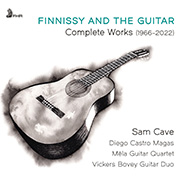 Michael Finnissy: Finnissy And The Guitar [First Hand]. “For this year, the usually anniversary-happy Proms have programmed sweet F. A.” I wrote this ten years ago as a passing comment on Michael Finnissy turning seventy. Now he’s eighty, the Proms has again conspicuously ignored him; I’m not sure if that matters for the Proms, any more. Meanwhile, some new albums have been coming out, with Métier adding another hefty volume of piano works adroitly tackled by Ian Pace (includes English Country Tunes) and a complete collection of his organ works, played by Forrest Eimold. The latter is a less-known facet of Finnissy’s work, as are the works for guitar. Finnissy And The Guitar: Complete Works 1966-2022 is an especially rewarding compendium both for bringing these works to light and for displaying the great clarity in Finnissy’s compositional voice; a voice that once acquired a reputation for speaking a recondite language. This may be down to the eclecticism of his style, which mixes a feeling for the more abstract harmony and counterpoint of 20th-century Europeans (and so looked at askance in Britain) with references to the musics of other times and places. He combines these tendencies intuitively, with a traditionally English empiricism.
The earliest work dates back to when Finnissy was about twenty: Two Cut-Ups of Three Fantasias by Alonso Mudarra makes free use of William Burroughs’ cut-up technique to collage fragments from the 16th-century composer, creating a pair of studies which explore polyphonic implications within an “economy of gesture”. It’s a youthful work so it can be called ‘limpid’, favouring construction over direction to make two pieces which are immediate but obscure, opening up a new way to hear how sounds fit together. It also captures the tone of ambiguous melancholy that permeates many of Burroughs’ collages. This is a first recording, made by Sam Cave, who also unearthed the piece while compiling this collection; he’s done a superb job in conception and execution. Cave plays four of the seven pieces here, the others played by guitarists closely associated with the music; all but one have not perviously been recorded commercially, if at all.
In the Two Cut-Ups any continuity is of course self-constructed, and the subsequent works carry over a sense of continuity that is friable, illusory or complicated to varying degrees. Felix namque, a compact work from 2012, carries over traces reminiscent of baroque lute and Spanish folk but metamorphoses between different expressions of one or the other, with sudden schisms and an abrupt end. The more elaborate but perhaps less refined Song 17 from 1976 contrasts flourishes of more esoteric language with moments of stillness and quiet, extended tremoloes. Cave takes those tremoloes to the threshold of hearing; his playing beautifully conveys Finnissy’s affection for the instrument, interpreting the music in a deceptively simple way, appearing not to take on a false persona for each piece or assume a burden of emotional strain on behalf of the avant-garde. (This is a more nuanced way of saying he makes it sound easy.) More particularly, Cave and the other musicians empathise with Finnissy’s observation that “one can become intoxicated with the sound, and forget about continuity and structuring”, giving attention to each moment while securing its place in the overall construction. Finnissy’s writing for guitar always makes time for the ear to linger on sensual details, even in the protean monologue of Nasiye (1982), played with pointed momentum by Diego Castro Magas. It’s a piece which creates its own shape out of attempting to reconcile, or at least find balance between, its inconguities, without ever resorting to easy despair. The duo Normal Deviates (2017), played by Daniel Bovey and Julian Vickers, who commissioned it, is even more of a headlong rush, with the two guitars locked in heated dialogue that alternately meshes and clashes. It’s complex, but never rushed to the point it feels like trivial scurrying; the Vickers Bovey Duo brings out its eloquence. Bovey also commissioned the guitar quartet Albion on the Road to Hell in 2019: played by him with the Mela Guitar Quartet, it begins as a shocking study in brutal timbre with all four musicians ferociously plucking out a series of repeated chords in unison. After finally exhausting itself, the piece slowly rebuilds from quiescence into a hazy miasma of mingled voices. The final work is the most recent and the longest, with Cave playing Outcast, a piece started during the Covid pandemic and finished in 2022. Both the most variegated and the most introspective in mood, Outcast is a musical transcription of sorts, or a translation, of the 9th-century Welsh poem Claf Abercuawg and so is in form another monologue. Cave imbues the work with tenderness, even in it’s bleakest moments and violent outbursts. It’s a pleasure to learn this music is now not so overlooked.
Filed under: Music, Reviews by Ben.H
Tags: Michael Finnissy
No Comments »
Not quite there: Stepančić, McIntosh
Sunday 24 May 2026
 Teodora Stepančić: Transparent Duo [Cloudchamber Recordings]. I dismissed Stepančić’s O A | F G as “precious”, accusing it of “silences, hushed tones, reverential playing and exquisite delicacy”. Transparent Duo reveals her bravado and commitment to this seemingly unrewarding aesthetic by producing a work of forbidding harshness and austerity, even as it is almost imperceptible. Composed for two string instruments with field recordings and written on transparent paper, the score’s pages either indicate towards a direction and length of glissando, or otherwise towards bowing style. The two sets of instructions may therefore combine to form an ephemeral but definite structure and substance. The realisation here is for two cellos, played by the n/ether duo of Laura Cetilia and Hannah Soren, heard recently in Cetilia’s own soil + stone. If you expect this combination to produce a warmer, fuller sound than the meagre materials suggest, you will be disappointed: Stepančić’s score admits that the glissandi played will be “mostly inaudible”. What is heard is whatever seeps through, however faintly, almost by accident; tentative silences open up and then persist, and as they do so become harder to dispel. The sounds lightly scratch upon the ear, as though carried by wind. This sensation is matched by the interludes of field recordings, open air with distant rural sounds. It’s all incredibly sparse, but it is not precious; it’s saved by the heiratic formality that arises from the piece’s conception, where raw but unconfronting sounds are studiously interspersed with silence, human and natural sounds separated, all arranged through impersonal, non-hierarchical means. The two cellists of n/ether exemplify concentration and seriousness of purpose in the extreme reticence with which their playing may be heard; as though to hammer the point home, the unyielding strictness of this realisation produces what sounds like a recapitulation at end.
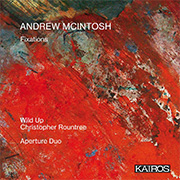 Andrew McIntosh: Fixations [Kairos]. McIntosh, who composed A Moonbeam Is Just A Filtered Sunbeam and who we recently heard as violist on Ian Power’s Brace and various bits of Jürg Frey, returns with three compositions for strings, without electronic processing, extended techniques or field recordings. The strings are retuned throughout, in just intonation. Besides the inherent resonances of the tuning McIntosh makes the perceptual tension, between our brains hearing it wrong while our ears hear it right, integral to the fabric of his music. The title work, a thirty-minute string octet, alternates between brief melodic passages on individual instruments with passages of stillness where a couple of harmonies float back and forth irresolutely. They act on the piece’s supposed momentum as though time were suspended, but that suspension of time and lack of movement becomes the subject. As observed in Moonbeam, “either the time is filled with greater complexities of tone and colour, or even less happens than before, depending on the attitude you take while listening”; Fixations has a more defined structure and as such those complexities arising from apparent insensibility become the focus of attention, more than the moments of activity. In other words, these pieces have a curious effect on the listener, being indisctinct but tough. The musicians are an ensemble called Wild Up, including McIntosh himself on viola and Erika Duke-Kirkpatrick on cello. Duo for viola and cello, with any number of violins features the duo tracing out faint patterns against an even fainter halo of the higher strings in shallow relief. All play in a similar range, rising up gradually until the soloists reach harmonics. The patterning is vague and subtle enough to make you forget the notes as such and remember only the translucent timbre of the work, until a sudden flourish of rapid, elegant arpeggios towards the end. The opening track is a brief amuse-oreille titled 434.6, played by the Aperture Duo of Adrianne Pope on violin and Linnea Powell on viola. A small secret is revealed here, as to how McIntosh uses his melodic material: the phrases are blunt and even simplistic, but played with great delicacy and refinement. To keep things suitably oblique, the booklet doesn’t contain notes on each work but a transcript between McIntosh and Cassandra Miller, which begins with the former questioning the latter.
Filed under: Music, Reviews by Ben.H
Tags: Andrew McIntosh, Teodora Stepančić
No Comments »
Jürg Frey: Clarinet Quintet, etc.
Tuesday 19 May 2026
 Jürg Frey: Clarinet Quintet [Another Timbre]. The live premiere of Jürg Frey’s new Clarinet Quintet took place in Bologna last night; it will receive a performance in London next week. The musicians, all members of Apartment House, have also recorded the work for Another Timbre so you can hear it right away – the work was commissioned by the label founder Simon Reynell. The quartet, with Heather Roche on clarinet and a string quartet consisting of violinists Mira Benjamin and Chihiro Ono, Bridget Carey on viola and Anton Lukoszevieze cello, perform the piece with their usual exemplary dedication, with all the confident, self-assured understatement of, say, the Melos Quartet playing Brahms. Kids these days won’t remember that Frey used to be considered a radical, with compositions that focused on silence and repeated, single sounds to the extent that it felt like a provocation. The thing here is that he has not mellowed with age, or rebelled against his earlier style. The Clarinet Quintet is a sublimation of his earlier instincts and interests, showing consummate mastery over materials and technique as he works his way through from the beginning of the piece to its end. It’s a complex work that feels simple and approachable, yet on its own terms. The music steadily rolls out at a comfortable pace, instruments never straining to extremes, with hints of subdued melody woven throughout. I’d tell people it has a kind of pastoral feel. Almost too subtle to consciously register, there are fleeting moments which disturb the peaceable atmosphere: a melodic loose end, a skip in the rhythm, a brief transition where the voices clash and you understand that Frey has determined to things the hard way. What could have passed as merely pleasant becomes a reflection on how such contentment is precarious, negotiated and hard won, thus making pleasure fulfilling – there’s no sermonising on this; the values are imbued in the music that has resulted. The Apartment House strings mesh together but not too sweetly, each voice having its own quirks and quiet flashes of tetchiness; Roche’s clarinet blends into the overall texture, then emerges as soloist, steps back for periods then resumes blending into the background, making a character out of her part. Beyond its overall initial impression of solidity and suppleness, several listenings so far indicate a profound depth to this music and I suspect the listener’s responses to it will alter a little each time it is heard.
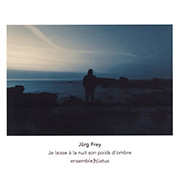 Jürg Frey: Je laisse à la nuit son poids d’ombre [Another Timbre]. It’s interesting to compare the Quintet with a work from about five years earlier, Je laisse à la nuit son poids d’ombre, released by Another Timbre last year. Of similar length, nearly an hour, but very different in its means and methods. The French ensemble]h[iatus with sopranos Hélène Fauchère and Géraldine Keller recorded this in 2021: a setting of lines by Swiss poet Anne Perrier and old Japanese haikus that fills out at a deliberately slow pace, seemingly to emerge one pitch at a time. Sounds, like words, are felt out and tested, with each one gradually finding a place in the larger scheme. For an ensemble of eight instruments plus voices, the texture is kept very thin until late in the piece; we’re well into the work before the presence of two voices is unmistakeable. Opposed to texture, the timbre is often strange and exotic, with unexpected percussion sounds and the addition of an analog synthesiser which nudges the ensemble towards the uncanny. I can’t write about this piece in greater depth now, but just wanted to draw attention to how Frey has produced two works that are apparently diametrically opposed in approach while sharing the same care and interest in sound and its effects, an equal level of craft.
Filed under: Music, Reviews by Ben.H
Tags: Jürg Frey
1 Comment »
Welcome returns (2): Timothy McCormack
Sunday 17 May 2026
 Timothy McCormack: The Hand is an Ear [Kairos]. It’s rare to hear music that makes you think differently about things: about the composer, the genre, music in general. I’ve seen a couple of equally enthusiastic reviews of this album and both start with descriptions of something beyond the music itself that struck the reviewer, which should give you some idea of how people react when they’re confronted by these two pieces. The pieces are your body is a volume, a fifty-minute string quartet played by the JACK Quartet, and the hand is an ear / the ear is a heart, a twenty-minute piece for solo violin played by JACK member Austin Wulliman. For me, I started thinking how they both delivered an emotional impact out of brutalist handling of sound, as I’d previously experienced when hearing his piano piece mine but for its sublimation. Then I went back and listened to mine but for its sublimation again and realised that I’d been hearing something completely different in the way it left its lingering impression on the listener. Turns out I’d been bamboozled, hearing those close-spaced and unresolved piano chords and thinking Feldman. There’s nothing of the kind on the new album, as niceties of pitch have lost all relevance. your body is a volume is an exquisite tour de force in noise, instructing the JACK players through a gruelling regimen of bowing speed, pressures, direction and placement, finger pressure, multiphonics and (at one stage) subharmonics, treating the musicians as conductors of an unstoppable current, filtering and modulating the spectrum of audible noise. It begins as a prolonged gasp, before suddenly unleashing a thunderous wall of dense, hyperdetailed granular sound; from there on it runs the listener and the players ragged. Obvious reference points I’ve seen cited are Lachenmann (fixation on extended techniques as the primary source of sound) and Scelsi (treatment of sound as a plastic medium); besides Lachenmann, I heard connections with Nono (self-created forms made out of impoverished material), Xenakis (visceral effects from conceptual abstraction) and Harley Gaber’s The Winds Rise In The North (prolonged sounds at once distant and uncomfortably close). So many discrete references can be found that, even if it were a synthesis, the work and its voice is unique. You’ll have noticed by now that I’m throwing ideas together just to convey and impression of this quartet’s power: it builds a grand, encompassing statement from an entirely new language, made out of the margins of the instruments’ vocabulary. The strings never fully speak yet they convey meaning at a gut level, with coarse eloquence. There’s a tremendous intellect at work behind it, even though one endures it as though it were a force of nature, immune to reason. The music teaches you a lot that you won’t understand right away, except for the idea that the JACK Quartet are heroes for achieving this. In conception and execution, it’s perfectly realised.
So far I haven’t given the hand is an ear / the ear is a heart its due. It is in no way overshadowed by your body is a volume; rather it achieves an elevated status by both complementing and transcending the preceding, larger work. Written a few years later, it fills the same sort of miraculous space occupied by Nono’s violin duo “Hay que caminar” soñando, using sparse sounds and silence in a way that feels like you’re hearing the instrument for the first time. Wulliman plays this piece with a stern, commandeering tenderness – such a thing is evidently possible – with all the alien yet touching sentiments that can instill in the listener. Rigorous in its orientation while more capricious in its method, the piece feels as though it’s been lived through more than composed.
Filed under: Music, Reviews by Ben.H
Tags: Timothy McCormack
No Comments »
Welcome returns (1): Sylvia Lim, Eldritch Priest
Sunday 10 May 2026
After being knocked out by Timothy McCormack’s mine but for its sublimation last year, I have now been blown away by the two pieces on The Hand is an Ear: an immense string quartet and a stringent violin solo. Both demand a fresh vocabulary to do them justice so let me get back to you on that asap. Speaking of brilliant follow-ups…
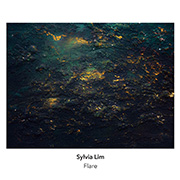 Sylvia Lim: Flare [Another Timbre]. It’s good to hear some more music by Sylvia Lim, having first heard her Sawyer Editions album back in 2022. On Flare you can hear her quietly individualistic style taking shape, resisting easy definition. Her compositions show an interest in acoustic decay and a peculiar method for exploring it. There’s no apparent system at work, relying on her curiosity and imagination to discover new ways of hearing instruments. The title work is for piano solo, played by Ben Smith: the instrument is treated as a resonator, using muted strings to eke out overtones from two keys, repeatedly struck in a trill. The substance of the music comes from the sonority, articulated by rhythm and phrasing, creating a piece made of shadows and echoes, a translucent projection of music. The small, intimate things we overheard is aptly named, a discordant congregation of clarinet and bass clarinet, violin and percussion passes by the ear as though partly concealed. The piece is played by various Apartment House alumni, as is shadowfolds, a recent piece for five musicians made in an attempt at polyphony; this manifests itself in compound, heterogenous changes in timbre. As shown in the piano piece flare, there’s a reductive approach taken in a number of Lim’s works: the Miyabi guitar duo of Hugh Millington and Saki Kato play the diptych same but different with one string prepared, snapping and buzzing against the others as the guitarists pluck single notes with only small variations in pitch, working their way down to one repeated, naked sound treated with minute attention. It’s striking how the reductionism never comes across as cold or affected, seeming to be born out of a strong affection for even the simplest sounds. Grafting, a trio for bass clarinet, violin and cello played by Mira Benjamin, Heather Roche and Natasha Zielazinski, might be the most completely realised composition here, with languidly winding melodic fragments surfacing briefly amongst slow, droning notes that are both tender and remote; it ends with a coda that recapitulates the material as a frail impression of its former self. By the time you reach the last piece Field of Play you become aware that the range of sounds has reduced down to a small, softly-lit space, reaching a minimum with this suite for prepared cello. Natasha Zielazinski, credited as co-composer, adds a single object to the strings for each section, muting the pitch and opening up a complex of frictional noise. All sorts of deep sub-tones and hoarse upper partials emerge from Zielazinski’s bowing, sounding as though barely above a whisper but recorded so closely as to seem immense, adding suspense that the delicate sounds may suddenly break. It’s common to describe a work as explorative, but this hushed work comes from a gentle but intense focus on a single spot.
 Eldritch Priest: dead-wall reveries [Another Timbre]. A collection of three more pieces by Eldritch Priest, including the promised recording of his string quartet dust breeding performed by Apartment House. When I heard them play it live I was struck by the way each of the seemingly incongruous threads that make up the piece seem to frequently end up chasing their own tails, likening it to “a complex knot, slackened to the point where you can’t tell if grabbing one end will pull it tight or unravel it completely.” Hearing it again now, the emphasis on harmonics and fast, heavily ornamented playing suggest that the work is an alternative interpretation of the string quartet form, transposed to a different order. The high, floating sounds add colour while removing the substance of the pitch, hinting at something transparent which is nevertheless obscured by the layers of filigree. dormitive virtue is a piano piece from 2001, recorded by the composer in his apartment around that time. It’s been heard before as a short track for solo electric guitar on his same-titled album, a collection of “wistul, bluesey jazz rumination”. Here the jazz is less in evidence, as the piano version takes a much longer time, lingering over phrases and repeating chords as though they were echoes, pausing before ready to move on to the next section. Strangely enough, its the earlier, longer take which is the fully composed version; the guitar’s improvisation is a distillation of certain motives and mood. The introspective nature of the solo piano carries over into the other works to some degree. dead-wall reveries continues in his style of angular, discontinuous melodies and antimelodies to construct an ergodic composition that would otherwise seem typical for him, except that in this work the music is cast in a more mellow and vulnerable mien than the usual bluff statements that take on mystifying twists and turns. An ensemble of clarinet, vibraphone, violin, cello and piano (played here by the ensemble Arraymusic) picks its way through a confounding course of contradictory conversation; yet even as it does so seems to reflect upon itself – it never resolves, of course, but it does seem to be reaching some sort of understanding of the situation and adapts its behaviour accordingly. The violin part is the most frequently active, loosing off fast melodic passages charged with nervous energy, or cutting across the other instruments with electronic distortion. All three works find new ways of elaborating upon knots; self-interfering structures that feed upon entropy. Apartment House will also be playing his long, earlier work pleasure drenching… in London later this month.
Filed under: Music, Reviews by Ben.H
Tags: Eldritch Priest, Sylvia Lim
No Comments »
Some older stuff I had saved but forgot about (1)
Saturday 9 May 2026
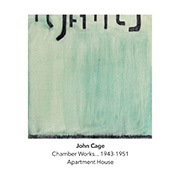 John Cage: Chamber Works… 1943-1951 [Another Timbre]. I can remember a gig with Kerry Yong playing a selection of Cage’s Sonatas and Interludes on an electronic keyboard, for which he had substituted the original piano preparations with a lurid array of samples. It was blasphemous, it was hilarious, it was godawful, it somehow worked on its own crazy terms. It also strongly reminded me of Messiaen. There’s nothing sacrilegious in this fine selection of pieces from the intriguing transitional phase of Cage’s career, but Yong’s irreverence and dry wit must play a role in him rescuing In A Landscape from the realm of New Age rack jobbers. Treading firmly where others have been fey and floaty, he rediscovers the shocking reductionism of the piece and gives it a simple, big-boned elegance of movement. Similar treatment is given to Dream, which in this version has an added cello part played by Anton Lukoszevieze – the embellishment is understated and not where you expect it would be. Yong also gives us the seldom-heard Haikus from 1950-51, as oblique and elusive in their fleeting gestures as the Six Melodies for Violin and Keyboard, played here with Mira Benjamin. I don’t think it’s possible to have too many recordings of the sublime String Quartet in Four Parts and the version is more than welcome: Benjamin and Lukoszevieze are joined by fellow Apartment House cronies Gordon MacKay and Bridget Carey. They all play without even thinking of vibrato, which makes the muted sounds appear perversely wholesome rather than anaemic. They dance through the deceptively tricky rhythms and make the slow movement seem positively glacial, in a way which makes it all the more compelling.
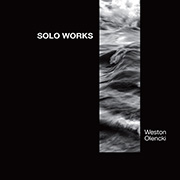 Weston Olencki: Solo Works [Creative Sources Recordings]. Four pieces for solo brass, each that wears its experimentalism on its sleeve. This is raw, bare-boned music that grapples at length with fundamentals of instrumental sound. From the start, seven stones (parallax) hits like a soprano vacuum cleaner fed through a ring modulator. The album is, however, all-acoustic and the instrument being played is in fact a bass trumpet with preparations, using a snare drum as a resonator. The bass part becomes apparent when the pitch suddenly plumments to the abyssal depths before snapping back into its usual frequency band of noise. On all four pieces, silence used as compositional device, abruptly marking off boundaries for each monolithic aural block. The longest work is the most elaborate, capacity for unadulterated trombone, alternating compound tones with stuttering bursts of percussive sounds, gradually opening up into long braids of buzzing multiphonics, a brutalist sound sculpture in granite. The modified euphonium in bisected mass hisses electronically and builds up into the sound of grinding machinery and a clipping microphone caught in a gale.
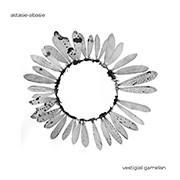 Astasie-abasie: Vestigial Gamelan [Shame File Music]. Stupid me overlooked this one, even though I enjoyed Ian Andrews’ previous release Elliptical Gamelan. I guess this is the third in a trilogy, collecting recordings made between 2021 and 2023. The M.O. is as before: amplified small objects motivated by electrical devices, so each pretty short track is made up of layered loops and cycling sounds. As with Elliptical Gamelan (less so on the preceding Molecular Gamelan), the range and quality of sounds that Andrews elicits from his instruments bring the conceptual conceit to life. Each piece is less defined in form, unlike the preceding album, but gains from additional textural and timbral depth. By continuing to work with these devices, he’s moved beyond getting things to simply sound different and reached a level of understanding where the sounds can share similarities but complement each other. This time, the pieces are distinguished by presence of lower-pitched sounds and less-traceable looping patterns, suggesting something more organic than mechanical. The variety of sounds continue to surprise through the album and each track functions as a tableau, working as either background of foreground. The evocation of nature also comes from the way the pieces now succeed in avoiding any obvious human intervention without seeming to run on rails.
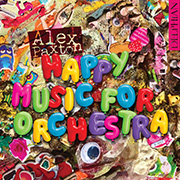 Alex Paxton: Happy Music for Orchestra [Delphian]. Really, really did not enjoy Paxton’s Music for Bosch People album a while back, so I was really, really surprised when I braced myself for this follow-up album and ended up loving pretty much the whole thing. It felt like there was something wrong with me, I got into it that much. Everything that Bosch People got wrong Happy Music gets right. Where the old one felt stiff and forced and trying to signal that it’s funny, the new one feels loose and spontaneous and actually is funny without any apparent effort. (Bosch People did seem to improve in the places where the sounds get more free.) It’s rare to hear genuinely funny music but the six pieces on Happy Music pull it off though a lightness of touch and a consistent silliness, where the incongruous instrumentation, styles and levels of competence make no attempt to justify themselves and so remain defiantly, self-assuredly ridiculous. This time around, you don’t have to think about why the music could be considered comedic, you just know it by listening. Instead of sounding obnoxious, Paxton’s goofy trombone soloing comes across as good-natured and well-intentioned, just a little misguided.
Filed under: Music, Reviews by Ben.H
Tags: Alex Paxton, Astasie-abasie, John Cage, Weston Olencki
No Comments »
Reviriego, Helena, Reuter et. al.
Wednesday 6 May 2026
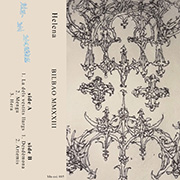 Helena: BILBAO MMXXIII [Blu-Rei]. The composer is Àlex Reviriego – the five pieces here make up a half-hour live set played by Helena, a trio of Reviriego on double bass, Clara Lai on piano and Vasco Trilla on percussion, with some background audience sound. Each piece is distilled, concentrated into little moments of articulate stillness, proceding from one moment to another with stead deliberation. At times some of the pieces resemble cool jazz, but the absence of any propulsive beat atomises the elements of the genre into something more abstract and rarefied. Trilla plays a large side drum with a soft mallet, more for emphasis than rhythm, with bells, woodblocks and a cymbal for faint washes of noise. Lai’s piano acts as a focal point but limits herself mostly to slow, chordal themes which offer some movement while always staying in the same place, while Reviriego and Trilla act as commentary, the bass part often shadowing the piano. Things start out weird with the first track and then gradually build momentum to an almost indulgent climax on the penultimate track, with the trio’s members throwing out some more demonstrative chops, but then regain composure for the final piece: a stately, slowly unwinding processional.
 Markus Reuter / Vasco Trilla / Àlex Reviriego: Música fúnebre [self-released]. Speaking of processionals: Reviriego and Trilla join up with Markus Reuter on Música fúnebre, an ominous piece that spreads out over half an hour to steadily immerse the listener in a sensation of crepuscular horripilation. Reviriego’s bass provides the sombre undertones for Trilla playing a set of flat bells and Reuter on a Phillicordia organ. The source of inspiration is Lutosławski’s Musique funèbre, specifically the twelve-note series in its opening form, all tritones and half-steps. The trio wallow in the funereal harmonies, starting out as a drone before using otherworldly bowed bell edges and the eerie electrical sound of the organ to evoke old-timey spooky movie music. It’s almost cheesy, except that it’s done wih seriousness of purpose and, thanks to pursuing the twelve-tone ramifications, just keeps evolving into something different. When the bells are finally struck the instrument’s overtones imbue everything with a luminous, sinister halo. The trio take an obvious pleasure in indulging their creepy side, not least when Reviriego starts to get some coffin-like sounds out of his bass fiddle.
Filed under: Music, Reviews by Ben.H
Tags: Àlex Reviriego, Markus Reuter, Vasco Trilla
No Comments »
Quartets: Power, Tremblay, Tougas, St-Pierre
Sunday 3 May 2026
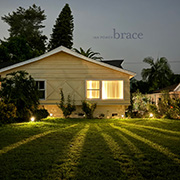 Ian Power: Brace [Semayd]. My first encounter with Power’s music found “slow, widely-separated and often repeated sounds” but with “messy edges” – a tendency that appeared both soncially and conceptually. While maintaining an impassive exterior, his music relies upon internalised self-discipline from the musicians to determine the course of the composition. The elemental string quartet Brace Each Other Dive comes across to the listener as a constructivist assembly of contrasting sonorities, but the finer matters of timbre, intonation and texture in each block of sound are given life and interest by an unpredictable degree of imprecision that lurks behind each switch in direction. The intrigue comes from Power’s compositional method for this piece: a set of instructions to the players with loosely-defined materials, often relying upon the musicians’ own judgement and intuition, such as “Eyes closed: 1 person plays a 30″ solo using one of the above materials, e.g. very slow bow, mp-mf, 3″, non vibrato.” Some passages require eyes to be closed, others open, adding to the taut balance between freedom and control. The piece is realised by the Bergamot Quartet, who pull off the whole thing with inventiveness and clarity, sounding confident and spontaneous. To give you an idea of their commitment to the piece, the booklet comes with excerpts from the score, together with the quartet’s own “graphic shorthand” score for realising the piece. The graphics show the extent of their imagination, with an approach far beyond what I would envisaged as a technical sugbject. The quartet is framed by two shorter works; reveni ad me has Power himself playing organ in piece which moves in slow-motion between small, clustered chords and clean intervals. The untitled piece for viola and cello uses a minimum of textural contrast as material, moving together almost in unison with a plastic treatment of notes and effects being expanded and contracted. The musicians are Andrew McIntosh and Jennifer Bewerse, who make the most of the implicit variety in colouration.
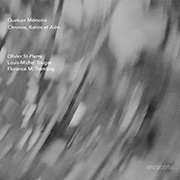 Quatuor Mémoire: Chronos, Kaïros et Aiôn [Mnémosyne]. Three Québécois string quartets performed by an ensemble dedicated to new music. All three are big on making use of sonority as a material, with what sounds like forms of distorted spectralism. As a matter of fact, one of the blurbs online states outright that they share interests in “exploration of microtonality, complex polyrhythms, and sound-based compositional approaches”. The first two are compact: Florence M. Tremblay’s Insides is peppered with moments of busyness, with some neat interlocking patterns, before morphing into slews of long sliding tones. Other than that, the polyphony in these pieces is more about texture than rhythm. Louis-Michel Tougas’s Quatuor à cordes no. 2 “Vague à l’âme” throws in dramatic gestures here and there at odds with its tendency to languidly pass time in luxurious but slightly sour-toned colours. The third piece is extensive: Olivier St-Pierre’s Chronos, Kaïros et Aiôn stretches out beyond half an hour. It draws its inspiration from classical Greek conceptions of time, but the question is how its use of time manifests itself to the listener. There are recurrences and refrains, but the overall impression it made with me was of a traversal of a horizontal landscape with large open spaces, with occasional moments of interest spurring sudden activity. These brief outbursts do signal variegations in the material, creating a fairly broad, earth-toned palette and torquing the pace of the work just enough to add tension. Some nicer details for appreciation come through here and there on closer listening, but for your first hearing you will either want to soak in the faintly carbolic waters or else wonder when something is going to make you sit up and take notice.