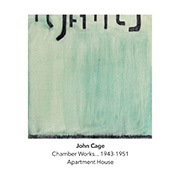
 John Cage: Chamber Works… 1943-1951 [Another Timbre]. I can remember a gig with Kerry Yong playing a selection of Cage’s Sonatas and Interludes on an electronic keyboard, for which he had substituted the original piano preparations with a lurid array of samples. It was blasphemous, it was hilarious, it was godawful, it somehow worked on its own crazy terms. It also strongly reminded me of Messiaen. There’s nothing sacrilegious in this fine selection of pieces from the intriguing transitional phase of Cage’s career, but Yong’s irreverence and dry wit must play a role in him rescuing In A Landscape from the realm of New Age rack jobbers. Treading firmly where others have been fey and floaty, he rediscovers the shocking reductionism of the piece and gives it a simple, big-boned elegance of movement. Similar treatment is given to Dream, which in this version has an added cello part played by Anton Lukoszevieze – the embellishment is understated and not where you expect it would be. Yong also gives us the seldom-heard Haikus from 1950-51, as oblique and elusive in their fleeting gestures as the Six Melodies for Violin and Keyboard, played here with Mira Benjamin. I don’t think it’s possible to have too many recordings of the sublime String Quartet in Four Parts and the version is more than welcome: Benjamin and Lukoszevieze are joined by fellow Apartment House cronies Gordon MacKay and Bridget Carey. They all play without even thinking of vibrato, which makes the muted sounds appear perversely wholesome rather than anaemic. They dance through the deceptively tricky rhythms and make the slow movement seem positively glacial, in a way which makes it all the more compelling.
 Weston Olencki: Solo Works [Creative Sources Recordings]. Four pieces for solo brass, each that wears its experimentalism on its sleeve. This is raw, bare-boned music that grapples at length with fundamentals of instrumental sound. From the start, seven stones (parallax) hits like a soprano vacuum cleaner fed through a ring modulator. The album is, however, all-acoustic and the instrument being played is in fact a bass trumpet with preparations, using a snare drum as a resonator. The bass part becomes apparent when the pitch suddenly plumments to the abyssal depths before snapping back into its usual frequency band of noise. On all four pieces, silence used as compositional device, abruptly marking off boundaries for each monolithic aural block. The longest work is the most elaborate, capacity for unadulterated trombone, alternating compound tones with stuttering bursts of percussive sounds, gradually opening up into long braids of buzzing multiphonics, a brutalist sound sculpture in granite. The modified euphonium in bisected mass hisses electronically and builds up into the sound of grinding machinery and a clipping microphone caught in a gale.
 Astasie-abasie: Vestigial Gamelan [Shame File Music]. Stupid me overlooked this one, even though I enjoyed Ian Andrews’ previous release Elliptical Gamelan. I guess this is the third in a trilogy, collecting recordings made between 2021 and 2023. The M.O. is as before: amplified small objects motivated by electrical devices, so each pretty short track is made up of layered loops and cycling sounds. As with Elliptical Gamelan (less so on the preceding Molecular Gamelan), the range and quality of sounds that Andrews elicits from his instruments bring the conceptual conceit to life. Each piece is less defined in form, unlike the preceding album, but gains from additional textural and timbral depth. By continuing to work with these devices, he’s moved beyond getting things to simply sound different and reached a level of understanding where the sounds can share similarities but complement each other. This time, the pieces are distinguished by presence of lower-pitched sounds and less-traceable looping patterns, suggesting something more organic than mechanical. The variety of sounds continue to surprise through the album and each track functions as a tableau, working as either background of foreground. The evocation of nature also comes from the way the pieces now succeed in avoiding any obvious human intervention without seeming to run on rails.
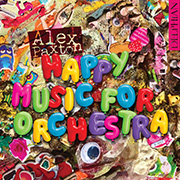 Alex Paxton: Happy Music for Orchestra [Delphian]. Really, really did not enjoy Paxton’s Music for Bosch People album a while back, so I was really, really surprised when I braced myself for this follow-up album and ended up loving pretty much the whole thing. It felt like there was something wrong with me, I got into it that much. Everything that Bosch People got wrong Happy Music gets right. Where the old one felt stiff and forced and trying to signal that it’s funny, the new one feels loose and spontaneous and actually is funny without any apparent effort. (Bosch People did seem to improve in the places where the sounds get more free.) It’s rare to hear genuinely funny music but the six pieces on Happy Music pull it off though a lightness of touch and a consistent silliness, where the incongruous instrumentation, styles and levels of competence make no attempt to justify themselves and so remain defiantly, self-assuredly ridiculous. This time around, you don’t have to think about why the music could be considered comedic, you just know it by listening. Instead of sounding obnoxious, Paxton’s goofy trombone soloing comes across as good-natured and well-intentioned, just a little misguided.
Filed under: Music, Reviews by Ben.H
Tags: Alex Paxton, Astasie-abasie, John Cage, Weston Olencki
No Comments »
Alex Paxton: Music for Bosch People
Saturday 15 May 2021
 The word ‘manic’ pops up twice in the press release for Alex Paxton’s album Music for Bosch People. ‘Garish’ should be used too, meant as a positive; it should come as no surprise from the cover art that this music is played by an amplified ensemble with saxophone, electric guitars, drum kit and samplers bouncing around Paxton’s trombone. The bright, clashing colours and patterns in the packaging threaten the listener with a “fun” experience, which too often means music that is at once hectoring and ingratiating. Paxton and his crack team of musicians thankfully avoid this for the most part.
I got the download version of this, with the tracks tagged as ‘Jazz’, so I had to strip those tags out before listening so I wasn’t too prejudiced against it. The album falls into two halves: the long title piece, with a mani-… let’s say frantic solo coda of Paxton vocalising on trombone, and a suite of “Prayers”. The musical idiom throughout is good old-fashioned New York Downtown free improv: constant activity, frenetic and eclectic. TV and movie samples break out amongst the music, like listening to alternative radio in 1990. Is this an exercise in retro pastiche? The remarkable thing here is that Paxton has composed this densely-packed free-for-all, while allowing the musicians scope for improvisation. The advantage is that the momentum and inspiration never flags; the disadvantage is that it never soars to any exhilarating highs, either. For all its wildness, the music tries its best to stay likeable and so remains harmless, never acquiring even the undercurrent of casual menace that makes this kind of playing come alive for the listener. Heard in the wrong frame of mind, parts of the long track come across like attempted humour, stiff and forced.
Given Paxton’s and the ensembles adeptness with the established techniques and technology, he seems strangely reluctant to use it to say anything new – hence the impression of pastiche. The second half of the album is stronger, as he uses his devices in a new and more interesting way. These five short tracks were made by Paxton using cheap MIDI keyboards, improvisation and multitracking as compositional devices, building up layers of improvised solos and then transcribing them into notated arrangements for ensemble. Everything is much more fluid in these pieces, with fleeting gestures and soundbites appearing and disappearing with greater independence and mutual indifference, thus sounding with greater spontaneity. It allows a track titled “Prayer with Strings and Joan Rivers” to be crude and witty without needing to slap you on the back. Even as these tracks are less dense, the musicians can create more connections between the sounds and present the listener with a more complex experience than the title piece.