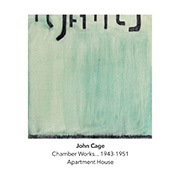
 John Cage: Chamber Works… 1943-1951 [Another Timbre]. I can remember a gig with Kerry Yong playing a selection of Cage’s Sonatas and Interludes on an electronic keyboard, for which he had substituted the original piano preparations with a lurid array of samples. It was blasphemous, it was hilarious, it was godawful, it somehow worked on its own crazy terms. It also strongly reminded me of Messiaen. There’s nothing sacrilegious in this fine selection of pieces from the intriguing transitional phase of Cage’s career, but Yong’s irreverence and dry wit must play a role in him rescuing In A Landscape from the realm of New Age rack jobbers. Treading firmly where others have been fey and floaty, he rediscovers the shocking reductionism of the piece and gives it a simple, big-boned elegance of movement. Similar treatment is given to Dream, which in this version has an added cello part played by Anton Lukoszevieze – the embellishment is understated and not where you expect it would be. Yong also gives us the seldom-heard Haikus from 1950-51, as oblique and elusive in their fleeting gestures as the Six Melodies for Violin and Keyboard, played here with Mira Benjamin. I don’t think it’s possible to have too many recordings of the sublime String Quartet in Four Parts and the version is more than welcome: Benjamin and Lukoszevieze are joined by fellow Apartment House cronies Gordon MacKay and Bridget Carey. They all play without even thinking of vibrato, which makes the muted sounds appear perversely wholesome rather than anaemic. They dance through the deceptively tricky rhythms and make the slow movement seem positively glacial, in a way which makes it all the more compelling.
 Weston Olencki: Solo Works [Creative Sources Recordings]. Four pieces for solo brass, each that wears its experimentalism on its sleeve. This is raw, bare-boned music that grapples at length with fundamentals of instrumental sound. From the start, seven stones (parallax) hits like a soprano vacuum cleaner fed through a ring modulator. The album is, however, all-acoustic and the instrument being played is in fact a bass trumpet with preparations, using a snare drum as a resonator. The bass part becomes apparent when the pitch suddenly plumments to the abyssal depths before snapping back into its usual frequency band of noise. On all four pieces, silence used as compositional device, abruptly marking off boundaries for each monolithic aural block. The longest work is the most elaborate, capacity for unadulterated trombone, alternating compound tones with stuttering bursts of percussive sounds, gradually opening up into long braids of buzzing multiphonics, a brutalist sound sculpture in granite. The modified euphonium in bisected mass hisses electronically and builds up into the sound of grinding machinery and a clipping microphone caught in a gale.
 Astasie-abasie: Vestigial Gamelan [Shame File Music]. Stupid me overlooked this one, even though I enjoyed Ian Andrews’ previous release Elliptical Gamelan. I guess this is the third in a trilogy, collecting recordings made between 2021 and 2023. The M.O. is as before: amplified small objects motivated by electrical devices, so each pretty short track is made up of layered loops and cycling sounds. As with Elliptical Gamelan (less so on the preceding Molecular Gamelan), the range and quality of sounds that Andrews elicits from his instruments bring the conceptual conceit to life. Each piece is less defined in form, unlike the preceding album, but gains from additional textural and timbral depth. By continuing to work with these devices, he’s moved beyond getting things to simply sound different and reached a level of understanding where the sounds can share similarities but complement each other. This time, the pieces are distinguished by presence of lower-pitched sounds and less-traceable looping patterns, suggesting something more organic than mechanical. The variety of sounds continue to surprise through the album and each track functions as a tableau, working as either background of foreground. The evocation of nature also comes from the way the pieces now succeed in avoiding any obvious human intervention without seeming to run on rails.
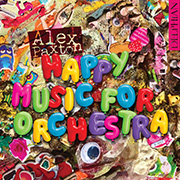 Alex Paxton: Happy Music for Orchestra [Delphian]. Really, really did not enjoy Paxton’s Music for Bosch People album a while back, so I was really, really surprised when I braced myself for this follow-up album and ended up loving pretty much the whole thing. It felt like there was something wrong with me, I got into it that much. Everything that Bosch People got wrong Happy Music gets right. Where the old one felt stiff and forced and trying to signal that it’s funny, the new one feels loose and spontaneous and actually is funny without any apparent effort. (Bosch People did seem to improve in the places where the sounds get more free.) It’s rare to hear genuinely funny music but the six pieces on Happy Music pull it off though a lightness of touch and a consistent silliness, where the incongruous instrumentation, styles and levels of competence make no attempt to justify themselves and so remain defiantly, self-assuredly ridiculous. This time around, you don’t have to think about why the music could be considered comedic, you just know it by listening. Instead of sounding obnoxious, Paxton’s goofy trombone soloing comes across as good-natured and well-intentioned, just a little misguided.
Filed under: Music, Reviews by Ben.H
Tags: Alex Paxton, Astasie-abasie, John Cage, Weston Olencki
No Comments »
Routines: Rasten & Dupleix, Bondi & d’incise, Astasie-abasie
Thursday 12 January 2023
 There are some pieces that act like a microcosm of dealing with new music – composing it, playing it, listening to it – in the whole: observed from a distance, these activities boil down to a matter of repetition, reiteration, routine. In this situation, the importance of the act of concentration is heightened, becoming almost an aesthetic goal in itself. When listening to such music, the question is whether composer, performer and audience can all find a comparable level of concentration.
 Routine differs from repetition, in that a repeated set of actions can lead to changes in those actions, as they adapt to new possibilities observed from the results. Fredrik Rasten and Léo Dupleix’s Delve II takes a composition by Rasten made from reiterated elements, expanded over thirty-eight minutes as a duet for 12-string acoustic guitar and spinet. Short gestures are repeated in near-unison, producing a composite instrument in which the features and contents are in a slow but unceasing flux. The arepggiated chords are not so much elaborated – or even extended, in the manner of an old-school minimal composer – as they are pursued into new articulations, as though allowing some natural process of musician’s curiosity to take its course. Chords are slowly pulled apart and reassembled, with new aspects casually introduced or removed, all at a seemingly steady, breath-like pace. The effect is entrancing.
 Ian Andrews has made two albums now under the name Astasie-abasie. The first one, Molecular Gamelan, didn’t interest me too much as it was all too much like sound sculpture and wasn’t working as foreground. The new one, Elliptical Gamelan, is much better. As before, the pieces are all made from amplified metal objects motivated by electrical devices, so loops and cycling sounds are the base material here. Where Elliptical Gamelan succeeds is in the details, with the sounds more intrisically complex so that they are less recognisable with each repetition, overlaying each other in patterns that may be inferred but cannot be identified rhythmically. Each of the ten short pieces here evolve as they progress, giving each one a distinct sound and form, making them work as music instead of just exercises in instrument-building. One of us was paying closer attention this time.
 The excessive focus on instruments has a detrimental effect on Cyril Bondi and d’incise’s latest collaboration, Le secret. Bondi made an extensive investigation into Swiss Alpenglocken before the two musicians were let loose on a large collection of bells. The focus here is on the differences in tone and timbre of bells, as they’re played in slow, antiphonal permutations, to the exclusion of almost all other considerations. Unless you want to invest it with your own significance, the arrangements here seem overly reverential and dry. Perversely, d’incise’s solo album καῦμα (kaûma) is all electronic but feels more lively and capricious, even as it tries to maintain a steady state of repeated actions. Synthesiser is mixed with analogue filters and reverb as well as digital processing, creating a fuzzy, saturated set of small riffs that perpetually drift off course. The material is simple and unassuming, but in d’incise’s renderings they become tantalisingly indistinct. It recalls the fin de siècle interest in glitchcore and lowercase, returning to follow up on where those two subgenres had left off before fully delivering on their promises.