Beats me why Redundens 4 comes out all messed up in The Listening Room. It works fine on the player on my NetNewMusic page so if you want to hear it properly you can go there.
In the meantime, I’ve added Redundens 7 to The Listening Room, and it sounds perfectly fine. It’s very similar to Redundens 4, but then all the Redundens pieces strive to be as alike as possible.
Filed under: Music by Ben.H
No Comments »
It’s a wonder I don’t get this stuff more often
Thursday 9 April 2009
At 19:09 07/04/2009, Stave Scout wrote:
Dear sir/madam
My name is stave scout and urgenly need some DRILLS to order
from your company.please email with the types of DRILLS you have in
stock for sale now.and the price and i will like to know what type of credit
card do you accept. I will be looking forward to hear from you soon.
Thanks
Regards,
stave
Dear Sir/Madam,
Thank you for your enquiry about DRILLS. I have a wide selection of reconditioned DRILLS and DRILLBITS for sale – from the most delicate surgical equipment to heavy machinery for vast construction projects (laparoscopy, shipping canals). Please inform me of what type of DRILLS you need and I’m sure I can arrange prompt delivery. I accept Mastercard.
Kind regards,
Filed under: Stupidity by Ben.H
2 Comments »
Pause
Tuesday 7 April 2009

The world won’t let me stay put. After having to move unexpectedly at the start of last year, it now turns out I need to find somewhere else to live in the next few weeks. Excuse me if updates are a bit spotty while I get a new place, broadband etc.
Filed under: The Bunker by Ben.H
3 Comments »
Please Mister Please
Sunday 5 April 2009
Richard Maxfield, “Cough Music” (1959).
(5’54”, 8.26 MB, mp3)
(5’54”, 8.26 MB, mp3)
Now streaming on the jukebox.
Filed under: Please Mister Please by Ben.H
No Comments »
Another Voynich Enigma Cleared Up
Sunday 5 April 2009
After sorting out the true meaning behind the Voynich Manuscript, and uncovering the Voynich Manchester lurking in East London, another revelation. Thanks to the anonymous commenter who disclosed that the mysterious Edward-Kelley Lorem-Ipsum style curtains can be bought at Argos for £10 a pair.
In fact, they can be had for as low as £8.99 if you get them in terracotta, or for as much as £19.59 if you want them ‘natural’. Judging from the customer reviews on the website, they’re very popular with cheapskate landlords; but it beats me why anyone would voluntarily waste their time writing about stupid curtains on the internet.
Filed under: The Bunker by Ben.H
No Comments »
The Giant Adenoid that Ate St James’s takes a step closer to reality
Thursday 2 April 2009
Now it turns out that this light bulb over the colonel’s head here is the same identical Osram light bulb that Franz Pokler used to sleep next to in his bunk at the underground rocket works at Nordhausen. Statistically (so Their story goes), every n-thousandth bulb is gonna be perfect, all the delta-q’s piling up just right, so we shouldn’t be surprised that his one’s still around, burning brightly. But the truth is even more stupendous. This bulb is immortal! It’s been around, in fact, since the twenties, has that old-timery point at the tip and is less pear-shaped than more contemporary bulbs….
Thomas Pynchon, Gravity’s Rainbow, pp.647.
Welcome to the homepage devoted to the Longest burning Light Bulb in history. Now in its 108th year of illumination.
First Meggezones, now this.
Filed under: London, Writing by Ben.H
1 Comment »
Redundens 4
Tuesday 31 March 2009
The series of works collectively titled Redundens was begun in 2001. All the pieces take Arnold Schoenberg’s Three Pieces for Piano, Op.11 as their starting point: only the top line in Schoenberg’s pieces is retained as an unaccompanied melody (or as a list of pitch classes if you’re more technically-minded.) Each set of pieces uses a different method of encoding this melody; by pitch, register, timbre, duration, dynamics, or other means.
Redundens 4 arranges this melody for solo piano, with all variations in rhythm and articulation removed, always making the smallest possible leap from one note to the next.
Redundens 4 (8’26”, 12.99 MB, mp3)
Update: whoa! Something’s terribly wrong with the Listening Room version of this piece. It plays fine if you download it, but let me know if the Listening Room version comes out all distorted.
Filed under: Music by Ben.H
No Comments »
What’s on top of the pile?
Sunday 29 March 2009
– Why are you listening to Latin music?
– Why not?
– You don’t listen to Latin music.
– I am now.
– You never listen to Latin music!
– Don’t you like it?
– It’s fine.
– So what’s the problem?
– You, you never listen to Latin music! Why do they keep shouting “cumbia”?
– I dunno, so I’m just assuming it’s Spanish for “blues explosion”.
– Why not?
– You don’t listen to Latin music.
– I am now.
– You never listen to Latin music!
– Don’t you like it?
– It’s fine.
– So what’s the problem?
– You, you never listen to Latin music! Why do they keep shouting “cumbia”?
– I dunno, so I’m just assuming it’s Spanish for “blues explosion”.
Filed under: Music by Ben.H
1 Comment »
Please Mister Please
Friday 27 March 2009
The Masters Apprentices, “Undecided” (1966).
(2’30”, 3.36 MB, mp3)
(2’30”, 3.36 MB, mp3)
Now streaming on the jukebox.
Filed under: Please Mister Please by Ben.H
No Comments »
Please Mister Please
Wednesday 25 March 2009
Held over due to nosebleed.
Filed under: Please Mister Please by Ben.H
No Comments »
An open letter to the imaginary kebab shop owner in my dream last night
Wednesday 25 March 2009
Dear imaginary kebab shop owner in my dream last night,
I apologise for attempting to order a large lamb doner from you by referring to it by the hitherto unknown slang term, “cock”. I could tell immediately that you were offended and had possibly misunderstood me. In this alternate reality I truly believed that it was common to call large lamb doner kebabs “cocks” but, even if I hadn’t been misled, my usage of it was overly familiar and gratuitously vulgar. I am sincerely sorry.
Thank you for not throwing me out of your shop or spitting in the garlic sauce.
Yours etc.
Filed under: Stupidity by Ben.H
No Comments »
Google vs Death, Round 2
Monday 23 March 2009
Google Street View has finally launched in the UK and is already out of date. This is a good thing, as far as I’m concerned. I’m more interested in checking up on where I used to be than where I am now, despite the new pictures looking like they’re better quality than the Australian ones (and the taunts about growing up in a tip).
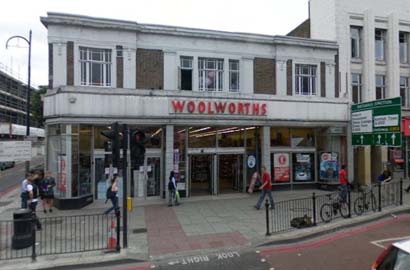
The Google camera car went up my street last summer. In fact, it went up my street twice:


I’ve talked before about how Street View’s illusion of the present masks a preserved version of the recent past, already decaying and proving less and less true to reality. Now we can see street corners that exist simultaneously in two time zones at once.
For most Britons, the illusory, alternate-reality nature of Street View is immediately visible in the high streets. The economic downturn has worsened in the time between the photos being taken and appearing on the web. Google’s Britain is a brighter, nostalgic land with fewer boarded-up shopfronts, where Woolworths, MFI, Zavvi, and other chain stores are still in business.
Back in Australia, the emerging anomalies are more poignant. On the main street of the town of Marysville in Victoria, the season abruptly changes from summer to winter for a few metres; then just as suddenly, the sky clears, the ground dries up again, and the trees regain their leaves. Of course, neither version is true: we know the town was all but obliterated by fire last month.
(Crossposted at Sarsaparilla Lite.)
Filed under: London, Travel by Ben.H
1 Comment »
The Listening Room is Open
Friday 20 March 2009
To save you the hassle of downloading music you know nothing about, I’ve stayed up all night figuring out how to get every single piece of my music on this website collected in one convenient location, playable as streaming audio. So far, there are over 50 mp3s to choose from.

You’ll need a Flash player in your browser for this to work. It probably needs a few bugs to be worked out and some extra functions added, but it seems to do the job for now. Drop me a line if it’s giving you grief.
Please Mister Please has also been given the jukebox treatment.
Filed under: Music by Ben.H
No Comments »
Sentimental Education
Thursday 19 March 2009
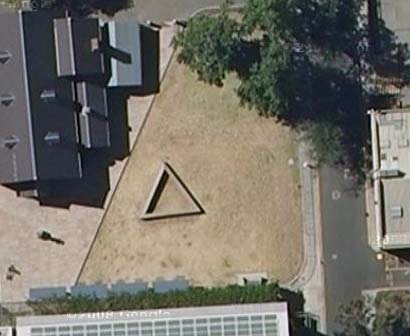
When I was growing up I walked past this object all the time, for years, without realising what it was. As a small kid I simply thought it was a triangular, walled-off space and never thought about it being a work of art. I just wondered why that area was walled off, why there was no way in, and what was inside (I was too short to see over it).
Later on, I figured out that it was art: I’d found the plaque nearby which said it was ‘Untitled’ by Donald Judd. It was ‘modern art’ – minimalist and blank – but it still intrigued me because it was still extremely difficult to see what, if anything, was inside its walls (I was a late bloomer). Its featureless sides frustrated small kids’ attempts to climb it.
For a while I thought that was the point of the sculpture: to zone off an area you couldn’t see into. Finally attaining normal height put paid to that delusion, although the thickness of the walls still inhibit an easy view into the centre.

In any case, I grew up thinking of it as just one amongst many pieces of ugly public art scattered around Adelaide. It wasn’t until much later that I understood the size of Judd’s reputation and how unusual it was to have regular contact with a site-specific outdoor work by him. I assumed he had stuff like this scattered all over the world. I still can’t see it without thinking it’s bigger than it really is.
It doesn’t surprise me to hear the work described as “controversial for Adelaide” although I never heard that when living there. Adelaideans tend to be pretty reticent. Unusually, the controversy seems to have been less about the art, and more to do with the artist visiting Don Dunstan’s Adelaide being an American:
In the last phases of the Vietnam war, anti-American sentiment ran high and both the exhibition and Judd’s sculpture commission caused a public outcry in Adelaide. Local academics joined with students, political groups and the media to denounce this “American imperialism” and “servility to things foreign” through protests and a debate which continued into 1975.
(Crossposted at Sarsaparilla Lite.)
Filed under: Art by Ben.H
No Comments »
Redundens 1k
Monday 16 March 2009
The series of works collectively titled Redundens was begun in 2001. All the pieces take Arnold Schoenberg’s Three Pieces for Piano, Op.11 as their starting point: only the top line in Schoenberg’s pieces is retained as an unaccompanied melody (or as a list of pitch classes if you’re more technically-minded.) Each set of pieces uses a different method of encoding this melody; by pitch, register, timbre, duration, dynamics, or other means.
Redundens 1k retains for each pitch class in the melody the same register and duration throughout the piece, as determined by the nature of their initial appearances in the original. This new melody is then arranged for solo flute by transposing each note up one or two octaves to fit into the instrument’s range. Dyads are replaced by the actual pitch-class occurring in the original sequence.
Redundens 1k (14’33”, 22.33 MB, mp3)