New mp3s ready for download or streaming.
This way of working was a conscious attempt at “formalizing” a disorientation of memory… In this regularity, there is a suggestion that what we hear is functional and directional, but we soon realize that this is an illusion; a bit like walking the streets of Berlin — where all the buildings look alike, even if they’re not.
— Morton Feldman, “Crippled Symmetry”
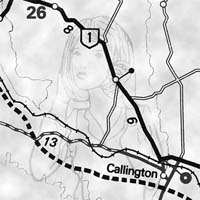 The set of pieces that make up Callington began with the vision of an image I couldn’t make real. For some years now I’ve been interested in using means of visual processing to make music, with limited success. In this case, I’d been imagining the music of a spectrogram, itself made up of a montage of spectrograms of different musics, laid over each other with continuously varying degrees of transparency.
Not too surprisingly, my attempts to make music from such an image have so far all been unsuccessful. The few image-to-sound converters I have worked with interpret spectrographic information (intensity of frequency over time) in ways that make an actual spectrogram sound clumsy and dull. As an alternative, I patched together a system of filters and mixers to simulate the sort of effect I imagined the spectrograms would create.
The entirety of Callington is based upon five source sounds, each of a similar nature and roughly similar length. Only four of these source elements are used in any one piece. For each subsequent piece (Callington 2A, Callington 3A, etc) one of the sources is substituted, until all five possible combinations of four sources are used. Each piece is thus designed to differ as little as possible from its neighbours.
Each subsequent iteration of the source material (Callington 1B, Callington 1C, etc) is an imitation of its predecessor, using a different technological approach to mimic the previous section as best it can (full details here). Each section is thus a failed attempt to maintain a uniform identity throughout the entire piece.
The many small differences can be said to be caused by ‘mishearings’ as the music is translated from one format to another. This consistency is carried over into all the pieces, each sharing three of its four source materials with the others. The main noticeable difference between sections is in timbre. The outer sections have complex timbres and dynamics, whereas the inner sections reduce this material to a uniform timbral simplicity.
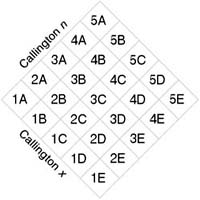 The twenty-five sections can be played individually or juxtaposed in a variety of ways. In particular, two ways present themselves as obvious arrangements. In Callington x, each successive iteration of the same source material is played (e.g. Callington 1A, 1B, 1C, 1D, 1E). The other, Callington n, groups common treatments of the different sets of material (e.g. Callington 1A, 2A, 3A, 4A, 5A). Other permutations, of course, are possible.
The multi-movement versions can be played from these m3u playlists:
Callington 1 Callington A
Callington 2 Callington B
Callington 3 Callington C
Callington 4 Callington D
Callington 5 Callington E
The entire set, along with detailed composition notes, can be downloaded from its page on the music website, or heard in streaming audio at The Listening Room.

Filed under: Music by Ben.H
No Comments »
Please Mister Please
Thursday 6 August 2009
Pavement, “Pueblo” (1995).
(3’25”, 4.38 MB, mp3)
(3’25”, 4.38 MB, mp3)
Filed under: Please Mister Please by Ben.H
No Comments »
No wonder London’s public transport is so unreliable.
Thursday 6 August 2009

All this time, and I never realised that the buses were made of cardboard.
Filed under: London, Stupidity by Ben.H
No Comments »
Filler By Proxy LXXII: You Passed Too Bad Gas!
Monday 3 August 2009

Hooray! StSanders, the genius who gave the world so many excellent shreds of the world’s finest guitar heroes, has raised the stakes in a new video that’s gonna make the people sway and rock and clap their hands to the beat. Hooray!
Because YouTube kept taking them down, the complete gallery of shreds can now be found here.
Filed under: Filler By Proxy, Music, Stupidity by Ben.H
No Comments »
Filler By Proxy LXXI: So It’s Come To This, A Post About Cats
Sunday 2 August 2009
These videos have been doing the rounds, but I feel obliged to link to them because of my obsession with reworking Schoenberg’s Opus 11. An exemplar of how the internet wastes your time, Cory Arcangel has produced a performance of Schoenberg’s Three Piano Pieces on his website. The angle? It’s made up entirely of snippets of YouTube videos of cats on piano keyboards.
It’s not quite an infinite number of monkeys, but…
first I downloaded every video of a cat playing piano I could find on Youtube. I ended up with about 170 videos. Then I extracted the audio from each, pasted these files end to end, and then pasted this huge file onto the end of an audio file of Glenn Gould playing op11. I loaded this file into Comparisonics. Comparisonics, a strange free program I found while surfing one night…
Full details, and the videos, on his website.
Filed under: Filler By Proxy, Music by Ben.H
No Comments »
The Composer and His Audience
Friday 31 July 2009
I was just listening to an old radio broadcast commemorating the death of Harry Partch in 1974, and learned that he shared a particular trait with another eccentric composer, Kaikhosru Shapurji Sorabji. Sorabji lived in a castle in Dorset, with a sign on the gate reading:
Visitors Unwelcome.
Roman Catholic Nuns in Full Habit May Enter Without An Appointment.
Partch kept an equal yet opposite sign on his front door:
Occupant is a Heathen Chinee. Missionaries at this door will face the Dowager Empress and another Boxer Rebellion. Please do not disturb 11.00 am to 2.00 pm. Missionaries – never.
Filed under: Music by Ben.H
No Comments »
Please Mister Please
Wednesday 29 July 2009
Gloria Coates, String Quartet No.2 (1972). Kreutzer Quartet.
(6’29”, 5.55 MB, mp3)
(6’29”, 5.55 MB, mp3)
Filed under: Please Mister Please by Ben.H
No Comments »
I Am Cleaning Up Some Scans Of Old Slides
Wednesday 29 July 2009


He’s got a million of them
Tuesday 28 July 2009
Among the memorials and tributes to Merce Cunningham, I’ve seen yet another pithy quote from Morton Feldman which I didn’t know about before. I don’t know where this one comes from, but it’s in a description of the unusual way Cunningham often worked with artists and composers he knew well.
His works may have a score, but it’s made separately from the choreography; the same can go for the set. Elements meant to work together in performance are created independently by a cohort of trusted collaborators. Composer Morton Feldman explained the process like this: “Suppose your daughter is getting married and her wedding dress won’t be ready until the morning of the wedding, but it’s by Dior.”
Filed under: Music by Ben.H
No Comments »
Merce Cunningham
Monday 27 July 2009
There’s a rumor Merce’ll stop. Ten years ago, London critic said he was too old. He himself says he’s just getting a running start. Annalie Newman says he’s like wine: he improves with age.
— John Cage, “Where Are We Eating? and What Are We Eating? (Thirty-eight Variations on a Theme by Alison Knowles)”, 1975.
If I’m asked to name the greatest gigs I’ve been to, the first one that comes to mind is the performance of Merce Cunningham’s Ocean at the Roundhouse in 2006. Now I’m kicking myself for not going out of my way to see more of Cunningham’s choreography – it’s highly unlikely the time it would have taken was better spent.
Merce Cunningham died yesterday at the age of ninety. As a music snob I’ve always thought of him first as John Cage’s partner, but even then neither Cage’s life or work can be considered independently of Cunningham’s. It seems like there are so few artists of their kind these days, who are so truly fearless and adventurous, and less interested in grandstanding over how “provocative” and “radical” they claim themselves to be.
Just last month Cunningham announced his plans to preserve the legacy of his dance company and his work. Hopefully his death did not come too soon for these plans to be carried out.
Filed under: Music by Ben.H
No Comments »
Stockhausen: The Cosmic Conspiracy
Friday 24 July 2009
What about my symphony No. 3? I forgot to write…simple, like that–therefore recently, I commissioned Ken Friedman to write my Symphony No. 3.
— Nam June Paik, “My Ten Symphonies” in Source: Music of the Avant Garde, Number 11, 1973/74.
___________

My BELOW-LEFT Symphony was here.
Someone must have torn it off.
Now will no one ever hear it?
Stockhausen
March 15th 2003
___________
Someone must have torn it off.
Now will no one ever hear it?
Stockhausen
March 15th 2003
___________

Sigmar Polke, “Higher beings ordered: paint the right upper corner black!”, 1969.
___________
For beings from the planets of the Sirius system, “everything is music, or the art of co-ordination and harmony of vibrations. . . . The art is very highly developed there, and every composition on Sirius is related to the rhythms of nature . . . the seasons, the rhythms of the stars.”
— Karlheinz Stockhausen, Towards a Cosmic Music, 1989.
Other snippets of vitally important information then came to me through a couple of revelatory dreams. Crazy dreams, from which it emerged that not only did I come from Sirius itself, but that, in fact, I completed my musical education there.
— Karlheinz Stockhausen, in Mya Tannenbaum, Conversations with Stockhausen, 1987.
___________
Ken Friedman gladly wrote Nam June Paik’s 3rd Symphony, but reported that the score was lost at the rehearsal in Saugus, during the San Fernando earthquake of 1971. The earthquake itself constituted the finale of the piece.
Filed under: Music by Ben.H
No Comments »
The Strange Case of Dr. Chicago
Thursday 23 July 2009

One thing I forgot I wanted to talk about when mentioning Alvin Lucier last month was his starring role in George Manupelli’s Dr. Chicago trilogy*. I first heard about these films only last year, over at Renewable Music, where Daniel Wolf suggests that Lucier is the composer with the most prominent film career.
(Possible runner up, Erik Satie in Entr’acte. John Cage makes a blink-and-you’ll-miss-it appearance in Maya Deren’s At Land, and almost had a part in La Dolce Vita, but didn’t.)
The thing that reminded me was Kyle Gann has just posted about these films, and mentions that Robert Ashley made the soundtracks for them. That’s something else I didn’t know before but do now.
I’ve only seen short excerpts from each film, on YouTube and Manupelli’s website. They look like a mixture of cinéma vérité, awkward improvisation, and flights of deadpan absurdity. A lot of that last element comes from Lucier’s portrayal of the nefarious Dr. Chicago as he flees with his meagre entourage across the United States into Mexico. His Chicago combines the feckless insouciance of Nick Riviera with the calculating amorality of Burroughs’ Dr. Benway deprived of a budget.
* “There was also a fourth film, Dr. Chicago Goes to Sweden, but Manupelli got pissed off at a film festival in Toronto and drove around town with the only copy of the film unreeling out the window of his car.”
Filed under: Film, Music by Ben.H
No Comments »
Please Mister Please
Tuesday 21 July 2009
Filed under: Please Mister Please by Ben.H
No Comments »
When Pianos Ruled The World
Thursday 16 July 2009
Now that I’m the proud custodian of a piano, I’m starting to notice more pianophernalia in my neighbourhood. Down the street a way is this fine old advertisement for Boyd Pianos, one of many defunct piano companies, from the days when piano merchants hawked their wares on walls and billboards.

The Ghost Signs blog has a more thorough analysis of this rather unusual sign, and comments:
In addition to their main piano business Boyd also had a sideline in theatre box office ticket sales. Perhaps this relates in some way to them supplying pianos to theatres and this being a natural bolt on service they could offer to the theatres and the public?
When I saw the phrase “Box office for all theatres”, I thought it was mid-century adspeak meaning that theatre owners could pack in the punters if they have a piano; but maybe that turn of phrase was too American to make sense to the English.
 There’s another, less elaborate wall advertisement for a piano store in Willesden Green. This became the inspiration for my composition St Paul’s Pianos.
Filed under: Music by Ben.H
2 Comments »
All Kinds of Awesome: Ashley, Maxfield, Riley, and Young
Tuesday 14 July 2009
I’ve probably said it before somewhere, but the Other Minds Archive is an invaluable treasure trove of recordings of the musical avant-garde for the past 50 years or so; and it keeps on getting better. I was stoked when I checked the updates today to find they’ve just uploaded:
- Terry Riley performing his Two Piano Pieces (1958-59) – this is Riley before he became the hippieish minimalist of In C, A Rainbow in Curved Air etc.
- Three pieces by Richard Maxfield: Amazing Grace (1960), Structures for 10 wind instruments (1951), and Piano Sonata No.2 (1949). Maxfield was a brilliant composer who has fallen into obscurity since his early death. Best known for his electronic music, his body of work for conventional instruments has gone largely unheard.
- Early music by Robert Ashley: The Fourth of July (1960) and Heat (1961) for tape, and the piano sonata Christopher Columbus crosses to the New World in the Niña, the Pinta and the Santa Maria using only dead reckoning and a crude astrolabe (1959-61). Ashley’s reputation rests on his extraordinary series of operas begun in the late 1960s, so this is a rare glimpse into his early work.
- La Monte Young’s B Flat Dorian Blues (1963) – a chunk of Young playing sopranino sax, backed by Tony Conrad, John Cale, Angus MacLise, and Marian Zazeela. This program also includes one half each of the Black Record and Dream House albums. Somewhere in the Archive is a radio broadcast of the rest of the Black Record.
Young’s music is notoriously hard to find, and apart from Amazing Grace I don’t think any of the pieces by the other composers has been made available anywhere before. So yeah, I’m stoked.
More details about these recordings, and access to other materials, can be found at radiOM.org.