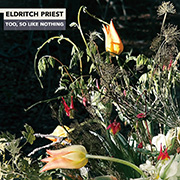
 Eldritch Priest: Too, So Like Nothing [Halocline Trance]. Three piano pieces by Eldritch Priest, played by someone else. …soot?aporia from 2005 begins with a stutter and seems to be breaking down before it’s even begun, and the fleeting, fragmentary nature of the piece carries on from there, finding the most unlikely continuity out of the abrupt positioning of stumbling chord sequences, delicate arpeggios and unequal phrases of unexpected tenderness. The someone else playing is Roger Admiral, who interprets EP’s jostling, angular movements with supreme felicity and tact. All three pieces share a louche, hazy nocturnality under Admiral’s hands as he finds the undercurrent of cool late-night jazz beneath the surface agitation. In …soot?aporia he sounds like Milton Babbitt playing a cocktail lounge: the textures are more relaxed but shares the phrasing that seems erratic disguises a canny understanding of the flow of time against rhythm. nape…wrinkle…linger is a shorter work from 2002, more open in its texture and so more tractable for the listener’s sense of direction. Admiral plays it all with a loving touch and delicious sensuality; he insinuates jazz impressions out of supple technique, even more than the compunded harmonies do. The title piece is a later work from 2020: the same tricksy energy is less obvious, but still present in a more refined form. On the album, it seems to find a balance between the two preceding tracks, and Admiral still manages to rhapsodise at fascinating length upon recondite musical language.
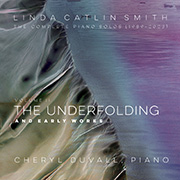 Linda Catlin Smith: The Complete Piano Solos (1989-2023), Volume 2: The Underfolding and Early Works [Redshift]. After Volume 1, dedicated to the recent, hour-long The Plains, Cheryl Duvall turns her attention to Smith’s earlier pieces: The Underfolding is from 2001 and the remaining eight pieces are short works from the last century. These are generally less well-represented on record than her later stuff, so to hear a collection of them gathered together affords a glimpse into a world of inspirations and influences which have shaped her present work. Some time ago, it took me a while to get a bead on where Smith was coming from; as heard in this collection, she spent the Nineties trying to find a clarity of language, which I had first assumed was a pose of folksy simplicity. That clarity is produced in different ways: Poire is deconstructed Satie, Iceberg isolates rising arpeggios from one of Bach’s Goldberg Variations. The earliest work here is Zart, a homage to Feldman by way of Schoenberg, making use of touch, attack and decay to dwell upon clotted harmonies; the surprising variety of dynamics and cut-off of resonances also appear in 1990’s Music For John Cage, clarified both in technique and harmonic language. Duvall plays these pieces with a directness, even bluntness, the stark dynamics and clean attacks giving it an unvarnished sound – that may seem like I’m gearing up to use ‘folksy’ again but that doesn’t apply here. Duvall’s directness takes on the appearance of attempting to explicate Smith’s various methods, but in fact conceals questions of compositional technique behind the need to show the unity of a common goal which unites these works. 1999’s For Udo Kasemets is another tribute piece, where Smith honours the dedicatee by adopting a system of permutations and yet she and Duvall produce a piece which sounds warm and intuitive; the earlier Bloom is also dedicated to Kasemets and shares qualities with Smith’s pieces for Feldman and Cage. In all of this experimentation, it’s really only The Surroundings from 1995 which left me cold, sounding a little too stark and formulaic in this company. The key work to understanding Smith’s later music is The View From Here, a 1992 composition that eschews direct references, systems and intellectual querying to instead rely on personal experience, not as a means of self-expression but as a means of contemplation. The assimilation of all these tendencies can be heard in The Underfolding, which slowly roils and churns through successions of dense chords for 22 minutes, maintaining an internal calm even as it never reaches a point of balance or stability. At times the pace slows or pauses, lingering on a particular sonority before continuing as before. The tension and relaxation in the piece feels like an organic process, yet still leaves the listener with the memory that the piece was more difficult and disturbing than it seemed at the time. Duvall’s head-on approach comes through here, neither overstating nor soft-pedalling the confrontations contained within the piece.
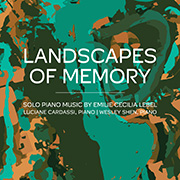 Emilie Cecilia LeBel: Landscapes of Memory [Redshift]. I described LeBel’s earlier field studies as admirably spare in places but susceptible to moments of fussiness. The two halfhourish pieces on Landscapes of Memory are both composed for piano with e-bow drone. Ghost geography, played by Wesley Shen, focuses on a figure which articulates a repeated chord, followed by a high single note. This gets elaborated upon, but gently. The bowed piano string acts as pedal point and sounding board for the decaying chords and pitches, giving additional colour to each iteration of the chords. Later, there is a dramatic flourish, characteristic of LeBel, with loud arpeggiated chords and then some hushed inversions of the opening motif. The dramatic effects sought after by the composer are based in sonority more than any direct theatrical reference and so appear more focused and coherent than in the previous collection I’ve heard. Pale forms in uncommon light was composed a year later (2023) and is played by Luciane Cardassi. It’s equally slow and deliberate, as you would expect in making the overtones heard against the drone. The bowed string is a higher pitch and the figures played by Cardassi are a bit less reticent, allowing a hint of chord progressions, cadences or melodic fragments to appear; as such, this piece is in five named sections which explore each of the immplicit facets a little further. They’re not the easiest pair of compositions to get along with, each being very sombre throughout, but they are two serious attempts to make expressive music out of psychoacoustic phenomena, without resorting to cheap drama.