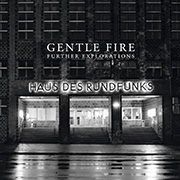
 Gentle Fire: Further Explorations [Paradigm Discs]. I called Explorations, the first Paradigm issue of Gentle Fire recordings, an example of all that is best in archival box sets, combining historical interest and importance with a compelling and exciting listening experience. Further Explorations extends the previous collection with a single disc of performances recorded by German radio in 1973 and 1974. The group, musician/composers Richard Bernas, Hugh Davies, Graham Hearn, Stuart Jones and Michael Robinson, play a combination of conventional instruments, electronics and home-made instruments. Yeah, they’re British but they also worked closely with Stockhausen (Sternklang) and so their ways of making music are an intriguing hybrid of the empiricist, do-it-yourself methods espoused by the Scratch Orchestra and the abstract or mystical idealism that directed improvisations under the European avant-garde. This permits them more than a single dimension to their playing, allowing for interpretations of these very open scores that question and play with the assumptions upon which these compositions operate, whether expecting rigour or anarchy, high seriousness or sly irreverence: there’s a bit of everything in the way they tackle these pieces, without resorting to making the vehicles for their own ideas. The new face amongst the composers here is the late Erhard Grosskopf, whose Looping 1 begins the album. Composed for the ensemble, the piece is built out of playback of tape loops of filtered electronic tones and speech, which the musicians must match with suitable harmonic relationships. This gives it an unusual consistency, as though the piece is all straight-through playback, with a fixed, minimal texture. The voice fragments are electronically treated and distorted, gradually becoming clearer. The text is, almost inevitably, by Mao Zedong, as period-perfect as a Raleigh Chopper.
Graham Hearn’s Art Must Be Fed sets the musicians randomly-selected tasks to perform, either to play something “badly” or sing, hum or whistle some remembered music from elsewhere. The wonky, humorous nature of the piece is tempered and made more poignant by the gentle pacing of the work, guided by a slow, repeating piano phrase that resembles the beginning of a Satie piece that never gets going, enhancing the atmosphere of melancholy absurdist theatre. Their rendition of Christian Wolff’s perennial Edges is a different performance from the London EMI recording from a few years earlier and shows the group’s interpretative chops in a more conventional light. While very different, both pieces require their performers to make decisions on the fly, where the given instructions are unstable, flexing back and forth between acting as a waypoint and a limit. The two group compositions are striking in the way they take a monolithic premise and then build variations out of it. Group Composition III is made by the ensemble as it goes along, each musician working on a gong tree built by Michael Robinson, using methods roughly similar to those in Stockhausen’s Mikrophonie I. The surfaces are worked over with various mallets and microphones to create an extended abstraction of resonant metallic sounds shaded by reverberation and filtered noise. It’s with this piece that you realise how much modern free composition and improv is still modelled on these performances from over half a century ago. In Music Project V-II, the numbers refer to intervals in the traditional diatonic scale; in short, it’s a pop vamp stretched and stripped to its barest essentials of hovering between dissonance and resolution. Like an early, unexplored path of minimal composition, it takes a simple idea and transforms it by taking it in an unexpected direction, finding strange sounds in a confined harmonic space. The conception of the piece, as something so open and irreducible as to defy authorship, produces something that sounds like something quite different from any other possibly related works from this time.
The sound quality is as good as you would expect from 1970s West German radio production, perhaps a little dry in places, which was the style at the time for presenting new music. None of these recordings have had a legitimate commercial release before now, so this will sound better than that untagged MP3 you downloaded from some blog years ago. The accompanying notes and booklet are again excellent and informative, including the original programme notes from the concerts and a radio talk given at the time by Michael Robinson, in whose memory this album is dedicated. It’s another step towards recovering a past which is still felt today but is not yet fully recognised.