Sachiko M: Sounds From M [Party Perfect!!!]. The latest two Party Perfect releases return to their abrasive and bloody-minded roots. I heard Sachiko M play live in Melbourne back in (checks sleeve notes for this album) 2001? Gosh. She had a sampler with nothing in the memory and somehow got the high-pitched sine wave that emerged from it to move about a bit, after a fashion. Since then, I have never actively kept tabs on her career but I had always hoped that she was still doing more or less the same thing, somehow. It is therefore a pleasure to say that Sounds From M proves the last twenty-five years have neither softened nor diluted her end-point aesthetic. The piece, recorded one day in 2024, falls into seven nested movements of precisely five minutes each, forming a kind of palindrome. A high-pitched sine wave pierces the air, ducking and diving depending on where your head is in relation to your speakers. Pulses of digital switching create pops and crackles at various frequencies; the sine wave returns, but higher pitched and out of phase, creating dead spots in your room. In the central section the sine wave pushes upwards against my threshhold of audibility, becoming frangible with more pulsing. Then it recapitulates on each action in reverse. Digital pops aside, it’s all mastered at a very low level. There’s a level of commitment here, beyond experimentation, to create sonic objects that evoke a physical presence while seeking an absolute minimum of texture and colour.
 Luciano Maggiore: tordo + uah + cick [Party Perfect!!!]. It’s Luciano Maggiore, so as is the custom I must admit I have no idea what is going on. This time, however, he is unwilling to help me, other than to say he composed and performed this piece a small number of times around Europe in 2024. I think there’s a sampler invovled here too, maybe with CD players, Walkmans, stuff like that. Track 1 was recorded live in London and has lots of low-level twittering and the occasional chirp on a farily regular basis. It goes for over half an hour so you know he’s committed and you’ll have to start paying attention sooner or later, but what that attention will get you is something never really answered. He’s confronting you but giving you the freedom to be unaffected by it; a rare commodity in modern art, to accommodate indifference. Maggiore makes insistent but neutral sounds, refuses to elaborate, then on track 2 goes and does it all over again in Berlin. Hilariously, the two sample extracts on the Bandcamp page are each thirty seconds long, because really anything more is superfluous. You can also get it on cassette, so that the low-level twittering is submerged in hiss.
Filed under: Music, Reviews by Ben.H
Tags: Luciano Maggiore, Sachiko M
No Comments »
Repetition and novelty
Saturday 21 February 2026
 Andrew Greenwald: for Distractfold [dFolds]. A couple of new interpretations of Andrew Greenwald pieces which have previously appeared on a Kairos CD, with a newer ensemble work. Greenwald credits Distractfold as being part of “the beginning of a metamorphosis in my composing” and this half-hour programme gives some insights why. The brief solo for electric guitar A Thing Made Whole VI is played here by Daniel Brew at a more relaxed pace than on Kairos, using a “bifurcated electric guitar”. This is not as painful as it sounds; it’s just that the guitar is miked up at both ends to capture the small sounds produced above and below the fingers to be heard in close-up, spatialized detail. Instrumental colour thus becomes a greater feature in this performance. Greenwald’s colours are complex but take on additional brightness and vividness in these recordings, as can be heard in the Distractfold version of the ensemble piece A Thing Made Whole IV which even breaks into fleeting moments of unexpected radiance and stilness amongst the thicket of contested sounds. The newer work, (Coda) A Thing Made Whole for bass clarinet, violin, cello, and acoustic guitar, signals a change in approach, coming after Greenwald felt he his current approach to composition had lead to a dead end. (Coda) may turn out to be a transitional work or the start of a new phase: the material is noticeably “poorer”, making do with less and with less overt focus on technique, finding ways to still produce surprising blends of timbre and creating variety out of coloration and texture as the music’s substance. This suits the Distractfold musicians down to the ground, as they find moments of beauty in the unlikeliest places. The album is bolstered by a phone recording of the rehearsal and a copy of the score in full, if you want to get serious about finding what makes this music tick.
 Jürg Frey: Composer, alone [elsewhere]. A few years back Reinier van Houdt presented a three-disc set of solo piano pieces by Jürg Frey. Composer, alone is another triple helping of piano works from 1990 to 2024. The sequencing is out of chronological order, allowing the older, more notorious pieces to appear interleaved with his more congenial compositions of late. The earliest work is Invention, a skeletal drawing of ascending scales that barely elaborate into a slight framework for a piano piece, with van Houdt giving just enough tension to hold things in place. Klavierstücke 1 and 2 are both present, with their obsessive repetitions acting as prolongation and obstruction to each piece’s progress, caught in a paradox of finding no need to go further as yet, while aware that this impassivity is itself a provocation to the listener. The lengthy journey of Pianist, alone (1) is at the centre of this collection. In comparison of these works as performed by van Houdt compared to the earlier recordings I’ve heard by R. Andrew Lee, I’ll go back to my previous observation that van Houdt’s interpretation give greater prominence to each piece’s overall shape, over the succession of details that are encountered from one moment to the next. The two newest works, Composer, alone (1) and Composer, alone (2), open and close the album, inviting comparison with the earlier pair of Pianist, alones. More varied in their introspections and less stringent in their reflections, each of these substantial works suggests a kind of subjective retrospective, including echoes of the earlier works softened and transformed with time. Van Houdt’s interpretative approach here meshes particularly well with Frey’s late style.
Filed under: Music, Reviews by Ben.H
Tags: Andrew Greenwald, Jürg Frey
No Comments »
Old News In Brief
Sunday 8 February 2026
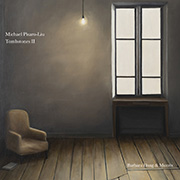 Michael Pisaro-Liu: Tombstones II [Circum-Disc]. Four years ago, Barbara Dang and the ensemble Muzzix put out a recording of selections from Pisaro-Liu’s songbook Tombstones: a set of essential distillations of song-form. Here are the rest of them, again sung by Maryline Pruvost. Again, the material and the interpretative approach can be likened to gemstones under a magnifying glass. The remaining pieces in the cycle allow for a sort of interlude to appear at times in this batch: “The outside of everything” focuses on long-held tones and beating frequencies, the stop-start of “Rattle” is intuitive but impersonal – a good analogy for the entire set. Around the middle of the album “Time may” brings everything almost to a standstill before the music becomes a little more expansive again, with the final work played here “The darkness is falling” recalling Cage’s Experiences No. 2, sung well.
 Niels Lyhne Løkkegaard, Michael Pisaro-Liu: Fata Morgana [Edition Wandelweiser]. I get the idea; but you can’t listen to an idea. First part is Løkkegaard outside somewhere idly tootling a recorder for a good while, with wind blowing into the mic now and then to remind you this is all spontaneous and artless: life with the boring bits left in. Second part is same again with fidgety electronic schmutz overlaid by Pisaro-Liu. There’s too much fiddling about for its own sake: the sounds aren’t interesting enough to reward attention but also too intrusive to be sufficently uninteresting that your attentiveness open outwards. Just looked at the cover and remembered it’s Wandelweiser.
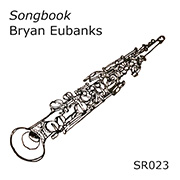 Bryan Eubanks: Songbook [Sacred Realism]. I can’t imagine ever getting enthusiastic for an album of soprano saxophone solos, even if it’s only about half an hour long. Eubanks plays horn: there’s electronic schmutz here too, but subtle. Is it necessary? I guess, in that the soft crunch and distorted thuds that underline the more forceful notes don’t so much punctuate the solos and ground them, pinning each one down to a flattened, cubist perspective. Eubanks’ expressive lyricism on display here is similarly cubist in its muted palettes and calm angularity, melodic lines reminiscent of Brant or Wolpe at their most serene (sorry, I’m devoid of suitable jazz references). I find it all kind of ugly but maybe your ears work better than mine for this stuff.
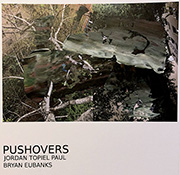 Jordan Topiel Paul & Bryan Eubanks: Pushovers [Sacred Realism]. Eubanks is back to pure electronics here, applying a modular synth to Topiel Paul on snare drum. That’s not the most appetizing combination on paper either, but the two of them really pull out the stops to make it work, Paul mining the amplified drum for a surprisingly deep array of textures and timbres, using it as a source of sound more than rhythm, with smart and sympathetic treatments by Eubanks. At times the synth reworking of the drum sounds like real-time tape manipulations, giving both acoustic and electronic musicians the feel and flow of live performance – I’m guessing these are studio improvisations. They actually do achieve the “ambiguous textural and rhythmic universe where synthetic and acoustic meet” as described in the sleeve notes; that doesn’t happen every day. Each of the four tracks, ranging from five to twenty-five minutes in length, combine a dramatic sweep with attention to detail that make listening to it at home as much fun as listening to it half-cut in a noisy art club.
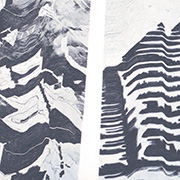 Cosimo Fiaschi: unveil / unfold [Insub]. I can’t imagine ever getting enthusiastic for an album of soprano saxophone solos, even if it’s only about half an hour long. I can make exceptions though, and the two pieces Fiaschi recorded here (both on the same day, it seems) hide the source of the instrument by making each piece a study in tone – prolonged notes approach what appears to be pure, uncoloured pitch, until an added overtone or small change in breath reveals the hidden coloration. The sounds and the methods are electronic, even though both are achieved acoustically, through human means. Never quite drone, never quite ambient, Fiaschi’s pair of works carve out space into a clean acoustic shape which leaves an immediate impression that becomes more intriguing with prolonged examination.