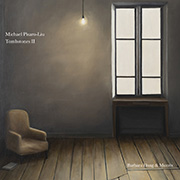
 Michael Pisaro-Liu: Tombstones II [Circum-Disc]. Four years ago, Barbara Dang and the ensemble Muzzix put out a recording of selections from Pisaro-Liu’s songbook Tombstones: a set of essential distillations of song-form. Here are the rest of them, again sung by Maryline Pruvost. Again, the material and the interpretative approach can be likened to gemstones under a magnifying glass. The remaining pieces in the cycle allow for a sort of interlude to appear at times in this batch: “The outside of everything” focuses on long-held tones and beating frequencies, the stop-start of “Rattle” is intuitive but impersonal – a good analogy for the entire set. Around the middle of the album “Time may” brings everything almost to a standstill before the music becomes a little more expansive again, with the final work played here “The darkness is falling” recalling Cage’s Experiences No. 2, sung well.
 Niels Lyhne Løkkegaard, Michael Pisaro-Liu: Fata Morgana [Edition Wandelweiser]. I get the idea; but you can’t listen to an idea. First part is Løkkegaard outside somewhere idly tootling a recorder for a good while, with wind blowing into the mic now and then to remind you this is all spontaneous and artless: life with the boring bits left in. Second part is same again with fidgety electronic schmutz overlaid by Pisaro-Liu. There’s too much fiddling about for its own sake: the sounds aren’t interesting enough to reward attention but also too intrusive to be sufficently uninteresting that your attentiveness open outwards. Just looked at the cover and remembered it’s Wandelweiser.
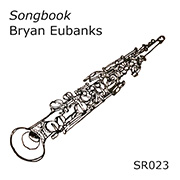 Bryan Eubanks: Songbook [Sacred Realism]. I can’t imagine ever getting enthusiastic for an album of soprano saxophone solos, even if it’s only about half an hour long. Eubanks plays horn: there’s electronic schmutz here too, but subtle. Is it necessary? I guess, in that the soft crunch and distorted thuds that underline the more forceful notes don’t so much punctuate the solos and ground them, pinning each one down to a flattened, cubist perspective. Eubanks’ expressive lyricism on display here is similarly cubist in its muted palettes and calm angularity, melodic lines reminiscent of Brant or Wolpe at their most serene (sorry, I’m devoid of suitable jazz references). I find it all kind of ugly but maybe your ears work better than mine for this stuff.
 Jordan Topiel Paul & Bryan Eubanks: Pushovers [Sacred Realism]. Eubanks is back to pure electronics here, applying a modular synth to Topiel Paul on snare drum. That’s not the most appetizing combination on paper either, but the two of them really pull out the stops to make it work, Paul mining the amplified drum for a surprisingly deep array of textures and timbres, using it as a source of sound more than rhythm, with smart and sympathetic treatments by Eubanks. At times the synth reworking of the drum sounds like real-time tape manipulations, giving both acoustic and electronic musicians the feel and flow of live performance – I’m guessing these are studio improvisations. They actually do achieve the “ambiguous textural and rhythmic universe where synthetic and acoustic meet” as described in the sleeve notes; that doesn’t happen every day. Each of the four tracks, ranging from five to twenty-five minutes in length, combine a dramatic sweep with attention to detail that make listening to it at home as much fun as listening to it half-cut in a noisy art club.
 Cosimo Fiaschi: unveil / unfold [Insub]. I can’t imagine ever getting enthusiastic for an album of soprano saxophone solos, even if it’s only about half an hour long. I can make exceptions though, and the two pieces Fiaschi recorded here (both on the same day, it seems) hide the source of the instrument by making each piece a study in tone – prolonged notes approach what appears to be pure, uncoloured pitch, until an added overtone or small change in breath reveals the hidden coloration. The sounds and the methods are electronic, even though both are achieved acoustically, through human means. Never quite drone, never quite ambient, Fiaschi’s pair of works carve out space into a clean acoustic shape which leaves an immediate impression that becomes more intriguing with prolonged examination.
Filed under: Music, Reviews by Ben.H
Tags: Bryan Eubanks, Cosimo Fiaschi, Jordan Topiel Paul, Michael Pisaro-Liu, Niels Lyhne Løkkegaard
1 Comment »
Listening In (I): Mara Winter, Niels Lyhne Løkkegaard
Sunday 4 August 2024
 Do we even know what we mean anymore when we talk about drones? I seem to remember a definition given by Robert Ashley many years ago which turned away from descriptions of surface appearance to consider the internal mechanism; the exact details have slipped my mind and I’m not going to look them up now but the idea that stuck in my mind is that drone is a form of music in which the passage of time is experienced on its own terms. In popular and artsy genres, working with the awareness of this concept appear to be broadly assimilated into most modern musical thinking – you can work with it or against it, but it’s there.
Does it make sense to call the three pieces in Mara Winter’s The Ear And The Eye: Music For Four Renaissance Flutes (self-released) drones? Heard casually, each of the three rebuffs the ear with long tones held in apparent stasis. Winter and her colleagues in the Phaedrus quartet make the most of the thickened tones of their Renaissance flutes. She has done a similar thing before with Rise, follow, her duet for contrabass Renaissance flutes, but where the earlier work made use of resonant space and more overt interactions between the performers, the three new pieces use a more thoroughly research and composed approach. Closer listening reveals each piece to be a complex essay in timbre related to pitch and dynamics: Hyacinth harmonises its way through consonances and microtonal dissonances through overlapping pitches which highlight the difference in timbre between each instrument. Incarnadine moves the emphasis away from change in pitch to change in dynamics, exploiting the variations in colouration available without needing to move between registers. Smaragd focuses on sonority, expanding and contracting the pitch space between the instruments to reveal variances in intonation and clarity or complexity of tone. What may be taken for drones are really being used as a vehicle to express the flutes’ relationship between pitch and timbre, a concept made audible. Winter composed her pieces based on “historical sources which described color proportions analogous to the ratios of tonal musical intervals” and created a notation that used watercolours to convey variances in intonation. The colour analogy is studied here and applied to practice to produce ever more sophisticated manifestations of the initially observed phenomenon.
 There’s a similar approach to material in Niels Lyhne Løkkegaard’s Colliding Bubbles (surface tension and release), a composition for string and harmonica quartet. Again, a drone, but in service of a more elaborate conceit. Løkkegaard draws upon the behaviours of bubbles in collision, how the forces at work may cause fluctuations in surface tension, or ruptures in which tension is released. That sounds like a principle behind a Xenakis piece, but Løkkegaard’s method and material are very different. It may not even be a method as such, more of a philosophical or poetic guide without seeking a direct analogy in what or how the musicians play; despite this, however, the piece expresses its principle through fundamental activity rather than through interpretation. String quartet and harmonica quartet are to be, one and the same: here, Quatuor Bozzini follow the composer’s instructions to play their usual instruments while also playing harmonicas. Both involve slow, constant tones, simultaneous throughout, presenting a challenge for the musicians. The Bozzinis can maintain diaphanous harmonies indefinitely, sure, but those even tones become more fraught when they’re also required to blow with a similar lightness. Despite the references to bursting bubbles, there’s nothing explosive here, just the constant unsteady and fragile balance between pitch and timbre as the colouration of the two sets of instruments clash and the pitch and force of each note wavers minutely. The piece begins in the high register, slowly descending somewhat lower before finding a sort of resolution, with the transition to a lower register bringing its own challenges in maintaining tone, even as the pitch seems to settle. Both here and with the Winter album, there’s a tension at work which drives the music, with a seemingly implacable surface that reveals itself to be made up of many softer strokes in combination.