 Manja Ristić: lights shimmered like whispers in the depths of the trees; Miska Lamberg: stillness in their isolation; Dylan Kerr: Pas de la Demi-Lune; Michael Pisaro-Liu: anabasis (1) [Sawyer Spaces]. Sawyer Spaces is a sub-label of Sawyer Editions, focused on soundscapes, pretty much: their albums are either field recordings, or make use of field recordings, or are otherwise defined by the particular location in which they were created or recorded. Ristić presents a pair of montages, made up of recordings made around Portugal, Austria and Croatia. There’s a lot of autobiographical and genealogical subtext behind both pieces, but Ristić seeks to convey the meaning through ambience without resorting to allusion or narrative. The open-air sounds are deep and nuanced without being overtly suggestive, which also lets you work out for yourself that you’re hearing a composition and not raw documentation; you feel validated when the instrumental sounds appear. The thing about ambience is that you really need to be in the place itself to be certain you truly feel anything that place has to tell you. With music, the best you can do is take it on trust and sympathise with whatever the musician is trying to convey. Also, any time I heard cicadas I assume it’s a reference to Presque rien. The Lamberg also presents two pieces, or one piece in two movements. The sounds are those of urban ambient hum, the constant nagging drone of traffic and air conditioning (If only! gasps the European audience). Both tracks generate a negative presence through layered industrialised white noise, not pleasant but not actively unpleasant, just intrusive. Lamberg recommends playing it soft (I didn’t) so it presumably works as a compounding, or confounding effect on the noise you’re already dealing with, but I’m not sure if the intended effect is amelioration or alienation. I played both these albums on a sunny afternoon and dozed off to both.
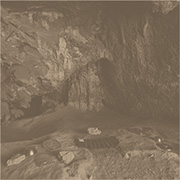
Kerr’s Pas de la Demi-Lune is a different deal; composed for a performance in a cave, and recorded here in a performance in a different cave, this is a straight-up musical piece, albeit one entirely shaped by environment. Kerr plays computer-generated sine tones that build up high, complex harmonics by following lattice processes devised by James Tenney. Transducers are attached to metal bowls and trays, causing them to vibrate and rattle sympathetically with the sine tones. Organ pipes are blown, selected and tuned to the frequencies created from the harmonies generated by the sine tone processes. It’s a rough-sounding work, suitably harsh and craggy for the landscape in which it was created, with interference patterns cutting across organ and sines and bolstered by agitated metalwork. Not the easiest of listening nor the most lucid of sonic phenomena, suggestive of the way nature conceals more than displays the principles upon which it operates. Evocations of rituals aside, what is interesting is the way Kerr uses his methods as a sort of armature for nature, with his instruments acting as a representation of the natural surfaces and features, without the need for analogies.
anabasis (1) was composed by Pisaro-Liu in 2013; this performance was made in London in 2024. It’s a sectional score – 72 parts – for five musicians using materials assigned to four categories: sand, wind, tone and wave. The musicians here (I recognise James Creed and Mia Windsor) use a prepared reed organ, electromagnetic pick-ups, pedals, a fan, microphones, a giant sail, digital processing, various objects and, of course, sand. Is this site-specific? I suppose it is. On the first listen it sounded like documentation of a rather busy performance which you probably needed to be an audience member, if not a performer, to fully appreciate. It’s all a bit wild and woolly, with no conceptual elegance immediately observable as in some other Pisaro-Liu pieces. This can be a strength or a weakness in performance, depending on the musicians, the venue, your mood. The second time I heard it, something clicked. The busyness meant that things kept happening over its 72-minute duration; you’d think you had a feel for how the piece was progressing and then it suddenly takes off in a new direction. The second time, every new angle or development sounded fresh and spontaneous. The second time, I wondered how they were all coming up with so many sounds. The second time, I forgot that it was recorded indoors.
Filed under: Music, Reviews by Ben.H
Tags: Dylan Kerr, Manja Ristić, Michael Pisaro-Liu, Miska Lamberg
No Comments »
Almost Nothing: Pisaro-Liu, Reinhard, Ullmann
Sunday 15 March 2026
 Michael Pisaro-Liu: Concentric Rings in Magnetic Levitation [Sawyer Editions]. Just last month I was carping that Fata Morgana, Pisaro-Liu’s collaboration with Niels Lyhne Løkkegaard, had both not enough and too much going on all at once, making for stultifying listening. This realisation of his 2011 composition, on the other hand, is the real stuff. It shows the profound difference between almost nothing and not enough, with much of the hour’s duration passing almost inaudibly. The near-silence is observed with intense concentration by the three musicians, and their concentration becomes infectious. The name of the ad hoc trio is Forming; they listen in to a cycle of almost imperceptible sine tones, articulating the presence of sound, if not always its manifestation. Andrew Weathers marks off tiny inflections with small piano notes, Ryan Seward’s cymbals augment the upper partials of the faintly humming air, Carl Ritger uses electronics and field recordings to compound the implicit hum that pervades the absence of activity. By the end of the hour, what had at first been inaudible has soaked into your consciousness, radiating sound. This recording captures a very special moment.
 Samuel Reinhard: For 10 Musicians [elsewhere]. I described Reinhard’s earlier piece For Piano and Shō as “tinting the backdrop of silence”. In For 10 Musicians the forces are larger but the music is even more intangible. Two pianists – Paul Jacob Fossum and Gintė Preisaitė – reiterate a single chord at their leisure, with some free interplay on a small gamut of single notes. They are circled by an ensemble of clarinets, violas, cello and double bass, who play as softly as possible at their discretion. There are faint developments that occur by chance, through small changes in colouration and harmony, keeping everything still but alive. The ensemble’s presence reminded me of the electronic treatments that shadow the solo pianist in Michael Pisaro-Liu’s Green Hour, Grey Future, but in Reinhard’s case the sound has greater depth and the form is more rigorous. There are four movements, each identical other than the pianos’ chord; as always, same but different, each resembling the other but cast under a different shade. It’s a large work which is always present but elusive, with the musicians and recording successfully transcending the music’s substance into the aether.
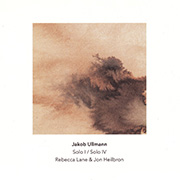 Jakob Ullmann: Solo I / Solo IV [Another Timbre]. Way back in 2013 at Huddersfield I heard the first (successful) performance of Jakob Ullmann’s Son Imaginaire III. It had a galvanising effect on me. “Again, a piece that hovered on the threshold of audibility, but in Ullmann’s case the music contained a faint but indelible richness, a mystery in how the sounds blended together in ways that couldn’t be understood, from one musician to the next and with ambient sounds in and outside St Paul’s Hall. Sitting there, attention focused on perceiving the music, you could lose yourself, your concentration on a sound so diffuse that your attention becomes a sort of dream state. Over a hundred years ago painters really started to pull apart the idea of what it meant to see something; we still don’t know what it means when we say we’ve heard something.” In a talk before the piece, Ullmann described his compositional methods, making use of a kind of palimpsest of overlaid pages. These translucencies partly reveal and partly obscure. In the Solo works, the musician accompanies themself with recordings of alternative interpretations, covering additional aspects of the suggestive score that cannot be realised in a single take. On top of this, pieces can also be played simultaneously. Rebecca Lane plays Solo I on quarter-tone flutes, Jon Heilbron double bass for Solo IV: both have a strong history and affinity for this type of sensitive handling of small sounds. Their combined performances produce superbly evocative sounds for compositions that expect the material to be kept at a level below perceptible, wide-ranging in timbre and register without ever seeming deliberate or intentional. Everything just seems to emerge and persist organically, creating an experience both indistinct and indelible.
Filed under: Music, Reviews by Ben.H
Tags: Jakob Ullmann, Michael Pisaro-Liu, Samuel Reinhard
No Comments »
Old News In Brief
Sunday 8 February 2026
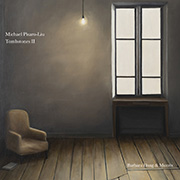 Michael Pisaro-Liu: Tombstones II [Circum-Disc]. Four years ago, Barbara Dang and the ensemble Muzzix put out a recording of selections from Pisaro-Liu’s songbook Tombstones: a set of essential distillations of song-form. Here are the rest of them, again sung by Maryline Pruvost. Again, the material and the interpretative approach can be likened to gemstones under a magnifying glass. The remaining pieces in the cycle allow for a sort of interlude to appear at times in this batch: “The outside of everything” focuses on long-held tones and beating frequencies, the stop-start of “Rattle” is intuitive but impersonal – a good analogy for the entire set. Around the middle of the album “Time may” brings everything almost to a standstill before the music becomes a little more expansive again, with the final work played here “The darkness is falling” recalling Cage’s Experiences No. 2, sung well.
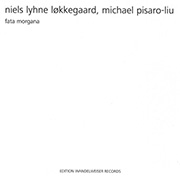 Niels Lyhne Løkkegaard, Michael Pisaro-Liu: Fata Morgana [Edition Wandelweiser]. I get the idea; but you can’t listen to an idea. First part is Løkkegaard outside somewhere idly tootling a recorder for a good while, with wind blowing into the mic now and then to remind you this is all spontaneous and artless: life with the boring bits left in. Second part is same again with fidgety electronic schmutz overlaid by Pisaro-Liu. There’s too much fiddling about for its own sake: the sounds aren’t interesting enough to reward attention but also too intrusive to be sufficently uninteresting that your attentiveness open outwards. Just looked at the cover and remembered it’s Wandelweiser.
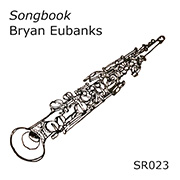 Bryan Eubanks: Songbook [Sacred Realism]. I can’t imagine ever getting enthusiastic for an album of soprano saxophone solos, even if it’s only about half an hour long. Eubanks plays horn: there’s electronic schmutz here too, but subtle. Is it necessary? I guess, in that the soft crunch and distorted thuds that underline the more forceful notes don’t so much punctuate the solos and ground them, pinning each one down to a flattened, cubist perspective. Eubanks’ expressive lyricism on display here is similarly cubist in its muted palettes and calm angularity, melodic lines reminiscent of Brant or Wolpe at their most serene (sorry, I’m devoid of suitable jazz references). I find it all kind of ugly but maybe your ears work better than mine for this stuff.
 Jordan Topiel Paul & Bryan Eubanks: Pushovers [Sacred Realism]. Eubanks is back to pure electronics here, applying a modular synth to Topiel Paul on snare drum. That’s not the most appetizing combination on paper either, but the two of them really pull out the stops to make it work, Paul mining the amplified drum for a surprisingly deep array of textures and timbres, using it as a source of sound more than rhythm, with smart and sympathetic treatments by Eubanks. At times the synth reworking of the drum sounds like real-time tape manipulations, giving both acoustic and electronic musicians the feel and flow of live performance – I’m guessing these are studio improvisations. They actually do achieve the “ambiguous textural and rhythmic universe where synthetic and acoustic meet” as described in the sleeve notes; that doesn’t happen every day. Each of the four tracks, ranging from five to twenty-five minutes in length, combine a dramatic sweep with attention to detail that make listening to it at home as much fun as listening to it half-cut in a noisy art club.
 Cosimo Fiaschi: unveil / unfold [Insub]. I can’t imagine ever getting enthusiastic for an album of soprano saxophone solos, even if it’s only about half an hour long. I can make exceptions though, and the two pieces Fiaschi recorded here (both on the same day, it seems) hide the source of the instrument by making each piece a study in tone – prolonged notes approach what appears to be pure, uncoloured pitch, until an added overtone or small change in breath reveals the hidden coloration. The sounds and the methods are electronic, even though both are achieved acoustically, through human means. Never quite drone, never quite ambient, Fiaschi’s pair of works carve out space into a clean acoustic shape which leaves an immediate impression that becomes more intriguing with prolonged examination.
Filed under: Music, Reviews by Ben.H
Tags: Bryan Eubanks, Cosimo Fiaschi, Jordan Topiel Paul, Michael Pisaro-Liu, Niels Lyhne Løkkegaard
1 Comment »
In the field: Ahti & Ahti, Marta Zapparoli, Michael Pisaro-Liu
Thursday 30 November 2023
 Marja Ahti and Niko-Matti Ahti created this piece for radio in 2020. Nokivesi (it means ‘soot-water’) is a musique concrète montage of domestic and natural sounds, deftly treated with electronics and some synth work, threaded through with fragments of spoken dialogue. It tells a fragmented story of some sort, which is lost on me as I don’t speak Finnish. Even though deprived of a clear meaning, it’s effective in the way it conveyed an impression of rural isolation without me needing to look that up in the sleeve notes. Even though sober tales of the ruminative and bucolic kind aren’t really my thing, I – wait, is that an electric kettle boiling near the beginning? The same kind of sound I was admiring in Ryoko Akama & d’incise’s No register No declare? Maybe they heard Nokivesi on the radio and made an homage, or it’s a happy coincidence, but for the record the Ahtis got there first.
 I’ve probably ranted enough about my hangups with field recordings (tl;dr you gotta be good) so it’s nice that Dissipatio has found a novel twist on the genre. Marta Zapparoli’s field recordings are of magnetic fields, specifially those produced by the Aurora Borealis. Her Interdimensional Generated Space is a half-hour composition made from these electromagnetic emanations, captured by her on a variety of devices, including a homebrew crystal radio. It’s evidently the result of a lengthy period of field research, notable for the variety found in the thin but densely detailed sounds collected here. Zapparoli has produced something just stable enough to present a coherent listening session, yet filled with disruptions and breaks that underline the mercurial nature of the phenomenon, reflecting that their aesthetic delights (visual and aural) can be captured but not controlled. Further details emerge on re-listening. Also, props for releasing a digital download in original one-track mono instead of a dump of the CD master.
 This is close to miraculous. Michael Pisaro-Liu’s A room outdoors is a 2006 composition lightly scored for harmonium, any sustaining instrument and field recordings. In this piece, the field recordings bring the outdoors, indoors, to create a imagined space for the musicians to play. These two substantial realisations published by elsewhere feature Guy Vandromme and Adriaan Severins on keyboards and synthesizer, recorded in Brussels in April 2020 (lockdown time) and a version from Cremona this summer, played by Luciana Elizondo on viola da gamba with Vandromme on Indian harmonium; Fabio Gionfrida mixes the field recordings here. The playing is sublime, recalling the subdued simplicity of Ferrari’s Presque rien, but given deeper colouring and shade by Vandromme and Severins, neither musician intruding to comment but only augment the sound into an evocative pastoral without a narrative. The Cremona realisation, with Vandromme switching to a rougher instrument and Elizondo’s string playing, adds a sharper relief of acoustic sounds to the mix, with more to direct the listener’s attention without either musician being so crass as to demand it. Each is notably different in their intepretation while staying true to the piece, with the musicians both offering a richly satisfying evocation and contemplation of landscape, much in the same way that landscape itself presents form and subject as one.
Filed under: Music, Reviews by Ben.H
Tags: Ahti & Ahti, Marja Ahti, Marta Zapparoli, Michael Pisaro-Liu, Niko-Matti Ahti
1 Comment »
New Elsewhere: Michael Pisaro-Liu, Jordan Dykstra and Koen Nutters
Sunday 10 October 2021
 Michael Pisaro-Liu (fka Michael Pisaro) walks an eccentric path between conceptual process (cf. ricefall) and free-flowing wanderings that follow a concealed narrative. In Tombstones, this approach is atomised: a collection of twenty “experimental-pop” songs, each made from the slenderest of means. Each song may be concise or extended, to extremes if desired, and arrangements are left open. For this album, the ensemble Muzzix under the direction of pianist Barbara Dang perform eleven songs, the same selection recorded by a different ensemble some nine years ago which I haven’t heard and so can’t compare.
The titles, and thus lyrics, derive from popular songs, but any vagaries or digressions are constrained by the miniaturist approach to each composition. In each song the singer, usually Maryline Pruvost, rarely exceeds a couple of words, a couple of notes. The initial impression recalls Jürg Frey’s 24 Wörter. As often with Pisaro-Liu, his musical language is too inconsistent to induce a ‘minimal’ state of quiescence in the listener’s mind, leaving the song sequence’s success to depend upon the gemlike settings of the instrumentation. This is evidently left largely in the hands of Dang and Muzzix, who alter texture and colouration in fresh and unexpected ways, with an approach that is gentle but firm when making such potentially isolated and disparate elements cohere, yet also prolonging moments of chamber music from the same material. Ultimately, the album as a whole is required by its concentration on single words and sounds to balance between the hieratic artifice of its construction and the expressive substance of its contents, leaving to the mercy of the listener’s mindset whether it aspires to profundity or to preciousness.
 I’m sure I’ve never heard of Jordan Dykstra or Koen Nutters before. Their new Elsewhere release is a joint composition by the two composer/performers. This is usually grounds to be wary of an insider’s muso-fest but thanks to recent efforts by groups like Eventless Plot I’m not more hopeful. That hope is rewarded here. In Better Shape Than You Found Me is precisely one hour of music that ebbs and flows as though excerpted at random from a constant, natural process. Like nature, the only readily discernable structure or pattern is what may be observed, an impersonal, consequential logic that creates its own context and meaning as it goes on. A spare duo for piano and pitch pipes or viola is backed by soft drones and noises which drift in and out of focus, eliding between pure sound and documentary. Like Luc Ferrari under heavy sedation. An ascending scale interrupts, from time to time. Perhaps events are grouped into subtly distinguished episodes, or perhaps there are merely pauses. More likely, sometimes there is simply silence that emerges to the fore. A sense of place is created, but one where the mood or the tone never settles and so makes place into a lifelike thing.