 Ensemble Pamplemousse: Brightness Drifts [Ensemble Pamplemousse]. Heard that name somewhere before and… well, this isn’t what I expected. Pamplemousse are the ensemble who recorded Andrew Greenwald’s A Thing Made Whole III a while back and it turns out they’re as much a composer collective as a chamber ensemble. I wasn’t counting on these four pieces being so perky, with an emphasis on electronics. Natacha Diels’ What Do You Want to See Today? is one of those existential reflections on “the modern condition” that plays out as an attention-deficient satirical romp but, as happens all too often in these cases, the light-touch irreverence borders on whimsy. Nevertheless, it’s one of the better examples, aided by the musicians’ rapid-fire timing, some genuinely striking effects and the composer’s nous to keep the material as semantically empty as possible to put the emphasis on nebulous unease rather than tempt fate by suggesting specific cause. David Broome’s Luminosity II (from the Hertzsprung-Russell Project) is also playfully frenetic, using photoelectric cells to trigger synth sounds and drum machine samples to produce aural stroboscopic effects. Either the cheesy instruments are subverted by the impartial manner of their disposition, or the technical interest in the piece’s stop-go flow is offset by the trivial synth patches, I’m not sure. Bryan Jacobs’ Envelope En En is the most successful of the electronicky pieces here, using modern day low tech to emulate the effects of early electronic high tech: sophisticated, complex textures and timbres are produced by the ensemble operating “chirp toys”. Not exactly sure what these are – Google suggests either a cat toy or a wine pourer – but evidently they are put to use here as pulse generators, bubbling along and buzzing around like a reincarnation of the glory days at Westdeutschen Rundfunk. Odd percussive noises and vocal sounds may or may not be from “field recordings”, but they all add to a quirky, exotic atmosphere that suggests a well-intentioned but incongruous attempt at recreating natural sounds. The sole acoustic work is of David Broome playing Andrew Greenwald’s piano piece Facets. Greenwald’s usual contested thickets of sound receive a necessarily cleaner and neater appearance when expressed on the keyboard: Broome sounds unnervingly precise in his rapid, scattershot bursts of notes that build up a portrtait of nervous energy, manic episodes counterpoised with tentative periods of studied inaction. Didn’t find a mention of this piece anywhere else on the web, so I think it’s either new, or else very old.
 Pareidolia: Far Away Worlds [Dissipatio]. Saw the cover and assumed it was one of those improv/fusion things I usually ignore but read the blurb and saw that this is a duo one half of which is Marta Zapparoli, so I’m interested. Quick recap: she works with radio waves, using various antennae and devices to intercept broadcasts and natural electromagnetic phenomena alike. Pareidolia pairs her with Liz Allbee, exponent of the quadraphonic trumpet – which is not as depicted in the cover art but an equally fantastic electroacoustic gizmo. It’s sort of like if you first heard a Jon Hassell record at someone’s party while on shrooms. As a pair, they’re all you’d hope they’d be and more. The album grabs your attention with the thunderous opening track in which Allbee makes full use of extreme pitch bends and amplification, gleefully matched by Zapparoli electrical spikes and manipulated static. The subsequent pieces are less interested in showing off and more about world-building, creating alien aural landscapes that are ripe with allusions and implications. You’d expect the wildness of Zapparoli’s earlier work in the medium to be tempered somewhat by the somewhat more tractable nature of Allbee’s beast and to a certain point it is, but the collaborative effort is channeled into establishing an overall tone through echoing sonar booms and crackling atmosphere. A science-fiction theme seems almost inevitable here and while the duo suggest retrofuturist overtones they never get cute about it. Nerdier listeners will appreciate the shortwave transmissions and that there’s a track titled “Number Stations”.
 Erik Hall: Solo Three [Western Vinyl]. I sometimes wonder if certain musicians seek out novelty for the sake of it. Hall evidently has a vocation for arranging compositions for multi-tracked keyboards and guitars, then performing all the parts himself. As the title advises, he has two previous albums in this vein, tackling Steve Reich’s Music for 18 Musicians and Simeon ten Holt’s Canto Ostinato, neither of which I wish to hear albeit for differing reasons. This third effort follows the same compositional thrust but appears more palatable as it’s made up of shorter pieces by four different composers. He begins with Glenn Branca, perversely selecting one of his orchestral scores for the guitar/keyboard treatment; his take on the opening movement of The World Upside Down must be the gentlest Branca ever committed to disc, even as the source is relatively mild itself as far as Branca goes. Charlemagne Palestine’s Strumming Music is domesticated to a tidy fifteen-minute essay, with the overdubbed harmonic ramifications sounding decorative more than organic and the monadic form of the piece stripped of its obsessive forcefulness. There seems to be potential in a human interpretation of Laurie Spiegel’s A Folk Study, one of her pioneering works in digital synthesis and sequencing, but Hall sticks to keyboards and produces an interpretation that seems faithful but lacks the incongruity of the original. I was just wishing this piece used strings instead. By contrast, his version of Steve Reich’s Music for a Large Ensemble is unusually effective, taking advantage of a reduced palette of instrumental sounds to produce something crisp and propulsive out of Reich’s busy polyphony, with enough substance in the writing to stop it from coming across as trivial. It’s the one piece here which does let you hear the music afresh.
Filed under: Music, Reviews by Ben.H
Tags: Andrew Greenwald, Bryan Jacobs, Charlemagne Palestine, David Broome, Ensemble Pamplemousse, Erik Hall, Glenn Branca, Laurie Spiegel, Liz Allbee, Marta Zapparoli, Natacha Diels, Pareidolia, Steve Reich
No Comments »
Repetition and novelty
Saturday 21 February 2026
 Andrew Greenwald: for Distractfold [dFolds]. A couple of new interpretations of Andrew Greenwald pieces which have previously appeared on a Kairos CD, with a newer ensemble work. Greenwald credits Distractfold as being part of “the beginning of a metamorphosis in my composing” and this half-hour programme gives some insights why. The brief solo for electric guitar A Thing Made Whole VI is played here by Daniel Brew at a more relaxed pace than on Kairos, using a “bifurcated electric guitar”. This is not as painful as it sounds; it’s just that the guitar is miked up at both ends to capture the small sounds produced above and below the fingers to be heard in close-up, spatialized detail. Instrumental colour thus becomes a greater feature in this performance. Greenwald’s colours are complex but take on additional brightness and vividness in these recordings, as can be heard in the Distractfold version of the ensemble piece A Thing Made Whole IV which even breaks into fleeting moments of unexpected radiance and stilness amongst the thicket of contested sounds. The newer work, (Coda) A Thing Made Whole for bass clarinet, violin, cello, and acoustic guitar, signals a change in approach, coming after Greenwald felt he his current approach to composition had lead to a dead end. (Coda) may turn out to be a transitional work or the start of a new phase: the material is noticeably “poorer”, making do with less and with less overt focus on technique, finding ways to still produce surprising blends of timbre and creating variety out of coloration and texture as the music’s substance. This suits the Distractfold musicians down to the ground, as they find moments of beauty in the unlikeliest places. The album is bolstered by a phone recording of the rehearsal and a copy of the score in full, if you want to get serious about finding what makes this music tick.
 Jürg Frey: Composer, alone [elsewhere]. A few years back Reinier van Houdt presented a three-disc set of solo piano pieces by Jürg Frey. Composer, alone is another triple helping of piano works from 1990 to 2024. The sequencing is out of chronological order, allowing the older, more notorious pieces to appear interleaved with his more congenial compositions of late. The earliest work is Invention, a skeletal drawing of ascending scales that barely elaborate into a slight framework for a piano piece, with van Houdt giving just enough tension to hold things in place. Klavierstücke 1 and 2 are both present, with their obsessive repetitions acting as prolongation and obstruction to each piece’s progress, caught in a paradox of finding no need to go further as yet, while aware that this impassivity is itself a provocation to the listener. The lengthy journey of Pianist, alone (1) is at the centre of this collection. In comparison of these works as performed by van Houdt compared to the earlier recordings I’ve heard by R. Andrew Lee, I’ll go back to my previous observation that van Houdt’s interpretation give greater prominence to each piece’s overall shape, over the succession of details that are encountered from one moment to the next. The two newest works, Composer, alone (1) and Composer, alone (2), open and close the album, inviting comparison with the earlier pair of Pianist, alones. More varied in their introspections and less stringent in their reflections, each of these substantial works suggests a kind of subjective retrospective, including echoes of the earlier works softened and transformed with time. Van Houdt’s interpretative approach here meshes particularly well with Frey’s late style.
Filed under: Music, Reviews by Ben.H
Tags: Andrew Greenwald, Jürg Frey
No Comments »
Three Fusis
Monday 25 August 2025
 Andrew Greenwald: A Bridge Between Spaces [Kairos]. You wait ages for a solo viola d’amore album and then three come along at once. All three are by Marco Fusi and released on different labels so I checked for you and thankfully he hasn’t died. It’s not really true that these are strictly solo viola d’amore, not least because all the pieces on the Greenwald disc are for plain ol’ violin. At times you could be forgiven for thinking otherwise: Fusi digs deep into Greenwald’s A Thing Made Whole (heard previously as the opening of a larger cycle of works) to produce deep, rasping breaths and striated tones more associated with mediaeval instruments than the modern concert hall. In my earlier review, referring to Austin Wulliman’s interpretation of the piece, I blithely stated “I can’t imagine how their interpretations could be technically improved, given the consistency in their calm approach to the finicky scores.” Questions of technique aside, Fusi makes the piece an entirely different experience, dispelling any suggestion of spectralism by filling the tones with noisy urgency. The pacing is also urgent, with Fusi whipping through the piece in roughly two-thirds the time given by Wulliman, miked up close to catch every tiny extraneous sound.
Heard in this context, A Thing Made Whole becomes part of a new and different cycle, an intimate but confronting, even claustrophobic soliloquy of throaty harmonics and half-sounded pitch. A Thing is a Hole in a Thing it is Not (VIII) exemplifies the handsy approach Greenwald and Fusi take towards the violin, each bowed sound surrounded by clusters of taps and smudges against the instrument’s neck and body. It resembles the way Fusi and his composer collaborators treat the viola d’amore, as a resonant object more than a simple producer of notes. The opening piece on the album, the title work, is the most violinistic and, at least in the use of pitch, most conventional; it’s permeated with a nervy loquaciousness whose ticks and stutters which become the focus of close scrutiny in the subsequent, although earlier composed, works. (The contrasting Bourrée is a pregnant pause, seeming about a million miles away from the Back movement it echoes.) The solo works are set apart by Frames, the result of inspired improvisation between Fusi on violin and Greenwald on drumkit, the latter releasing the restrained voice of the former while sharing a percussive language, providing both grounding and ventilation to the more rarefied monologues.
 Wired Resonances [Huddersfield Contemporary Records]. Fusi’s collaborations with seven composers to produce works for solo viola d’amore are heard here, mostly recent plus one dating back to 2014. That older piece, Zeno Baldi’s Spikes, suffers from the extensive use of electronics which makes it all sound over-processed and less an extension of the instrument than attempt to dress up an unprepossessing subject. Five of the works use electronics, with Annie Hui-Hsin Hsieh’s Breathless having the same fault as the Spikes by using the viola d’amore as a means to an end without aparent regard for its particular characteristics. The electroacoustic works by Pierre Alexandre Tremblay and Barbara Nerness take place on a more equal footing, with Fusi performing in duet with the composer. Tremblay adds his own electric bass to his digital augmentations of Fusi’s playing, while Nerness spotlights and backdrops the viola d’amore with electronic treatments and field recordings. The most successful electronically-enhanced piece is Bára Gísladóttir’s ORF (en líka axir og önnur pyntingatæki), a characteristically audacious and pungent work with frailties and vulgarities set against discomfiting sound affects from suburbia. It’s not the only Gísladóttir piece which seems funny at first but gets more disturbing with further reflection – or the other way round, depending on your temperament. I’ll decide when I find out if they in fact have a suburbia in Iceland. Of the straight-up acoustic works, Giovanni Verrando’s Fourth Born Unicorn, rounded version is a brief Lachenmann-like study in the marginal sounds produced by a prepared viola d’amore, but Mary Bellamy’s Shivering Mountain is a substantial and comprehensive work that exploits the resilience of the instrument, with Fusi demonstrating how even the frailest sounds can persist, and revealing a surprising capability for richly coloured multiple stops.
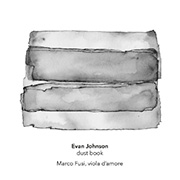 Evan Johnson: dust book [Another Timbre]. Speaking of exploiting the viola d’amore’s acoustic properties, Evan Johnson has Fusi pursue these qualities to their fullest, but in a very different direction. dust book is one long work in six sections, beginning and ending with interludes, each of which are longer than the sections they frame which should tip you off that we’ve strayed far from the conventional. On the first listen you’ll struggle to distinguish one section from another, because you’ll struggle to distinguish any sound at all from the background ambience of your home. Johnson’s predilection for redolent silences and small sounds are pushed to an extreme of sorts, spurred on by the viola d’amore’s dual nature of astringent timbre and surprising resonance. Fusi is given the task of microdosing the sonorous, concentrating everything into small flecks of sound. Some of Johnson’s compositions can enervate, but the tensions at play here arise from the level at detail set amongst the featureless expanse, mixing abundance with formal parsimony. It is ultimately about sound rather than about ideas about sound, contra the Sphinx-like pseudo-profundity found in, say Manfred Werder. Be reassured there’s no earrape with sudden outbursts, so you can safely listen to it cranked up and not miss anything. One section is labelled as “several canons”, as a challenge for the advanced listener.
Filed under: Music, Reviews by Ben.H
Tags: Andrew Greenwald, Annie Hui-Hsin Hsieh, Bára Gísladóttir, Barbara Nerness, Evan Johnson, Giovanni Verrando, Mary Bellamy, Pierre Alexandre Tremblay, Zeno Baldi
1 Comment »
Lost in music: Greenwald, Behzadi
Monday 7 November 2022
How much of a piece of music do we hear as itself, compared to what we hear in it as a reflection of our selves? Perhaps its greatness may lie in what it personally reveals in the listener, previously unsuspected. Having said that, the number of times I’ve heard a piece which seemed normal enough, only to find the critical consensus is that it is weird or disturbing in some way, is often enough to make me wonder if I listen with a childish naivete or with a somnolent inattentiveness. Some of this is probably because I don’t buy into expressiveness much: if any art starts to get too emotional with me I suspect it of chugging.
The upshot is that with so much music around, us listeners, no matter how enlightened, are in the position to dictate terms. Perhaps that’s why there seems to be a new generation of composers emerging from North America who all appear to be Polite Young Men. (This may be a trait amongst the women composers too, under-exposed as always, but the only one I’m aware of Caroline Shaw.) A lot of perfectly nice pieces by pleasant people who are quite sure they don’t want to make too much of a fuss. It’s hard to care too much about this music, and I haven’t even found a critic yet who says that it’s quietly subsersive about something or other. Perhaps there is and I haven’t paid the right attention, a thought that occurred to me only after the sixth time I played Apartment House’s recording of Kory Reeder’s seventy-minute chamber piece Codex Vivere on Another Timbre. It’s not just the length, but the odd shape it contains and the elongation of passages that are obviously more than note-spinning that suggest something deliberately off-kilter at work below the surface.
 On the other hand, there’s Andrew Greenwald’s cycle of chamber works A Thing Made Whole, seven pieces totalling seventy minutes, collected on a new release on Kairos. Here, surface and substance merge in a queasy uncanny valley of sound. The music is all activity, but at a dreamlike pace and with appropriately elusive results. Extended techniques are used to make pitch quiver and rattle, while the ensemble playing never unifies into a coherent image. Although self-contained (with different recording ensembles, venues and dates), each piece follows on from the last as an effective suite, much like Feldman’s Durations or Vertical Thoughts; the opening piece being an extended solo for violin comes across as an homage to Grisey’s viola Prelude. Four longer pieces are followed by three shorter ones, as an extended coda. The music wears its mysteriousness on its sleeve: in A Thing Made Whole II the piano part sounds like a battered upright in an empty hall, although no electronics are indicated in the sleeve notes. The pseudo-electronics are carried on by the trombonist using his mouth piece to layer white noise over the strings, while vibraphone rolls in the background simulate pure overtones. While the details are busy, the atmosphere is hushed throughout, with the biggest disruption occuring in piece number five, where a clear-voiced piano unexpectdedly plays a gentle pastorale above a strained string quartet. The opening piece is played by violinist Austin Wulliman, with Wild Up and Ensemble Pamplemouse performing the next two works; the rest are from the Contemporary Insights Ensemble. I can’t imagine how their interpretations could be technically improved, given the consistency in their calm approach to the finicky scores (examples reproduced in the booklet) while injecting the right amount incongruous eclecticism when needed, which all adds to the precisely blurred dream quality.
 Like I said, expressiveness doesn’t necessarily do it for me, and I don’t want to have to do background reading to find out what the big deal is. Take that admission of crassness as a caveat that I might be missing something even more important when I say that the TAK Ensemble’s recording of Ashkan Behzadi’s Love, Crystal and Stone is a damn fine piece of craftwork. Behzadi studied architecture in Tehran, and his cycle of seven songs draws inspiration from tapes he heard at that time of Iranian revolutionary poet Ahmad Shamlou reading his Farsi translations of Lorca. The TAK Ensemble (soprano Charlotte Mundy with Pierrot minus cello) stage a tour de force in presenting Behzadi’s finely detailed settings of Lorca. Any Spanish or Persian exotica is strictly sublimated, or present only through association. It can make for compelling listening when you focus on each moment, but I haven’t made all forty minutes hang together in my head to make something more than the moments. That might be helped if you splurge on the whole package, which comes with an art book and parallel translations.