 Michael Pisaro-Liu: Concentric Rings in Magnetic Levitation [Sawyer Editions]. Just last month I was carping that Fata Morgana, Pisaro-Liu’s collaboration with Niels Lyhne Løkkegaard, had both not enough and too much going on all at once, making for stultifying listening. This realisation of his 2011 composition, on the other hand, is the real stuff. It shows the profound difference between almost nothing and not enough, with much of the hour’s duration passing almost inaudibly. The near-silence is observed with intense concentration by the three musicians, and their concentration becomes infectious. The name of the ad hoc trio is Forming; they listen in to a cycle of almost imperceptible sine tones, articulating the presence of sound, if not always its manifestation. Andrew Weathers marks off tiny inflections with small piano notes, Ryan Seward’s cymbals augment the upper partials of the faintly humming air, Carl Ritger uses electronics and field recordings to compound the implicit hum that pervades the absence of activity. By the end of the hour, what had at first been inaudible has soaked into your consciousness, radiating sound. This recording captures a very special moment.
 Samuel Reinhard: For 10 Musicians [elsewhere]. I described Reinhard’s earlier piece For Piano and Shō as “tinting the backdrop of silence”. In For 10 Musicians the forces are larger but the music is even more intangible. Two pianists – Paul Jacob Fossum and Gintė Preisaitė – reiterate a single chord at their leisure, with some free interplay on a small gamut of single notes. They are circled by an ensemble of clarinets, violas, cello and double bass, who play as softly as possible at their discretion. There are faint developments that occur by chance, through small changes in colouration and harmony, keeping everything still but alive. The ensemble’s presence reminded me of the electronic treatments that shadow the solo pianist in Michael Pisaro-Liu’s Green Hour, Grey Future, but in Reinhard’s case the sound has greater depth and the form is more rigorous. There are four movements, each identical other than the pianos’ chord; as always, same but different, each resembling the other but cast under a different shade. It’s a large work which is always present but elusive, with the musicians and recording successfully transcending the music’s substance into the aether.
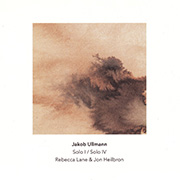 Jakob Ullmann: Solo I / Solo IV [Another Timbre]. Way back in 2013 at Huddersfield I heard the first (successful) performance of Jakob Ullmann’s Son Imaginaire III. It had a galvanising effect on me. “Again, a piece that hovered on the threshold of audibility, but in Ullmann’s case the music contained a faint but indelible richness, a mystery in how the sounds blended together in ways that couldn’t be understood, from one musician to the next and with ambient sounds in and outside St Paul’s Hall. Sitting there, attention focused on perceiving the music, you could lose yourself, your concentration on a sound so diffuse that your attention becomes a sort of dream state. Over a hundred years ago painters really started to pull apart the idea of what it meant to see something; we still don’t know what it means when we say we’ve heard something.” In a talk before the piece, Ullmann described his compositional methods, making use of a kind of palimpsest of overlaid pages. These translucencies partly reveal and partly obscure. In the Solo works, the musician accompanies themself with recordings of alternative interpretations, covering additional aspects of the suggestive score that cannot be realised in a single take. On top of this, pieces can also be played simultaneously. Rebecca Lane plays Solo I on quarter-tone flutes, Jon Heilbron double bass for Solo IV: both have a strong history and affinity for this type of sensitive handling of small sounds. Their combined performances produce superbly evocative sounds for compositions that expect the material to be kept at a level below perceptible, wide-ranging in timbre and register without ever seeming deliberate or intentional. Everything just seems to emerge and persist organically, creating an experience both indistinct and indelible.