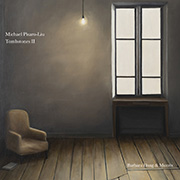
 Michael Pisaro-Liu: Tombstones II [Circum-Disc]. Four years ago, Barbara Dang and the ensemble Muzzix put out a recording of selections from Pisaro-Liu’s songbook Tombstones: a set of essential distillations of song-form. Here are the rest of them, again sung by Maryline Pruvost. Again, the material and the interpretative approach can be likened to gemstones under a magnifying glass. The remaining pieces in the cycle allow for a sort of interlude to appear at times in this batch: “The outside of everything” focuses on long-held tones and beating frequencies, the stop-start of “Rattle” is intuitive but impersonal – a good analogy for the entire set. Around the middle of the album “Time may” brings everything almost to a standstill before the music becomes a little more expansive again, with the final work played here “The darkness is falling” recalling Cage’s Experiences No. 2, sung well.
 Niels Lyhne Løkkegaard, Michael Pisaro-Liu: Fata Morgana [Edition Wandelweiser]. I get the idea; but you can’t listen to an idea. First part is Løkkegaard outside somewhere idly tootling a recorder for a good while, with wind blowing into the mic now and then to remind you this is all spontaneous and artless: life with the boring bits left in. Second part is same again with fidgety electronic schmutz overlaid by Pisaro-Liu. There’s too much fiddling about for its own sake: the sounds aren’t interesting enough to reward attention but also too intrusive to be sufficently uninteresting that your attentiveness open outwards. Just looked at the cover and remembered it’s Wandelweiser.
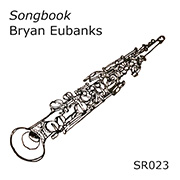 Bryan Eubanks: Songbook [Sacred Realism]. I can’t imagine ever getting enthusiastic for an album of soprano saxophone solos, even if it’s only about half an hour long. Eubanks plays horn: there’s electronic schmutz here too, but subtle. Is it necessary? I guess, in that the soft crunch and distorted thuds that underline the more forceful notes don’t so much punctuate the solos and ground them, pinning each one down to a flattened, cubist perspective. Eubanks’ expressive lyricism on display here is similarly cubist in its muted palettes and calm angularity, melodic lines reminiscent of Brant or Wolpe at their most serene (sorry, I’m devoid of suitable jazz references). I find it all kind of ugly but maybe your ears work better than mine for this stuff.
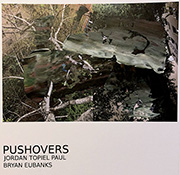 Jordan Topiel Paul & Bryan Eubanks: Pushovers [Sacred Realism]. Eubanks is back to pure electronics here, applying a modular synth to Topiel Paul on snare drum. That’s not the most appetizing combination on paper either, but the two of them really pull out the stops to make it work, Paul mining the amplified drum for a surprisingly deep array of textures and timbres, using it as a source of sound more than rhythm, with smart and sympathetic treatments by Eubanks. At times the synth reworking of the drum sounds like real-time tape manipulations, giving both acoustic and electronic musicians the feel and flow of live performance – I’m guessing these are studio improvisations. They actually do achieve the “ambiguous textural and rhythmic universe where synthetic and acoustic meet” as described in the sleeve notes; that doesn’t happen every day. Each of the four tracks, ranging from five to twenty-five minutes in length, combine a dramatic sweep with attention to detail that make listening to it at home as much fun as listening to it half-cut in a noisy art club.
 Cosimo Fiaschi: unveil / unfold [Insub]. I can’t imagine ever getting enthusiastic for an album of soprano saxophone solos, even if it’s only about half an hour long. I can make exceptions though, and the two pieces Fiaschi recorded here (both on the same day, it seems) hide the source of the instrument by making each piece a study in tone – prolonged notes approach what appears to be pure, uncoloured pitch, until an added overtone or small change in breath reveals the hidden coloration. The sounds and the methods are electronic, even though both are achieved acoustically, through human means. Never quite drone, never quite ambient, Fiaschi’s pair of works carve out space into a clean acoustic shape which leaves an immediate impression that becomes more intriguing with prolonged examination.
Filed under: Music, Reviews by Ben.H
Tags: Bryan Eubanks, Cosimo Fiaschi, Jordan Topiel Paul, Michael Pisaro-Liu, Niels Lyhne Løkkegaard
No Comments »
Loose Pianos
Saturday 31 January 2026
 Christopher Fox: Unmeasured
[Huddersfield Contemporary Records]. Stupid here missed the Christopher Fox recital at City University this week, so I’ve been compensating by listening to his Unmeasured, a set of three recent piano pieces expertly played by Kate Ledger. There’s an intellectual playfulness lurking behind Fox’s music, to a greater or lesser degree, and it’s a little more conspicuous here, exposing a constructivist game that underpins each work which tilts the conventionally expressive into the realms of the uncanny. The album title points to the compositional theme in these three works, that of rhythm, or perhaps timing. Opening with the most recent piece, Figures of Light takes ambiguous, chromatic chords and staggers them into slow arpeggiations that are left to resonate; the result strikes the ear as a single melodic line that erratically loops and folds upon itself, stopping and starting at unpredictable moments, freezing time to reveal the particular harmonic content in each segment. Tension builds through the steady pulse of notes, broken by irregular phrasing and pauses. As mentioned above, it’s more about timing than rhythm, and Ledger’s playing adroitly tests and teases how far the disruptions to continuity can be stretched. This aspect of playing has an increasingly important role in the next two pieces. Es war einmal requires Ledger to silently read excerpts from Grimms’ fairy tales as an internal guide to the phrasing and expression of the music on the page. It takes on the surface musical appearances of animated narrative speech, yet without any conscious attempt to mimic the human voice or illustrate semantic meaning; the rhythmic cadences paired with Fox’s colourful musical material function as a story on a deeper, subverbal level, as one told to you while falling asleep. The longest and oldest work here, senza misura, gives Ledger licence to determine both the ordering of the twenty-odd sections that make up the piece and the durations given to each event. It’s mostly chordal, with Ledger choosing how the relative density and dissonance of each successive sound may be reconciled through judicious timing, treating notes on the page as a plastic material to be stretched and shaped into a complex but balanced musical sculpture. Ledger’s performance acts as a superb vindication of Fox, whether intentionally or not, composing a virtuosic rejoinder to Ezra Pound’s Great Bass theory.
 Morton Feldman: Intermission 6 [Another Timbre]. Antti Tolvi has a background of playing various instruments in experimental jazz and free improvisation, so he has a flexible sense of timing too. He takes this to an extreme in his realisation of Morton Feldman’s Intermission 6, a piece composed in 1953 for either one or two pianos. It’s one of Feldman’s most open works, despite specifying pitches: just fifteen single events notated onto fragments of staves, haphazardly scattered across a single page. The brief instructions begin “Composition begins with any sound and proceeds to any other.” This opens up all sorts of questions which cannot be easily answered, as James Pritchett has noted when he played the piece. “Can you repeat any of the sounds? and how long the piece should go on?” The suggestion of a second piano permits further speculation on how freely the piece may be interpreted. It’s a thought that has occurred to me, too, but I lack a keyboard and the ability to test it for myself. Fortunately, Tolvi has given us one answer, in the form of a solo performance that lasts a little over seventy minutes. His phrasing and articulation are unconventional, with Feldman’s usual performance note of “as soft as possible” given some leeway, allowing for a piano with recalcitrant dynamics. I’m relieved to say it’s not one of those recently-fashionable slow interpretations that treats Feldman as a pioneer of ambient music; Tolvi uses silence and near-silence as a motivating force, creating a torqued stasis that keeps the listener alert. (To answer your anticipated questions: (a) Yes it’s Feldman, but not as we know it, and (b) Great work! Don’t do it again.) The material is relatively simple even by Feldman’s standards, which does provide a lot of the strangeness; that transparency also suggests extended repetition is permissible, and Tolvi demonstrates that you can sustain this music with almost nothing.
Filed under: Music, Reviews by Ben.H
Tags: Christopher Fox, Morton Feldman
No Comments »
For Philip Guston, later
Sunday 18 January 2026
Thirteen years ago I heard the GBSR Duo of George Barton and Siwan Rhys performing Morton Feldman’s For Philip Guston in the chilly back room of an art gallery for four-and-a-half hours. On that occasion, the flute part was played by a tag-team of two, working in shifts.I remember the earlier performance being slightly rough around the edges, in a clear and sympathetic interpretation – particularly Barton and Rhys. The flute part is especially tricky, for the listener as it is for the flautist: as Feldman understood, it is a loud instrument. How should it blend with piano and celesta, vibraphone and chimes? It can tend to dominate (e.g. the rather forthright recording made by the California EAR Unit). This afternoon, at Kings Place, Rhys on keyboards and Barton on percussion accompanied Taylor MacLennan on the flutes for a new interpretation of the piece, to launch their recording of all three of Feldman’s large trios. In this version, their understanding of how the three musicians relate was clear, with the flute primus inter pares in what aspires to be a soliloquy of the simplest and most elemental gestures, complicated by piano and percussion mirroring and echoing the parts in a fraught balance.
The immediate impression when they started playing was that they understood the dynamics, with MacLennan’s flute as gentle as possible (allowing for the impossibility of a quiet piccolo). I shouldn’t have to tell you that GBSR have better chops now than when they were kids. Barton plays mallet instruments with supreme softness, just enough to be heard through the hall. Rhys made her two keyboards blend seamlessly with Barton’s playing and with each other, creating a mercurial compound instrument. MacLennan seemed indefatigable, giving the audience full licence to find a wide range of interpretations alluded to in the programme notes without ever needing to emote. The spare, unadorned material and thin textures made substance from outlines. While I expected some degree of raggedness to inevitably creep in over time, the trio maintained a dignified stillness throughout, with a suprising consistency in sound where any tiredness was sensed and expected rather than aurally present. Better still, they maintained a flow throughout the piece’s excessive length, minimising the tendency in Feldman’s writing to create a series of episodes that inevitably wind down before starting over.
I mentioned before that I hear this piece differently every time. In the subterranean recital room of Kings Place, with such disciplined musicians, there were no external cue to the passing of time. The piece seemed longer than I remembered, particularly as it started to double back upon itself. This, with the way the trio played, left me at times entirely disorientated. I started finding certain passages too long, or too inert, then suddenly becoming alert and enthralled again, for no evident reason – this composition is a cussed beast. Like too many things in life, I wanted it to be over while knowing I’d be sad when it was done. (Why does he bring in the piccolo so early in the piece?) It all comes together in the long ending and coda, possibly the most audacious and subtle of Feldman’s compositional tricks. I need to hear MacLennan, Barton and Rhys’s recording of it soon, along with their versions of Why Patterns? and Crippled Symmetry.
Filed under: Music, Reviews by Ben.H
Tags: Morton Feldman
No Comments »
New Year Weirdness
Saturday 3 January 2026
Back from a break, but before I left I was able to hear Magnus Granberg and an expanded version of the group Skogen play Trouble, Had It All My Days in London. Thirteen musicians, with locals and Toshimaru Nakamura on his no-input mixing board adding to the colour and texture. After just going through some of his other recent compositions it was a pleasure to hear this work live, there being no recording available yet. Apart from the innate theatre of experiencing the music live, the piece showed another subtlety to Granberg’s approach, using his source (alluded to in the title) both as material largely untraceable for the unprompted listener and as inspiration for the direction the composition will take over its lengthy course. There is notated music, but it’s pooled as a resource for improvisation and repetition as directed; despite this apparent freedom in details, the piece is shaped to head from activity to quiescence. Sustained, simple textures predominated as the piece progressed, with fewer changes or overt disruptions from Granberg’s usual resources of ambient electronics and percussive small objects. (Nakamura’s feedback sounds were occasionally a distraction, but these appeared to be down to getting the balance right on his finicky electronic setup.)
 Pacha Wakay Munan: El tiempo quiere cantar [Buh]. I need to talk about two of the most downright weird albums that came in last year. El tiempo quiere cantar is on the Peruvian Buh label, credited to Pacha Wakay Munan – a duo of musicians “and researchers” Dimitri Manga Chávez and Ricardo López Alcas. The sleeve notes somewhat modestly describe it as a “showcase” of the sonic possibilities of pre-Hispanic South American instruments in a contemporary musical context. Listening to it sounds like so much more than a demonstration; the strangeness is multiplied by the absence of a convenient musicological or anthropological basis to rationalise what you’re hearing. You’re already thinking of pan pipes, rattles and drums, but this collection of eight pieces will periodically reinforce your preceonceptions only to confound them. As described in the notes, the instruments survive but their method of use has largely been lost, leaving any existing tradition a piecemeal assembly of repurposed practices. This gives our two musicians the freedom to invent a new context, which when heard as an album appears to be created on the fly, drawing in references to older ethnographic recordings, adding occasional European instruments and modern electronics. It becomes impossible to hear this music for what it is, as our heads are already filled with pre-existing interpretations of what it should or should not be, thus rendering even the familiar at odds with our expectations. It’s worse if you’re better educated to prioritise the “authenticity” of ethnic experience, as your aesthetic values become more prescriptive and constricted. The music shares Kagel’s understanding of slippery, subjective relativism which more dogmatic musicians attempt to deny. As with Kagel, it’s hard not to think there’s some conceptual programme at work behind the album when hoarse, distant whistles are succeeded by a slightly sentimental piano accompaniment to a siku melody, before suddenly giving way to a chugging vamp overlaid with braying ceramic trumpets. You can tie yourself in knots trying to intellectually justify it all on the musicians’ behalf, or just let it happen to you and marvel at the sonic variety.
 Jason Doell & Naomi McCarroll-Butler: FOUR FORMER MYRRH FORMERS FORMED HER HORN FOR MURMURS [Watch That Ends The Night]. The hell? Bunch of gamelan-cum-windchime sounds that appear to be played by a machine, Fifties musique concrète noises with a zither, fidgety electronic noodling with insouciant clarinet fripperies? Waat is this all supposed to add up to? It isn’t, and I’m not hearing it right; I’ll spare myself some embarrassment and say the misdirection is part of the point. McCarroll-Butler is the (very) human musician, and Doell (I should have known) has wrong-footed me again with his algorithmic programming. All three (computer code included) are jointly credited with composition. The sleeve notes offer “improvisations sampled and algorithmically composed” and that’s it. No wonder each of the four pieces here remain uncrackable nuts of inscrutability, but what particularly bamboozles the listener is how the choice of instruments, manner of initial playing and computational reorganisation defy the usual impassive mood that prevails when hearing non-human (or sufficiently alien) cultural artefacts: there always appears to be something at stake. To drive this point home, the final, long track glides effortlessly on a buzzing, chiming drone that could seemingly go forever, until a saxophone creeps in until it’s front of stage and joined by a drum kit in an ambivalent homage to Yoko and John’s Cambridge 1969.
 Harry Partch: The Wayward [Bridge]. A welcome piece of vintage weirdness is the latest instalment of Bridge’s series of fresh interpretations of Harry Partch, beautifully recorded and played by the Partch Ensemble. The Wayward is a sequence of five compositions Partch identifies as a suite, which until now hasn’t been collected into a complete recording it says here. Partch’s time as a hobo in depression-era America is the subject matter here, so his signature earthiness is at the forefront. That earthiness can make one want to prefer the gentle crustiness of his own recordings from the Fifties and Sixties, but the world owes him these crystal-clear renditions on lovingly recreated instruments to renew his legacy in the next century. That said, what immediately struck me is how damn well Partch’s original ensemble played his weird-ass music at the time; these new recordings won’t make you re-evaluate anything, but they will give you greater appreciation of Partch’s compositions as living music more than historical arefact. There’s still plenty of history here: Partch is one of the great exponents of that explosion of vitality in American English in the mid-20th century. The exotic instruments and tunings all serve to provide thrilling music more than exemplify a theory – one advantage of these new recordings is that the instruments don’t fade into the background. The Partch Ensemble’s musicianship and recitations are spot-on, capturing the zeitgeist of the language as well as can be expected without lapsing into pastiche. Veteran just-intonation guitarist John Schneider is the main narrator and his voice has gained a rasp with age that bears an uncanny similarity to Partch’s own. This take of U.S. Highball is a keeper, and if Barstow runs the risk of being overfamiliar in your household then the unbridled vocabulary used here will still make you perk up. The new item with this release is the alternative versions of Ulysses at the Edge, one with added improvisation on trumpet and baritone sax from when Partch envisioned the piece as a vehicle for Chet Baker.