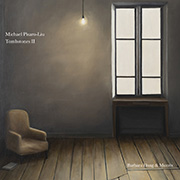
 Michael Pisaro-Liu: Tombstones II [Circum-Disc]. Four years ago, Barbara Dang and the ensemble Muzzix put out a recording of selections from Pisaro-Liu’s songbook Tombstones: a set of essential distillations of song-form. Here are the rest of them, again sung by Maryline Pruvost. Again, the material and the interpretative approach can be likened to gemstones under a magnifying glass. The remaining pieces in the cycle allow for a sort of interlude to appear at times in this batch: “The outside of everything” focuses on long-held tones and beating frequencies, the stop-start of “Rattle” is intuitive but impersonal – a good analogy for the entire set. Around the middle of the album “Time may” brings everything almost to a standstill before the music becomes a little more expansive again, with the final work played here “The darkness is falling” recalling Cage’s Experiences No. 2, sung well.
 Niels Lyhne Løkkegaard, Michael Pisaro-Liu: Fata Morgana [Edition Wandelweiser]. I get the idea; but you can’t listen to an idea. First part is Løkkegaard outside somewhere idly tootling a recorder for a good while, with wind blowing into the mic now and then to remind you this is all spontaneous and artless: life with the boring bits left in. Second part is same again with fidgety electronic schmutz overlaid by Pisaro-Liu. There’s too much fiddling about for its own sake: the sounds aren’t interesting enough to reward attention but also too intrusive to be sufficently uninteresting that your attentiveness open outwards. Just looked at the cover and remembered it’s Wandelweiser.
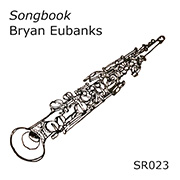 Bryan Eubanks: Songbook [Sacred Realism]. I can’t imagine ever getting enthusiastic for an album of soprano saxophone solos, even if it’s only about half an hour long. Eubanks plays horn: there’s electronic schmutz here too, but subtle. Is it necessary? I guess, in that the soft crunch and distorted thuds that underline the more forceful notes don’t so much punctuate the solos and ground them, pinning each one down to a flattened, cubist perspective. Eubanks’ expressive lyricism on display here is similarly cubist in its muted palettes and calm angularity, melodic lines reminiscent of Brant or Wolpe at their most serene (sorry, I’m devoid of suitable jazz references). I find it all kind of ugly but maybe your ears work better than mine for this stuff.
 Jordan Topiel Paul & Bryan Eubanks: Pushovers [Sacred Realism]. Eubanks is back to pure electronics here, applying a modular synth to Topiel Paul on snare drum. That’s not the most appetizing combination on paper either, but the two of them really pull out the stops to make it work, Paul mining the amplified drum for a surprisingly deep array of textures and timbres, using it as a source of sound more than rhythm, with smart and sympathetic treatments by Eubanks. At times the synth reworking of the drum sounds like real-time tape manipulations, giving both acoustic and electronic musicians the feel and flow of live performance – I’m guessing these are studio improvisations. They actually do achieve the “ambiguous textural and rhythmic universe where synthetic and acoustic meet” as described in the sleeve notes; that doesn’t happen every day. Each of the four tracks, ranging from five to twenty-five minutes in length, combine a dramatic sweep with attention to detail that make listening to it at home as much fun as listening to it half-cut in a noisy art club.
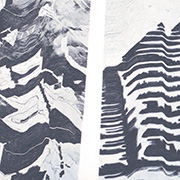 Cosimo Fiaschi: unveil / unfold [Insub]. I can’t imagine ever getting enthusiastic for an album of soprano saxophone solos, even if it’s only about half an hour long. I can make exceptions though, and the two pieces Fiaschi recorded here (both on the same day, it seems) hide the source of the instrument by making each piece a study in tone – prolonged notes approach what appears to be pure, uncoloured pitch, until an added overtone or small change in breath reveals the hidden coloration. The sounds and the methods are electronic, even though both are achieved acoustically, through human means. Never quite drone, never quite ambient, Fiaschi’s pair of works carve out space into a clean acoustic shape which leaves an immediate impression that becomes more intriguing with prolonged examination.