 Eva-Maria Houben & Harmjan Roeles: given [Sawyer Editions]. The last time I reviewed something by Houben I called her composition style as “on the cusp between just-enough and not-enough”, but her collaborations can often go in unexpected directions. In given, she plays a neat little portable pipe organ as part of a trio with Harmjan Roeles on double bass and the producer Roeland van Niele – yes, they describe their practice as involving all three. I don’t see any recording venue or dates on this album so the circumstances of the perfmormance(s) heard here are for conjecture, but the sleeve notes refer to it as an “exercise in breathing”, presumably with the producer providing outsourced mindfulness. In the first part they are susceptible to mood swings, with Roeles’ bass growling in the lowest registers while Houben’s organ is unsettled and flighty, with occasional florid outbursts. They gradually centre themselves, until by the end of the first part and throughout the remaining two they achieve near-immobility. The two musicians occupy a strange space in which timbre and pitch start to blur into a single quality, making as little overt action as necessary to produce sounds in which bow on string matches air through pipes, clear tone meshes with overtones. While working their way down to almost nothing, they never lapse into stasis; rather they feel their way through the piece moment by moment. Lasting over an hour, they seem to achieve a reductive endpoint by about a third of the way through, yet by extending far beyond this apparent limit they keep finding new places to explore with increasing attention and refinement.
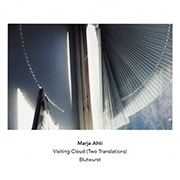 Marja Ahti: Visiting Cloud (Two Translations) [Another Timbre]. This is the first solo work by Ahti that I’ve reviewed, and it consists of two electroacoustic compositions from around 2019-20 that were repurposed for the all-acoustic Blutwurst ensemble, featuring Cristina Abati, Marco Baldini, Luisa Santacesaria et al. Laurence Binyon’s aphorism “slowness is beauty” is the watchword here: these new arrangements are about twenty minutes each, somewhere between two to three times longer than the originals. Which I haven’t heard, so I can’t make comments on the tempo. What I do hear is that Chora is stately and sumptuous, rendered as a slow series of chords that gradually fill out an existing harmonic idea rather than follow any form of development or process. The ensemble plays viola, trumpet, cello and double bass, bass clarinet, accordion and harmonium, offering a rich palette of sounds from relatively small forces. In Fluctuating Streams the progression is more linear, starting with unvoiced sounds that slowly morph into monotones, then begin to take on simple harmonisations. Once again, Ahti and Blutwurst prefer not to build up but to detail a single musical image, reaching a certain stage of completeness and then examining its effects at length, creating a piece with a strangely sinuous aspect to its languor.
Filed under: Music, Reviews by Ben.H
Tags: Eva-Maria Houben, Harmjan Roeles, Marja Ahti
No Comments »
In the field: Ahti & Ahti, Marta Zapparoli, Michael Pisaro-Liu
Thursday 30 November 2023
 Marja Ahti and Niko-Matti Ahti created this piece for radio in 2020. Nokivesi (it means ‘soot-water’) is a musique concrète montage of domestic and natural sounds, deftly treated with electronics and some synth work, threaded through with fragments of spoken dialogue. It tells a fragmented story of some sort, which is lost on me as I don’t speak Finnish. Even though deprived of a clear meaning, it’s effective in the way it conveyed an impression of rural isolation without me needing to look that up in the sleeve notes. Even though sober tales of the ruminative and bucolic kind aren’t really my thing, I – wait, is that an electric kettle boiling near the beginning? The same kind of sound I was admiring in Ryoko Akama & d’incise’s No register No declare? Maybe they heard Nokivesi on the radio and made an homage, or it’s a happy coincidence, but for the record the Ahtis got there first.
 I’ve probably ranted enough about my hangups with field recordings (tl;dr you gotta be good) so it’s nice that Dissipatio has found a novel twist on the genre. Marta Zapparoli’s field recordings are of magnetic fields, specifially those produced by the Aurora Borealis. Her Interdimensional Generated Space is a half-hour composition made from these electromagnetic emanations, captured by her on a variety of devices, including a homebrew crystal radio. It’s evidently the result of a lengthy period of field research, notable for the variety found in the thin but densely detailed sounds collected here. Zapparoli has produced something just stable enough to present a coherent listening session, yet filled with disruptions and breaks that underline the mercurial nature of the phenomenon, reflecting that their aesthetic delights (visual and aural) can be captured but not controlled. Further details emerge on re-listening. Also, props for releasing a digital download in original one-track mono instead of a dump of the CD master.
 This is close to miraculous. Michael Pisaro-Liu’s A room outdoors is a 2006 composition lightly scored for harmonium, any sustaining instrument and field recordings. In this piece, the field recordings bring the outdoors, indoors, to create a imagined space for the musicians to play. These two substantial realisations published by elsewhere feature Guy Vandromme and Adriaan Severins on keyboards and synthesizer, recorded in Brussels in April 2020 (lockdown time) and a version from Cremona this summer, played by Luciana Elizondo on viola da gamba with Vandromme on Indian harmonium; Fabio Gionfrida mixes the field recordings here. The playing is sublime, recalling the subdued simplicity of Ferrari’s Presque rien, but given deeper colouring and shade by Vandromme and Severins, neither musician intruding to comment but only augment the sound into an evocative pastoral without a narrative. The Cremona realisation, with Vandromme switching to a rougher instrument and Elizondo’s string playing, adds a sharper relief of acoustic sounds to the mix, with more to direct the listener’s attention without either musician being so crass as to demand it. Each is notably different in their intepretation while staying true to the piece, with the musicians both offering a richly satisfying evocation and contemplation of landscape, much in the same way that landscape itself presents form and subject as one.
Filed under: Music, Reviews by Ben.H
Tags: Ahti & Ahti, Marja Ahti, Marta Zapparoli, Michael Pisaro-Liu, Niko-Matti Ahti
1 Comment »
Judith Hamann: Peaks and Portals
Thursday 1 October 2020
 I’ve enjoyed cellist Judith Hamann’s music for years now, both in solo live shows and as part of Golden Fur. We’re finally getting more recordings out in public, with more on the way soon, it seems. The upcoming releases from Blank Forms focus on her cello playing, but the new Black Truffle album Peaks is an unexpected deviation into the unknown. It starts normally enough with Hamann playing characteristic sustained tones. There’s faint ambient noise in the background, which by now we recognise as the sounds of a lockdown home recording (it is not). The cello’s strings extend into a softly keening electronic drone; more prominent voices emerge from the echoes. Soon, the cello is lost altogether in hazy montage of locations, events and people, as though half-recalled in reverie. Sounds can be identified but their presence remains elusive as each slips in and out of perception. Hamann’s art has left her travelling the world for the past few years without ever settling down into a place of her own. Peaks is a powerfully evocative and poignant reflection of life in flux, made all the more compelling by never lapsing into the medium’s clichés in content or technique.
 Hamann’s collaboration with Marja Ahti on Takuroku, Portals, could be a companion piece to Peaks. Each currently resident in Finland but forced to work remotely, the two musicians fashioned a dialogue of their respective crafts. Ahti’s skill at constructing soundscapes with a strong sense of place is decentred here, with Hamann adding new musical and physical perspectives. With Ahti, the sonic images and narrative are more distinct, but it’s a double image and the narrative becomes a soft but insistent dtory of displacement. These are two of the most haunting works to come out of this year’s isolation, particularly because we know from their circumstances they will continue to speak to our anxieties in other times to come.