Congratulations on being chosen Time magazine’s Person of the Year! Use your powers wisely. And spare a thought for the ad executives about to get fired for thinking up this ad for Chrysler, after it spent millions of dollars securing sole sponsorship for this issue of the magazine.
Yours sincerely,
Ben.H
Time Magazine Person of the Year, 2006.
Filed under: Stupidity by Ben.H
No Comments »
Zen and the art of Magic 693
Sunday 17 December 2006
Circa 1.00 am on Monday (local time) Magic 693 1278, the world’s greatest radio station, played the following set of songs, keeping shift-workers alert with the mental whiplash-inducing combination of:
- The Everly Brothers: Cathy’s Clown
- Nana Mouskouri: Four and Twenty Hours
- Elmo and Patsy: Grandma Got Run Over By A Reindeer
- Southern Sons: Hold Me In Your Arms
- Scott McKenzie: San Francisco (Be Sure to Wear Some Flowers in Your Hair)
- Deodato: Also Sprach Zarathustra
Someone at Magic has obviously grasped the concepts of henka (change) and atarashimi (newness, refraining from stepping back) as practiced by ancient masters of the Japanese renga.
To cap this off, they followed with a plug for their traffic reports (generously sponsored by Mobility Aids Australia) which was backed by everybody’s favourite, “Tijuana Taxi”.
Unfortunately, they later blew it by playing Johnny Farnham’s “I Saw Mommy [sic] Kissing Santa Claus”, adding insult to injury by referring to him as an “Aussie Icon“. And by calling him “John Farnham”.
Gene Pitney Watch: I’m Gonna Be Strong
Filed under: Music by Ben.H
No Comments »
Index update? What index update? (Equine Remix)
Sunday 17 December 2006

Hello to TimT, who guessed that the mystery location was the White Horse of Uffington, seen here again from a more comprehensible angle. If you plan to visit between September and May, bring wellingtons! Chalk mud is a bastard.
The Scalagna debacle, as promised, keeps rolling along. In the latest news, Roberto Alagna has been staging a one-tenor picket outside La Scala, singing (badly) and reminding everyone that his last wife died, and appearing on TV playing up his Sicilian roots by singing a traditional song about a dead donkey, complete with hee-haw noises. No, it’s not about the donkey’s head ending up in a theatre manager’s bed.
Also, an expanded version of Contextualising the Contemporary Artist Yadda Yadda Tracey Emin is now posted at Sarsaparilla.
Filed under: Music, Travel by Ben.H
4 Comments »
Filler by Proxy XLIII: How long until someone makes an opera out of this?
Thursday 14 December 2006
There’s a big crossover audience in the fanbases for opera and for giant, train-wreck hissy fits, so there’s something for everyone to enjoy in the ongoing scandal at La Scala after tenor Roberto Alagna walked out of a performance of Aida on Sunday, after just ten minutes on stage. As over-reactions to mild booing go, they don’t get much bigger or better than this.
Opera Chic has the most frequently updated chronicle, as the surprises keep coming thick and fast, as well as the juciest details. Scroll back to 10 December to savour the unfolding mayhem in its chronological glory. YOU WILL SEE:
- Alagna sing damn near a semitone sharp during his first aria, then shake his fist at the audience and storm offstage when the fans are less than appreciative!
- An understudy replace Alagna onstage for the remainder of the opera, still wearing his street clothes!
- Alagna swear he will never, ever come back to La Scala!
- Alagna backpedal furiously in a series of increasingly demented interviews (seriously, how was one of the highest-paid tenors in the world to know that Italian audiences could be passionate and voluble?), once he notices everybody lining up to sue him!
- The undertsudy in his shirt and jeans admit he wasn’t the official stand-in (who was already in costume) for Alagna’s part: he just took advantage of the confusion backstage and ran on singing before anyone could stop him!
- Alagna announce his plan to countersue La Scala for “promoting a hostile work environment”!
- La Scala lock Alagna out of the theatre when he tries to come back, then tell him they won’t be paying his hotel bill!
- Increasingly convoluted rival conspiracy theories!
- Extreme closeups of Alagna’s gold platform sandals!
- Director Franco Zeffirelli offer up one of the most poised and comprehensive smackdowns in recorded history!
- Ballerino Roberto Bolle tell anyone who will listen all about his perfect arse!
- More, more, more! The craziness just doesn’t stop!
Video of the walk-off and switcheroo is, of course, on YouTube. It’s worth watching just to see mezzo soprano Ildiko Komlosi pull a double-take worthy of Margaret Dumont as she’s suddenly confronted by a pharaoh in shirt and jeans.
Filed under: Filler By Proxy, Music by Ben.H
2 Comments »
The cosmopolitan rush of Surrey; the interminable Peter Holm.
Wednesday 13 December 2006

Yes, it’s a placeholder. Today’s post about Morton Feldman has been held over until tomorrow, because it’s late and I suspect it’s gibberish.
Filed under: Self-promotion by Ben.H
No Comments »
A bitterly cold morning at a famous landmark somewhere in England.
Friday 8 December 2006

No time to write anything substantial, so in the meantime please enjoy the above photo. Feel free to speculate on where it was taken.
Filed under: Travel by Ben.H
2 Comments »
Contextualising the contemporary artist within capitalist society: a case study
Tuesday 5 December 2006
(Fournier Street, Spitalfields. Evening. A TOUR GUIDE is leading a small CROWD on a Jack the Ripper tour. He stops to point out the sights.)
TOUR GUIDE
Here we see Christ Church, the masterpiece of Nicholas Hawksmoor, known as “the Devil’s Architect”. People have spent decades trying to decipher the occult symbolism behind its mysterious design.
Here we see Christ Church, the masterpiece of Nicholas Hawksmoor, known as “the Devil’s Architect”. People have spent decades trying to decipher the occult symbolism behind its mysterious design.
CROWD
Aaah!
TOUR GUIDE
Opposite, we stand before the infamous Ten Bells pub, where the Ripper would select his unfortunate victims from among the ladies of the night.
CROWD
Oooh!
(Concluding his lurid peroration, the CROWD continues its walk up the street a little further, when the TOUR GUIDE stops again to call attention to another place of similarly sordid interest to the tour. He gestures at a doorway in a modest row of brick houses in the shadow of the church.)
TOUR GUIDE
And this house is the residence of the notorious modern British artist Tracey Emin, who paid one million pounds for the house several years ago.
CROWD
Whoah!
(On one of the upper storey windows, a wooden shutter suddenly bangs open. The head of TRACEY EMIN appears, leaning over the sill to yell into the street below.)
TRACEY EMIN
One POINT ONE million!
FINIS
Also published at Sarsaparilla.
Filed under: Art, London by Ben.H
2 Comments »
The half-yearly list: condition stable
Wednesday 29 November 2006
I am happy to report that for once there have been no additions to The List of People Or Things I Have Been Mistaken For, Or Allegedly Physically Resemble, In Increasing Order Of Ridiculousness, in the past six months.
Filed under: Self-promotion by Ben.H
No Comments »
Filler by Proxy XLII: I just spent fifty pounds to stand around in some godforsaken town freezing my arse off pointlessly arguing with someone.
Monday 27 November 2006

Via Straight From The Tated . If he’s anything like me, God has Prince Charles, Camilla Parker-Bowles, a Chinese man in an ambulance, and Elizabeth Montgomery on His fridge.
Filed under: Filler By Proxy, Stupidity by Ben.H
No Comments »
What do people do all day?
Wednesday 22 November 2006
In Köln, every office worker sits impassively regarding a slimline computer monitor at an otherwise empty desk.
Filed under: Travel by Ben.H
No Comments »
A quarter of a million people sitting at home watching TV
Wednesday 22 November 2006

I’ve added a few more photos to the Looking at People Looking at Art group on Flickr. These are from the launch of Raum 2810, a new art space in Bonn, which opened with an exhibition and collaborative performance by Michael Graeve and Christoph Dahlhausen.
I was over there for a weekend, to catch up with an old friend. The girlfriend is still thanking me for making her spend the weekend at an abandoned factory in a dormitory suburb on the outskirts of a dull, provincial town in one of the drabber corners of Germany.
Actually, the exhibition and opening were very pleasant; the people were friendly and invited us to stay on afterward for an enormous buffet and copious amounts of Australian shiraz cabernet. All very good, even though one of the dishes was a salad of onion rings and pineapple chunks in mustard sauce.
The old city centre of Bonn was bustling with crowds on Saturday, particularly with crowds of drunk people in silly costumes: it was the first day of Karneval. Yes, this part of the Rhineland starts its pre-lenten festivities in November. But then at night, and on Sunday, the city is deserted: it’s quite a job just finding somewhere to grab a coffee. After 10pm it’s possible to walk through the central streets utterly alone. It was uncannily like being back in Adelaide on a Saturday afternoon.
The girlfriend tried to amuse herself by photographing everything in town with the name “Beethoven” arbitrarily plastered over it, but her camera only had a 512 MB memory card. Nothing was named Schumann, despite both Robert and Clara being buried there, having lived at Endenich, which is now a suburb.
Even the toilets in the bars were hung with posters advertising the next piano recital at the Beethoven Konzerthaus, along with ads for Vicky Leandros’ christmas concert. Sadly, I think I’ll have to miss that.

Filed under: Art, Travel by Ben.H
No Comments »
Another London Pilgrimage: Wyndham Lewis
Sunday 19 November 2006

This jolly building is No. 4 Percy Street, Fitzrovia (“it would be called Soho by a careless guide”), sometime home of Wyndham Lewis at the time he was writing Tarr. No blue plaque marks the site, although Charles Laughton and Coventry Patmore have plaques on the same block. Appropriately, the ground floor is now a boutique called “Almost Famous”, and the first floor houses a “brand development” company.
(In fact, Lewis does have a blue plaque, but at one of his later residences, in Kensington.)

A little further south, across Oxford Street, is Soho Square, where T.E. Hulme once hung Lewis from the railings after an argument got a little out of hand. “I never see the summer house in its centre without remembering how I saw it upside down.” According to Humphrey Carpenter’s biography of Pound, the dispute was about which man had bonking rights over Kate Lechmere, but I haven’t found corroboration for this anywhere else, and Carpenter had a habit of ascribing motivations to his subjects based on nothing more than his distaste for them.
The statue is of Charles II. Despite his presence, there are no pelicans to keep down the rampant pigeon population.
Soho Square is also the place where Hulme was once apprehended by the law for urinating in public, in broad daylight. Hulme was indignant: “Do you realise you’re addressing a member of the middle class?” The policeman apologised and went away. I looked, but couldn’t find a plaque to commemorate the event.
Filed under: Art, London, Writing by Ben.H
1 Comment »
Masons in Distress!
Wednesday 15 November 2006
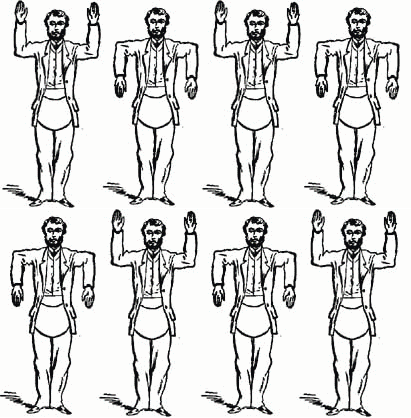
(Somewhere between Bonn and Bristol. Back in a few days. There are comments on the posts below to tide you over.)
Filed under: Self-promotion by Ben.H
No Comments »
London: City of Disappearances
Friday 10 November 2006
As part of my recurring curiosity about London’s psychogeography, I went to the launch of the book London: City of Disappearances in Bishopsgate. Bishopsgate was an appropriate location for the launch: the City’s frontier, the line of the old city wall acting as a threshhold where the establishment’s corporate bastions give way to the rapidly redeveloping East End. All around the Bishopsgate Institute’s Great Hall are new cafes and bistros built over what was formerly bohemian squalour, and before that working class and immigrant enclaves.
My own place in Hackney is on a similar border, but between two manifestations of the same economic weather. To the west, gentrification and property speculation encroaches, as the housing estates gradually disappear, one by one. Just to the east lies Olympic territory, the Hackney Marshes destined for wholsesale reconstruction by 2012.
The book, a collective repository of memories from the famous and unknown alike, solicited from an open call for contributions, was edited by Iain Sinclair, whom I have discussed several times before. He spoke of the intertwining of history and myth, of the city as a tissue of ephemera related from one individual to the next, its identity made or lost through what someone remembers or forgets.
“Every appearance is a disappearance,” we were reminded, thinking of the construction sites that surrounded us. It was not a necessary injunction. As a newcomer, I knew that arriving in a city entails always being reminded of how much you have already missed. As for Londoners, they are so preoccupied with memories, with conservation and preservation, that every change in the city is regarded as a loss. The preservationist urge is so strong in most Western cities today that the population’s response to the cityscape is almost entirely reactive, focussed exclusively on what is to be destroyed, with no deep consideration of what is to replace it. Really, it would be more instructive to remind ourselves that every disappearance is an appearance, for ill or good.
Sinclair himself has been guilty of this kind of barbaric nostalgia – who, not knowing what is of value, hoards everything – reacting to every alteration and relocation with an innate fear and mistrust. Transported back to Victorian times he would have doubtless been dismayed by the excavation of the sewers. His attitude has become more enlightened lately, having explored further afield into the suburbs, and learning from J.G. Ballard how to appreciate the new city that has sprung up in the Docklands.
Someone asked how he knew that all the stories collected are true. “I don’t.” Everyone invents their own world, and so each London described cannot help but bear a greater or lesser resemblance to the city you or I would recognise. Some of the collected memoirs are likely fabrications; some flatly contradict each other. (Two ageing anarchists in the book claim to have been working in the same Charing Cross Road bookshop at the same time, and each vociferously denies that the other was there.)
The book will not give a definitive overview or coherent mapping of a city plainly seen, but hopefully in its omissions, repetitions, dead ends and contradictions, its confusion will make a truer reflaction. As someone who prefers to play the hunter-gatherer of used and remaindered books, it will again be a portrait partly eclipsed by time when I get around to reading it.
Filed under: London, Writing by Ben.H
9 Comments »
Magic 693: The Listening Test
Wednesday 8 November 2006
Over at Sarsaparilla there has been a discussion about whether or not Magic 693 is the haven of awesomeness I described, or a high-rotation hell of the more obvious chestnuts. In the interests of objectivity I listened for an hour or so and wrote down their playlist, reproduced below. Songs with that ineffable “Magic” quality are marked with an asterisk; two asterisks mean a particularly “Magic” segue.
- Olivia Newton-John: Twist of Fate* (Mis-announced as “Second Time Around”)
- Herb Alpert and the Tijuana Brass: Tijuana Taxi**
- Charlie Rich: Behind Closed Doors
- The Diamonds: Little Darlin’
- Peter, Paul and Mary: Leaving on a Jet Plane*
- Stevie Wonder: For Once in My Life
- Dr Hook: Sharing the Night Together
- Gene Pitney: Mecca*
- ABBA: SOS
- The Walker Bros: The Sun Ain’t Gonna Shine
- Julio Iglesias: Drive (lame Cars cover, not a lame REM cover)
After this low point comes a sustained passage of brilliance which makes Magic so special:
- Normie Rowe: Ooh La La*
- Lobo: Don’t Expect Me to Be Your Friend*
- Ned Miller: Invisible Tears*
- Herb Ohta: Song for Anna*
- The Bee Gees: World*
- Christopher Cross: Arthur’s Theme (Best That You Can Do) (back announced with the comment “great lyrics!”)
- Astrud Gilberto and Stan Getz: The Girl from Ipanema (yes, the announcer remembered to name-drop Stan Getz)
- Tom T. Hall: Old Dogs, Children, and Watermelon Wine**
- Simon and Garfunkel: The Sounds of Silence
- Lulu: To Sir With Love
- Foster and Allen: I Will Love You All My Life
- Bruce Channel: Hey! Baby*
- Bobby Goldsboro: Summer (The First Time)**
- Peter and Gordon: I Go To Pieces
- Rod Stewart: That’s All (Sigh. Rod Stewart covers creaky old standards: the aural equivalent of Patterson’s Curse.)
- Mary Hopkin: Those Were The Days
- George Baker Selection: La Paloma Blanca*
- Bobby Vinton: Blue on Blue
- Billie Jo Spears: Blanket on the Ground**
- The Beatles: Michelle
- Dan Hill: Sometimes When We Touch
- Lonnie Lee: Starlight Starbright*
- Kevin Johnson: Rock & Roll (I Gave You the Best Years of My Life)*
And then I switched it off. I think this vindicates my opinion, don’t you? Ads included two rival Jayco caravan salesman, a shop that sells those self-lifting recliner rockers, Australian Pensioner Funerals, Ian Reid Vendor Advocacy (“Go on, ring us!”), Bayside Skin Cancer Clinic, Tyabb Packing House Antiques (“Need a new sideboard?”), and Leafbusters. Strangely, nothing from either Bargain National Tiles or OzKnits (“Love your cardigan! Paris?” “No! OzKnits at Ringwood!”)
I know it’s hard to imagine a station that plays “La Paloma Blanca” for serious, but look at their song choices for ONJ, Gene Pitney, and the Bee Gees! All that’s missing is Gary Puckett, and not spinning in either “Goodbye” or “Tema Harbour” for Mary Hopkin, but these are equally likely to happen at any hour of the day.
Also, Lonnie Lee has recorded a musical tribute to Steve Irwin, available for download! Lyrics printed for singalong with your kiddies, or anyone else’s kiddies.