It’s been a while since we all enjoyed a really hostile review, so please enjoy Heart On A Stick’s reaction to seeing a gig by indie wannabe-darlings Ra Ra Riot:
The world would be better off if they hailed from someplace like, oh, Chernobyl. There, people recognize tragedy when they see it. I imagine a bunch of concertgoing Chernoblians (sure, why not) in a post-show huddle, wondering just how quickly they could build another reactor and cause that to melt down.I admire the heroicism of the Ukrainian people….The guys on stage hopped about like indie clichés with tiny bladders filled with pissed-down Red Bull. There was the guy in the bad hat. The virgin in the ringer-T who desperately wanted to be Richard Reed Parry. The music-bleeding lead who’s probably never laughed in his life, not at the Three Stooges, not at the government, and definitely not at himself….It’s empty music from empty people for empty people who can’t bear to think of filling their lives with anything more than emptiness. It’s for people who can’t tell the difference between sincerity and honesty…. It’s an insult to anyone who’s ever been passionate about anything, an insult to the concept of passion itself.
Stand back, he’s just warming up.
Filed under: Filler By Proxy, Music by Ben.H
No Comments »
The Girlfriend is Learning Italian
Saturday 4 November 2006


Filed under: The Bunker by Ben.H
6 Comments »
The Night We Burned Down Bimbo Deluxe
Thursday 2 November 2006
“This is it! This is the new music!”
What do you do when your hard drive gets clogged with “temporary” files that never go away? You play them through a sound editor to hear what they sound like. One day I hope to record some music which takes less time to make than listen to: this piece gets pretty close to that goal.
This unedited file was subjected to four types of randomised filtering through parametric equalisers in Ross Bencina’s fine program AudioMulch, and then mixed by rapid, randomised crossfading between each of the four outputs.
So what does playing with 21st century technology get me? Maybe it’s the low quality of the sound from the original data file, or maybe it’s because I’m fifty years behind the times, but the piece sounds uncannily like the sort of tape music coming out of the Westdeutscher Rundfunk studios in Köln in the 1950s. In keeping with this sound, the title refers to the human phenomenon of futile longing for a vanished world.
It’s 4 Meg, it’s 4 minutes long. It’s noisy. Please download and enjoy The Night We Burned Down Bimbo Deluxe.
Part of the slightly revamped Boring Like A Drill Hit Parade!
Filed under: Music by Ben.H
No Comments »
The New Season at Sarsaparilla
Saturday 28 October 2006
The good people at Sarsaparilla have invited me to join their crew of kulchur bloggers, so of course I immediately accepted. Every now and then I’ll be posting stuff over there, which will either be cross-posted or linked to here.
My first contribution is up now, and even though you’ve probably read it before I suggest you go read it again, what with the nicer formatting and other interesting things to read that they have on their site.
Filed under: Self-promotion by Ben.H
No Comments »
Later, the pelican explained that it got the idea from reading my blog
Wednesday 25 October 2006
First it was the ravens, now it’s come to this. And always the pigeons pay.
Families and tourists in a London park were left shocked when a pelican picked up and swallowed a pigeon…. An RSPB spokesman said: “It is almost unheard of for a pelican to eat a bird. Their diet should be strictly fish.”
The bird got up and strolled along until it reached one of the pigeons, which it just grabbed in its beak.
Good.

Note for journalism students: the last two sentences of the linked article are a classic example of the inverted triangle in action.
Filed under: London by Ben.H
4 Comments »
Italy Welcomes American Tourists!
Monday 23 October 2006
On the tariff at the Tre Scalini café in the Piazza Navonna, Rome:
Coffee: €0.80 at the bar, €3.00 on the piazza.
Decaff: €0.90 at the bar, €4.50 on the piazza.
Coffee: €0.80 at the bar, €3.00 on the piazza.
Decaff: €0.90 at the bar, €4.50 on the piazza.
Filed under: Travel by Ben.H
No Comments »
Magic 693: an appreciation
Sunday 22 October 2006
A number of people have written in over the past few months to inform me that Magic 693, the greatest radio station in the world, has suffered a traumatic change. At first it seemed the station had gone for good, but instead it had just been shunted by its owner, without warning, to the more cramped frequency of 1278 KHz.
It’s an oldies station, with a focus on what people would generally describe as “easy listening” – e.g. they’ll play “Something” but not “I Am The Walrus” – but within that ambit they’re about the most eclectic radio station in the world. If they have a playlist, it’s so vast I’ve never been able to learn it. I once heard them segue from “Imagine” to “Baby Elephant Walk”, which is reason enough to love them.
They have a fairly loose, philosophical concept of “easy listening”, in any case. No-one would consider “My Boomerang Won’t Come Back” as a soothing piece of muzak, yet it has turned up without warning, right after Barbra Streisand. Magic’s disc jockeys are fearless, indiscriminately spinning anything that once was popular, without regard for taste, political correctness, or continuity, let alone the selective, sanitised memories of the aesthetic judgements of baby boomers. Their attitude can be heard from their ads for their Fifties show: “the Fifties was more than just rock and roll, and we play all of it!“
Besides the music, there is added appeal in listening to the ads. Magic presents itself to advertisers as “Melbourne’s highest-rating station for over-30s”, which is adspeak for geriatrics. The commercial breaks are invariably filled with spruikers for retirement villages, funerals, cat litter (“Is your home a bit… phew-whiff?”), and those recliner rocker chairs that tilt forward to get you up out of them. Bud Tingwell tells you about the good works of the Spastic Society and asks you not to give generously now, but to remember them in your will. They can wait a little longer for your donation.
Finally, there is also the mysterious fascination commanded by their announcers. There seem to be only three of them, who alternate in shifts that rotate around the clock, and after listening for years I still can’t distinguish one from another. The same guy is likely to turn up at 9pm on a Tuesday, and then at 3am on a Sunday.
The station’s indiscriminate inclusivity has put them far ahead of the cultural curve in a number of instances. Without realising it, they have perfectly implemented Negativland’s “Moribund Music of the Seventies” project on a mainstream, commercial station. They are also quite probably the only station which unironically plays records featured in the 365 Days Project, and always has done. A couple of times each I’ve heard them spin Jesse Lee Turner’s “The Little Space Girl” (see July 18) and Jack Clement’s rather fine “My Voice Is Changing” (see August 23) – an obscure B-side, according to the website.
It’s such a pity they’ve been shunted to a frequency with worse reception, and had to ditch their catchy station ID jingles; but on the upside, they’ve just introduced an internet streaming service! It sounds like someone’s holding a transistor to a styrofoam cup on the end of a taut string 16,000 miles long, but the one thing I have been wishing for since I left Melbourne is a reliable source of Joe South and Vicky Leandros broadcast into my house at any hour of the day or night. Now you, music lovers around the world, can share in the Magic.
Also, while looking for links for the above article, I discovered Bud Tingwell has a blog! I love the 21st Century.
Filed under: Music by Ben.H
4 Comments »
A potent mix of critical opinion and biographical fact
Friday 20 October 2006
Scrawled in biro over a poster for the movie of The History Boys on the platform at Euston station*: “Alan Bennett is an overrated poof from Yorkshire.”
Filed under: Journalism, London by Ben.H
No Comments »
Patrick White is a middlebrow hack.
Monday 16 October 2006
The final instalment of the online reading of Patrick White’s novel The Vivisector. Previous posts here and here.
“Then we also have our obligations to animals and humans,” she added with a moist pathos.He remembered the sackful of cats, and she lowered her eyes, perhaps on catching a reflection in his.
We remember it too, because we were told about it only two pages earlier. Even then, it was carefully spelled out to us that if a man is carrying a sack of cats to water, he means to drown them, do you see? The first sentence of The Da Vinci Code should be enough to convince you it’s not worth reading, yet it’s scarcely any worse than passages like the one above which litter The Vivisector.
There’s an old dictum that writers should show, not tell; but White has an exasperating compulsion to show, and then tell what he’s just shown. Perhaps he didn’t trust, or recognise, his own abilities as a writer. Perhaps he was pitching his writing toward an envisaged audience of reluctant students. Perhaps he was afraid that not quite everyone would appreciate his Depth of Feeling, and so had to keep reminding people that he was a Serious Writer, at the expense of the writing itself.
Just in case we’re too thick to get that the cats are Symbolic, Hurtle and Hero then proceed to argue about them for no-one’s benefit other than our own. Ridiculously, this carries on for several pages. Every subsequent, inevitable reference to cats for the remainder of the chapter (including one otherwise effective moment when Hero addresses her “adopted” Aboriginal child as “kitten”) comes across as phoney and heavy-handed as, well, something out of Dan Brown. An especially self-important Dan Brown.
For those wanting to keep track, Hurtle’s previous clichéd lover, the Maternal Whore, has been disposed of by authorial fiat and replaced in unconvincing circumstances by Hero, another clichéd lover, the Slumming Patroness. (Her husband is that other great cliché of the novelist’s time, the Greek Shipping Tycoon. Perhaps White was trying to forestall silly questions about where he gets his ideas from.) There is, of course, another patroness on the scene, and so another cliché, the Triangle, inveitably ensues, thus fulfilling the need for a section about The Artist And His Women.
Strangely, neither woman has apparently ever shown a personal interest in any other bohemian besides Hurtle. He is that most infuriating of stock protagonist types, the Guy Stuff Just Keeps Happening To.
The last three chapters of the book improve dramatically, inasmuch as they begin to play with our expectations more than fulfil them, albeit in a way that renders the preceding seven chapters superfluous. Hurtle is such an inert, narrowly defined character in the novel’s first 400 pages that there is nothing in him or the limited depiction of his world that enlarges upon our appreciation of the final 200. In fact, knowledge of the earlier chapters may even hinder our taking seriously the latter part of the book, with its plot heavily based upon a series of reunions of sufficient improbability to make Dickens blush.
White’s description of people and places is so thoroughly squalid that it becomes unintentionally comic; you could almost make a drinking game out of the number of times a character eats food that has spoiled. Ultimately, his unvarying determination to depict the vulgarity of everyday life is revealed as a veneer of bourgeois titillation to disguise the utter conventionality of the author’s thoughts behind it; a surface of exaggeratedly gritty reality to distract from the dishonesty of the characters and plot: the Crucified Artist Hero and Redemption Through a Child. The noble overreach of the book’s ambition is hamstrung by White’s self-regarding redundancies and need to assert the profundity of his unexceptional insight.
The Readers’ Group is planning another online reading of a White novel soon, which I won’t be joining. Reading this book put me off White more than I expected, and I don’t want to return to him in a hurry, when other, doubtless better books sit unread on my shelves. In particular, I don’t want to reread a White novel: I rather liked the ones I read years ago, and I’m afraid it will spoil my memories.
Filed under: Writing by Ben.H
6 Comments »
Simultaneously overenthusiastic and excessively lethargic
Tuesday 10 October 2006

New on the blogroll: Straight from the Tated . It has excellent taste in links.
Filed under: Art, Self-promotion by Ben.H
2 Comments »
New desk at last. It looks like this:
Tuesday 10 October 2006

Advanced East London anti-war campaigning techniques
Monday 9 October 2006
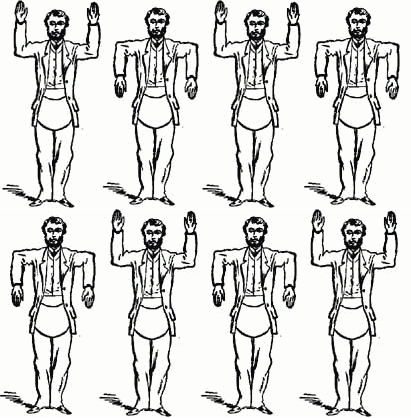
The real reason the war in Iraq is still going. Also, a rare sighting of the old Blogspot banner.
Filed under: Journalism, Stupidity by Ben.H
2 Comments »
Yeah, I can hardly believe it myself.
Saturday 7 October 2006
The name and subject indices have finally been updated, to the end of September. At last you can find out what El Lissitsky, Juvenal Habriarimana and Sally Thomsett have in common.
Also, the search function seems to have dropped off a few months back. I should probably get that fixed.
The long-dormant website will get some additions made to it over the next month, probably. Don’t hold your breath, though.
Filed under: Self-promotion by Ben.H
No Comments »
Filler by Proxy XL: An Incomplete History of the Art of the Funerary Violin
Wednesday 4 October 2006
For those of you with a love of the funerary violin, that obscure genre of music rendered almost extinct after it was condemned by the Catholic church in the 1830s, you will be glad to learn that Rohan Kriwaczek’s brand new book An Incomplete History of the Art of the Funerary Violin is now available on sale from Amazon (UK site only). Fittingly, Kriwaczek’s book is published by Duckworth, purveyors of the poetic oeuvre of William McGonagall.
If you don’t care much about funerary violin music but have a grudge against Pius X for his 1903 motu proprio on sacred music, this book may also be up your alley.
The New York Times gives a little more information about the book and the mysterious Guild of Funerary Violinists (you may need Bugmenot to get past registration).
Strangely, The Rosenberg Archive has been silent about this guild.
Filed under: Filler By Proxy, Music, Writing by Ben.H
2 Comments »
The Fall and the Liminality of Kitten Kong
Friday 29 September 2006
Has anyone made a comedy map of Britain? I don’t mean a map indicating clubs and the birthplaces of comedians; I mean a map marking the real locations inhabited by fictional comic characters, haunted by absurdist conceits. The more anonymous and duller a place is, the more likely it is to have been infused with significance by generations of comic minds: dormitory suburbs, brownfields, dead ends, postwar nowheres. Balham, Putney, Hendon, Cheam: London and the counties are held together in an invisible network of bathetic, negative landmarks. The enervated traveller crossing these liminal spaces is suddenly seized with a numinous inversion of meaning with which the no-place has become invested. What ley-lines connect these psychogeographical lacunae; do they awkwardly bisect the zones of conscious importance, or sneak behind and between through forgotten territory?
Last Friday night a self-selected cross-section of Londoners and American tourists were sharing a small frisson at finding themselves congregated outside a bingo hall in Cricklewood, reminding each other that The Goodies lived in Cricklewood. This wasn’t the reason we were all there; we had come to see a different British institution, of similar cultish appeal. We had come to see The Fall; or not see The Fall, as the case may be.
The Americans amongst us were hopeful of seeing a real, genuine Fall gig, having been repeatedly exasperated at home by the nominal band’s touring habits: either gracelessly imploding on stage or working a setlist top-heavy with interminable ten-minute dirges about supermarket car parks in Salford. (Mark E. Smith has his own appetite for psychogeographical nullity.) Perhaps they didn’t know that the band’s London gigs tended to be equally perfunctory: it seems anything south of Birmingham is much of a muchness, as far as Smith is concerned.
To get an idea of the venue, take a look at their website (proletarian visions of prosperity). No really, it’s priceless. A gilt-edged coffin for Punk’s corpse, WMC Blobs laid to boozy rest with Celtic troubadors and cowboys from Carlisle. As a harbinger of the muzzy haze of regression that threatened, the opening act was John Cooper Clarke, preserved like Sharon Osbourne.
Perhaps it was the faded premises on the cultural and subcultural margin that made the band turn up and play. The band, such as it is, all vestigal entity outside of Smith himself having long departed and now routinely replaced with such regularity that even fans can’t keep track of the musos’ names, has a reputation for only partly turning up, in body or mind; with Smith himself late, drunk, or a no-show. Instead of a vicarious trainwreck thrill we got the embodiment of a Rock Band at Work, of performance as routine.
Smith, famously looking 20 years older than his real age, stumbled round the stage snarling and hollering incoherently as usual, into one or two mics, as usual, dropping one or picking up the other, peripetetically bemused by their technical failings, nonconsensually futzing with his bandmates’ gear, as usual. Performance as routine, stripped of its romance and mythology when seen plain on stage as schtick – in the same way that he refuses to play any songs more than a few years old, Smith’s performance denies his fans the delusion of shamanism, of recollection of an intangible psychic resonance. What is left is form and technique, with no invocation of the past, to impress the punters – not appeals to faith. (My companion for the night, oblivious to The Fall’s history and significance, attested to this.) The conventional becomes experimental.
The band confined themselves to solid riffs, one per song, starting out OK and then locking into a tighter groove that propelled the music and voice into the higher levels, into the lower reaches of the transcendent state a good rock gig can give. After this peak it was in the recoil of the interval, ebbing into a slower, muted rhythm, “Blindness”, its protracted disorientation nudging the punters into a dreamlike semiconsciousness. Smith himself had delayed his entrance onstage, like Elvis in Vegas, but then disappeared early as well, before and after the encore, effacing himself backstage inconspicuously, not to return. It seemed over too soon.
Catching the band in an upswing of collateral cool thanks to John Peel’s untimely death, the crowd was a mixture of disoriented tourists, middle-aged punks in mufti, prematurely-aged anoraks comparing notes on Tuesday night’s gig (and observing that one band member had been sacked in the interim), curious students, a mosh pit, bright young things their dowdy finest, a pair of them dancing like frenzied muppets on the balcony behind the band, alternately irritating and amusing the more sombrely dedicated punters. And of course, the indifferent regulars up the back getting their pints in all the while.