No, apparently. I found a review in the paper about that Icebreaker gig last week – remember, the one that screwed up Philip Glass’ Music with Changing Parts in just about every possible way? The Guardian‘s review is more succinct than mine, but neglects to call Icebreaker an incestuous clique. Apart from that, we say pretty much exactly the same things.
One thing about the amplification used at the performance: Glass’ early music is meant to be LOUD, louder than it was at the Icebreaker gig. The problem wasn’t that Icebreaker were amplifying their instruments, but that the amplification was muddy, compounded by sloppy playing and a poor sound mix.
Zappa’s piece, pace Andrew Clements, sounded fine; possibly because Zappa was writing for a rock group and Icebreaker had hired a sound guy used to rock gigs? Just because it’s loud and you think it’s cool, doesn’t mean that a rock dude is the right choice for every type of music.
Filed under: Music by Ben.H
No Comments »
Name your ironic, Pavement-type indie band
Saturday 11 March 2006
- The Licensed Heroes
- Sex Yacht Wiki
Filed under: Music, Stupidity by Ben.H
No Comments »
A rare musical event: a bad Philip Glass performance that isn’t Glass’ fault
Thursday 9 March 2006
Icebreaker is a new music ensemble that lacks one of the most basic skills required by musicans in any genre: they can’t count. They listed seven pieces before the interval on their program at the Queen Elizabeth Hall last night, but played only six of them. For some reason the first piece got dropped from the concert.
We don’t know why the piece was dropped because noone, in either of the two awkward announcements to the audience, bothered to even acknowledge there was a change in the program. So, if you don’t usually go to concert halls gigs because you suspect that they’re a private party for incestuous cliques where you don’t belong, Icebreaker are here to prove you right.
The first piece they actually played was an ensemble arrangement of Conlon Nancarrow’s Study for Player Piano No.2b. Not many people applauded it, probably because they’d read the program and were expecting a piece 11 minutes long, and so wondered what had gone wrong when the musicians suddenly broke off after a couple of minutes. Of course, something had gone wrong: it was a bad arrangement, played badly.
I have never understood why people would want to arrange Nancarrow’s player piano music for ensemble, other than to allow musicians to show off at the expense of the music they purport to serve. The result is usually the aural equivalent of a watercolourist attempting to ‘enhance’ an Escher drawing. Nancarrow hand-punched music rolls for the player piano to play dazzlingly quick, complex rhythms with pinpoint accuracy. This wheezy arrangement for clumsily amplified winds and strings reduced all the detail and shape to a flat, muddy mess.
The remaining selection was a forgettable collection of condescending gestures toward accessibility, with all the ambition, depth, and canny grasp of cultural zeitgeist of an advertising jingle. There were two student pieces that sounded studenty: shapeless, limpdick prog-rock academically divested of any vitality.
The band pretty much admitted they were playing this stuff because it flattered them, so I hope at least they had fun playing it while boring the pants off anyone who had to listen to it. Honestly, there were more cheap thrills and a better rapport between musicians and punters at the supposedly egghead Elliott Carter gigs in January.
The second part of the concert was the main reason I went: Icebreaker were playing Philip Glass’ big 1970 opus, Music With Changing Parts. The concert hall was noticeably emptier after the interval: most of the absentees likely students who had dutifully turned out to see their colleagues/teachers in the first half, and felt no need stay a moment longer once their obligation was fulfilled.
Quite possibly, they were also superstitious types and wanted to avoid the curse of exposure to a piece by the ridiculously successful Glass written at a stage of his career when he still had to unblock toilets and drive a cab to make a living.
The derivative bombast which has fuelled the more financially rewarding phase of Glass’ career now obscures the fact that his music from the 1970s remains some of the most exciting and challenging music around. The early stuff doesn’t get played much: Glass restricts circulation of his scores, particularly ensemble pieces like this, written for his own group of dedicated musicians.
Unfortunately, it seemed like Icebreaker didn’t want to play this piece tonight. In the first place, fatigue was visibly setting in amongst the musos during the latter stages of the gig. In the second place, their interpretation of Glass’ piece was trying its damndest to make it sound as much like Steve Reich’s Music for 18 Musicians as possible.
Thirteen musicians (Glass typically made do with 6 to 8), some of them doubling on different instruments, were needed for this performance. Perhaps Glass would have liked to work with a broader instrumental palette when playing this piece in the 1970s, but I doubt he would have done it at the expense of keeping his ensemble tight, or together.
These days, maybe, he might simply hire a couple more mbira players to cover the bald spots, but he would not say to himself, “I’m sure the audience won’t notice when that really loud bass part drops out for two bars every now and then because the keyboard player has to turn pages.” (Pssst, Icebreaker. Rehearsals. Page turners.)
The unvarying pulse essential to Glass’ music was marred by sloppy changes from one figure to the next, poor and irregular intonation of some figures, and just plain disagreement between musicians about what the basic speed should be. Too often, when some kind of momentum was building up, another muso would take over after sitting out for a while and kill the pace. No more than three of the four keyboard players were active at any one time, but this relay-team approach failed to maintain any consistency across the piece.
The sound mixer spent much of his time working on damage control, trying to sort out the imbalance of instrumental sounds that the performers were incapable of resolving. Based on the first half of the concert, I’d say this particular Glass piece appealed to Icebreaker as one of the very few that allows some form of limited improvisation, but their excessive indulgence in these opportunities led to the musical material occasionally being swamped, and frequently chopped and changed so rapidly that the point of the piece was lost.
Pretty much everything Glass has written over the last 20 years has left me cold, so here’s one positive thing I took away from this gig. Given the crummy work he’s turned out over the last decade or so, I often start to doubt that he was ever any good. I still like this piece a lot despite the tone-deaf mangling it got from Icebreaker that night, so he must have been some kind of genius once upon a time.
I almost forgot: the one thing the band got right on the night was their early run-through of Frank Zappa’s brief Möggio, which I attribute to Zappa knowing his instruments and, more importantly, knowing his musicians: “Yes, you are all individuals – now do exactly what I tell you.”
Theatrical highlights: Electronic recorder guy almost getting garrotted when he went for a walk and forgot the lead on his instrument was only so long. One of the excessive number of keyboard dudes manically pattering out Glass’ repeating figures on his thighs when he wasn’t playing. Pity it didn’t help when he was actually touching the keyboard.
Overheard gossip in the foyer: The usual “music student going to see their lecturer get a performance” glad-handing.
Boring Like a Drill Cultural Beer Exchange: See the Xenakis reviews.
Filed under: Music by Ben.H
No Comments »
Tomorrow: Review of the Icebreaker gig at the IF Festival
Wednesday 8 March 2006
I still haven’t fully recovered from my trip to Riga over the weekend, so the review of the gig I went to last night isn’t finished yet. When it’s posted tomorrow, it will hold this blog’s record for the shortest turnaround from an event actually happening to me getting around to writing about it.
If you can’t wait that long, here’s the summary: it sucked. But how badly did it suck? The juicy details tomorrow.
Filed under: Music by Ben.H
No Comments »
In the back room of a pub in Dalston
Friday 3 March 2006
Ben Watson, a middle-aged adolescent in an op-shop jacket complete with a few stray badges on the lapels, his uncut hair swaying gently from his receding hariline, lightly crept from table to table, reciting glossolalic poetry written earlier in the day. In pauses between verses, his 18 month old daughter stood in her mother’s lap and applauded theatrically. Beside the bar, someone else’s kid wandered up to the piano in the back corner, and gently draped himself across the keyboard in affectations of ennui, accompanying the poetry with dense, plangent chords at irregular intervals.
Filed under: Music by Ben.H
2 Comments »
Continuing intimations of senescence
Monday 27 February 2006
I am old enough to belong to the generation that can remember Herbie Hancock’s Rockit and Harold Faltermeyer’s Axel F, which means that we are too old to remember clearly which is which. But what the hell, some journalists these days can’t even tell the difference between Faltermeyer and Eddie Murphy.
Just to keep you confused, the Evolution Control Committee have constructed their own version of Axel F, comprised entirely of chopped-up and reassembled bits of Rockit. Now you can prove to yourself, your friends and long-suffering family that it is, indeed, the same song. Pretty much.
I probably found this while looking through WFMU’s Beware of the Blog, so I’ll link to that too.
Filed under: Music by Ben.H
No Comments »
Heavy Metal + Curling = HEARTS ON FIRE
Wednesday 22 February 2006


Curling r0XX0r d00d!!!!!! Hammerfall and the Swedish Women’s Curling Team rock the rinks. Genius.
Filed under: Music by Ben.H
1 Comment »
Filler By Proxy XXXI: The Infamous London Records Chat Archive
Tuesday 21 February 2006
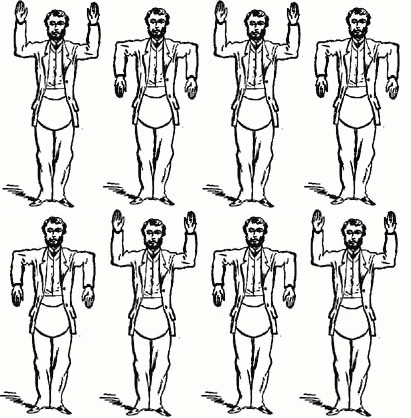
(Yes, the Masons are in distress again.) This is an old one and not pleasant reading, but it isn’t well represented on the web any more. Back in 1997 when corporations were pretty much clueless about the web, London Records (the American counterpart to Decca) launched their spiffy new classical music website, complete with a chat page:
We’ve included this area in the new site in response to the many requests for an on-line discussion forum. We hope that you will submit your comments and thoughts through the miracle of technology for others to absorb. Check back frequently as we’ll be refreshing this area with new topics.
Things started slowly in July and August, when most of the readers’ comments were about how lousy the London Records website was:
I have always held Decca/London in the highest regards for their recording quality, but the utter nonsense of this website greatly diminishes that reputation. This was truly a waste of my time.
By the end of August visitors were losing patience with the lack of updates and responses from anyone connected to the record label:
SO LONDON RECORDS THIS SITE IS SHIT AND MEANINGLESS. WAKE UP YOU BORING OLD FART OF A RECORD COMPANY… DO YOU HEAR ME!!!!!!!!@#@#$@#$$#@%
This message stayed up on the webpage for everyone to see. Finally, in September, Sir Georg Solti, one of the label’s greatest recording stars, died. Not a word from the London Records website, who contendly continued to list his forthcoming tour dates. And the floodgates opened. A message signed by Albert Imperato, head of London’s parent company Polygram, appeared on the chat page:
Hi there, this is Al, head of Polygram USA. Do you losers really think we care about your complaints? Shit, all of the money you chuckleheads spend on this classical crap would hardly buy me a noseful of decent blow. We’ll update this site if and when we fucking well feel like it, and I can tell you right now that it won’t be soon enough for you little crybabies. Why don’t you just stroke your little cocks if that’s all you want. As for Sholti, big fucking deal! I met him once and he blew me off, the arrogant bastard. Who cares about him now that he’s dead? Nobody at the New York office, that’s who!
For the next two months the page became a gratuitously offensive haven where, as Al himself put it, “potential customers have been asking their innocent questions for weeks, while persons sporting the names of top Polygram USA officers have been answering them with foul language, racial and sexual abuse, bad spelling and bad grammar! And that this has been happening on a server owned by Polygram itself.”
Eventually, the entire London Records website was taken down… except for the chat page.
Of COURSE it’s for real, you drop of piss from an old queen’s underpants. Look at the fucking URL if you don’t believe me. This is actually the server owned by Polygram Records, and this is all that’s left of the official London Records page. I am Albert Imperato, and while my title is Vice President of Deutsche Grammophon in the U.S. I am the guy in charge of marketing. I was given this job by my godfather (don’t laugh or I’ll have your eyes in a shotglass) after my cousin Cenzo screwed me out of some of the more lucrative family business out west… If I don’t start getting some RESPETTO I’m going to wipe some Clifford Curzon master tapes, and I mean wipe them on my ass after a prolonged shit. So enough of the stupid questions, and if you don’t like it you can fuck a donkey for all I care!
The almost-complete page has been archived, which, as I said, is not pretty reading but a good way to kill time if you like your trainwrecks long, slow, and laden with filth and invective.
London Records’ classical branch was closed down soon afterward. Polygram’s old web addresses now point to Universal Music Group; their classical site, iClassics, has a link to Sir Georg Solti on its front page.
Filed under: Filler By Proxy, Music by Ben.H
No Comments »
But when barrel-scraping stage musicals became known to more and more people, the demands to do something about Ben Elton became louder and louder…
Sunday 19 February 2006
So it’s come to this. Lord knows there’s enough crappy musicals plaguing the surfeit of fleapit theatres that infest London’s west end. Not content with Abba tribute shows, Queen tribute shows, Billy Joel tribute shows, and Joe Dolce tribute shows, the West End is racing to the bottom in a desperate bid to take more money from dazed tourists still punchdrunk from the currency exchange rate. I spotted this down the pub:

At first I thought, “Wow, two hours of Eagle Rock played over and over”, but then I noticed the tiny print below the big title and my heart sank. Apparently it tells the story of a young man who hangs out with Rasputin, Ma Ba(r)ker, Ross Wilson and baby Jesus. Please note that it says “love and music”, not “love of music.”
Previews start on 26 April, so hurry! Australians will eat this shit up too. Americans are less likely to get it (in more than one sense).
Worse still, it’s not just Boney M but other bands created by musical genius Frank Farian – this includes Milli Vanilli. Yes, the little blue flyer promises that punters will get to “Girl You Know It’s True”, but doesn’t mention that for the first time ever, you will actually see someone really sing it. Although this is true of all the blokey bits in Boney M’s oeuvre as well.
It’s worth reading the interview with Farian about the show, if only for the choice quote, “I can’t make a comedy, it doesn’t go with our songs.” More importantly, it reveals the Boney M no-one remembers, such as their mid-80s attempt at prog-rock, and the long lost TV special…
which Farian says was called Boney M Lost the M. “What was the plot of that?” He shakes his head. “The story was Boney M lost the M. It was a very low-budget film.”
Think about it: it failed to meet Frank Farian’s standards. I need to see this.
Filed under: Music, Stupidity by Ben.H
No Comments »
Filler by Proxy XXX: Billy Stewart sings ‘Summertime’
Friday 3 February 2006
B-rrrrrrrrrrrrrrrrrrrrrrrrrrrr!
Up-jump-jump
Chuka-chuka-jump-jump
H’uh! Jump!
Up-jump-jump
Chuka-chuka-jump-jump
H’uh! Jump!
(horns & instrumental begin)
A-summertime an the livin’ is easy
Fish are jumping
Don’t ya know my darlin’?
I-I said, a-right now
An a-cotton is high
Fish are jumping
Don’t ya know my darlin’?
I-I said, a-right now
An a-cotton is high
Laka-laka-laka yo old daddy is rich, so damn rich, girl-a
An a-yo mommy’s good looking, yeah-ay
So, a-hush pretty little, baby
Don’t a, a-you cry
An a-yo mommy’s good looking, yeah-ay
So, a-hush pretty little, baby
Don’t a, a-you cry
One-a-these, a-one-a-these a-one-a-these mornin’s come up, early
Ya gonna rise, ya gonna rise up, singin’
Then you spread yo little wings
Yo little wings
An-a take to the sky-la-la-la-lie
B-rrrrrrrrrrrrrr
Until a-that mornin’, you’re a free maid
There’s a-nothin’ a-gon’ harm you, girl
With a ‘dombie’, an a-daddy standin’ by
Ya gonna rise, ya gonna rise up, singin’
Then you spread yo little wings
Yo little wings
An-a take to the sky-la-la-la-lie
B-rrrrrrrrrrrrrr
Until a-that mornin’, you’re a free maid
There’s a-nothin’ a-gon’ harm you, girl
With a ‘dombie’, an a-daddy standin’ by
Yeah, blues!
(sax & instrumental)
Come a little la-a-a-ate
Payin’ up the dues
Give you the blues
I know my little darlin’ I love you, so
An a-never gonna let you go
Lord!
La, la-la-lie
Payin’ up the dues
Give you the blues
I know my little darlin’ I love you, so
An a-never gonna let you go
Lord!
La, la-la-lie
Tell-a lie, tell-a-lie, another lie, another lie, another lie, another lie
Say, pretty baby
Cannot save the day yet, girl
Hush, pretty little bab, don’t wanna have you cry
Hush! Shush!
Say, pretty baby
Cannot save the day yet, girl
Hush, pretty little bab, don’t wanna have you cry
Hush! Shush!
Don’t a-you cry, Lordy little darlin’, I say girl
No-po’ child, I said a-right now
A-listen, baby
No-po’ child, I said a-right now
A-listen, baby
I don’t, I don’t, I don’t, I don’t want you to die
Don’t-a, pretty baby child
A-don’t let-a tear, don’t let a tear
Fall from yo eyes!
Hey!
Don’t-a, pretty baby child
A-don’t let-a tear, don’t let a tear
Fall from yo eyes!
Hey!
All that mama do to please you-ooo’
Cause she paid her dues with blues
Cause she paid her dues with blues
Baby child, I said a-right now
Don’t let a tear, don’t let a tear, don’t let a tear
Baby doll, I said fall down a-from yo eyes
Don’t let a tear, don’t let a tear, don’t let a tear
Baby doll, I said fall down a-from yo eyes
So hush, pretty baby
D’oh-whoa, oh-whoa oh-whoa, oh-whoa oh-whoa, oh-whoa, oh-whoa-ooooooh-n’t
You-ooo-ooo!
Brrrrrrrrrrrrrrrrrrrrrrrrr!
Up-jump-jump
Chuka-jump-jump
D’oh-whoa, oh-whoa oh-whoa, oh-whoa oh-whoa, oh-whoa, oh-whoa-ooooooh-n’t
You-ooo-ooo!
Brrrrrrrrrrrrrrrrrrrrrrrrr!
Up-jump-jump
Chuka-jump-jump
Little darling do not let a little tear fall-a from your eye-hi-hi-hi-eye.
(‘Whoa!’)

Filed under: Filler By Proxy, Music by Ben.H
1 Comment »
Hurry! Only 33,113 weeks remaining.
Monday 30 January 2006
Having some years ago decided that the best way to cope with existence is to embrace my flaws as though they were endearing character traits, it follows that it is a point of pride for this blog to be always behind the times to a greater or lesser extent. I don’t think it matters being a few weeks late getting the news in this case, that the a new chord in the performance of John Cage’s Organ²/ASLSP in St Buchardi church in Halberstadt began on 5 January.
The piece began on 5 September 2001, but the first note wasn’t heard until 18 months later – the piece begins with a pause. The chord now playing now will end on 5 July 2012. Book tickets now.
Typically, a performance of Organ²/ASLSP as Cage wrote it would last only 20 minutes or so, but someone’s gotten the idea of taking the performance instruction “as slowly and softly as possible” very literally and come up with a rendition that will take 639 years. It beats me why this amount of time represents the ultimate in slowness and that someone couldn’t milk an extra fortnight or so out of the ending shows up the fatuousness of the enterprise.
At least they’ve beaten the Long Now people into actually starting a project designed to make people consider extra-human dimensions of time. The most tanglible products of their Millennium Clock project so far have been $100 pine cones and commemorative bottles of wine – presumably good for cellaring, but not quite enough to lift minds above everyday, material concerns.
What I don’t like is that they’ve attached John Cage’s name to it, enforcing Cage’s undeserved reputation as a conceptual artist whose ideas are more interesting than his music. Specifically, it is highly unlikely that Cage (who died in 1992) wrote the piece for anything other than a human performer, with an audience throughout. Generally, contrary to the claims of his detractors and some of his supporters, he was the least conceptual of composers, whose compositional ideas were always subservient to, and philosophically detached from, the resulting music. His later music was carefully written to avoid the need to be “understood”. More than any composer he wrote music to be heard without recourse to external ideas, whether cultural, literary, or theoretical. No “idea of America” here. His aim was always to make you hear, not make you think. Unlike many artists, he’d trust you to think for yourself.
An 600 year piece, which in practice cannot be heard, is at odds with everything Cage wrote. Worse still, it devalues the true beauty and importance to be found in Cage’s music, instead promoting Cage-the-personality as some blue-sky empty vessel that can hold any wacky idea that happens along. They may as well use that church organ for the next 600 years to perform a piece of Bach, who was pretty loose himself with tempo markings on his manuscripts. It would be a travesty of Bach’s music, but no less than this performance of Cage’s. But then, these supposed followers of Cage are OK with turning out a poor, wrong-headed misrepresentation of his music for the sake of their own clever thoughts.
In case you were wondering, the keys are held down with weights; they don’t have a relay team of organists pressing the things round the clock, which is a pity. I would have preferred a guy (possibly Rolf Hind) in a Keith Emerson cape storm into the church every few years and jam a knife into the keyboard, but I guess that’s why I don’t get grant money for this sort of thing.
Filed under: Music by Ben.H
3 Comments »
Carter, gotten. Note the sense of ambivalence throughout.
Saturday 28 January 2006
Elliott Carter is one of the few composers to have reached the exalted status of being widely and generally respected amongst a cognoscenti who nonetheless have few qualms about ripping into him whenever the opportunity arises.
Contrary to his forbidding reputation, his success can be attributed to the ease with which anyone can summarise his life and work: he is very old, and his music is very complex. Fortunately for his career, his long life has not resulted in an unmanageably large oeuvre, thanks to a slow work rate and to being a relatively late bloomer – all his music written before he turned 40 being largely, and deservedly, forgotten. Still working at a steady pace despite being in his 98th year, he has the rare privilege of attending his own funeral obsequies. You too may be apprieciated in your lifetime if you stick it out for a century or so.
Every American article I’ve read about about Carter observes that he is much more popular in Europe than at home, an idea reinforced by the festival thrown for his benefit at the Barbican, featuring a series of concerts the promoters titled Get Carter (ha! English humour.) Sadly, Michael Caine (or even Sylvester Stallone) was not on hand to punch on with the nonagerian composer in the car park afterward. I can’t wait until they stage a series dedicated to Luciano Berio called The Italian Job (“Sinfonia: It’ll blow the bloody doors off!”)
The complexity of Carter’s music (assigning each instrument unique musical characteristics, so that you hear a collection of individuals each with their own, distinct melodies, rhythms and harmonic traits) has earned him a reputation for weighty intellectualism; a reputation assisted by the music’s obscurantism. You can be complex and lucid, but in Carter you won’t hear any readily definable cross-rhythms or harmonic interplay – his string quartets come closest to achieving this. It’s hard to come away from any Carter performance remembering anything about the music in particular, other than the sense of an overwhelming rush of details.
Many of his fans (like me, to a certain extent) doubtless keep coming back to his music to get lost in its intricacy, but many critics and academics have seized upon the obvious difficulty of the music – writing, playing, and listening to it – as grounds to build him up into a Beethoven-like hero to whom all must defer. It’s a very old-fashioned, romantic idea that has paralysed the art-music establishment for decades, that there must always be a central authority figure to which musicians of all persuasions must aspire, or else be cast into darkness. Carter fits the role far too well, logistically and aesthetically dependent upon the classical music infrastructure to produce work that in turn supports stolid careers in academia. To many in music circles less obsessed with dead white men, Carter is a figure to be ignored or scorned.
For all the profundity attributed to this complexity, I can’t think of a magnum opus of sufficient depth to satisfy the reputation his supporters have saddled him with. Most of Carter’s major compositions seek equal status, to a greater or lesser degree, as works of entertainment, of compositional and musical virtuosity: qualities traditionally found as ends in themselves in the form of the concerto. Carter has shown a clear preference for writing concertos (I can think of 9 off the top of my head) but has avoided the charge of superficiality that critics habitually ascribe to the form. Claims of greater philosophical import in Carter’s work are invariably external to the music itself, and tend to age badly: their awkward appeals to intellectual concerns of the day come across in retrospect as calculated assertions of seriousness. The program notes to the Double Concerto for Piano, Harpsichord and Two Chamber Orchestras (1961) burdened the piece with ponderous musings on quantum physics and nuclear proliferation. One review described the piece as “a tempestuous, multifaceted dialogue” – an expression which applies equally to everything Carter has written. It’s an exemplary display of his style, a constantly shifting scene of roiling activity between the soloists and their orchestral counterparts, complete with several BBC Symphony Orchestra musicians almost losing their way at several critical points to add interest.
Stripped of its pseudopolitical baggage it’s a heavy slab of neo-baroque, in its steady flow of dense ornamentation and the curiously static way in which it spins its wheels for 20-odd minutes to no greater effect. The inclusion of a harpsichord telegraphs this intention all too well; even though, for the sake of the idea against musical realities, the discreet instrument has to be amplified to be heard above the piano and orchestra. It was miked up in a way that made it sound flat and ugly, but I’d rather hear this concerto than A L’Île de Gorée.
The Symphony for Three Orchestras (1976) again relies on a putatively philosophical theme, portraying “the idea of America” – note the year of composition and envision how artists must ingratiate themselves to their patrons. It also claims inspiration from another literary figure safely considered OK for the time, Hart Crane (try announcing your creative debt to William Burroughs and see how far you get with an orchestra).
It’s an enjoyably teeming and expansive work , evidently drawing from Charles Ives’ visions of America as a boundless horizon of rough-hewn wildness, right down to the searching trumpet solo at the opening. However, in Carter’s hands this style becomes most more restrained, particularly in this performance, flattening everything with a modesty and self-conscious tastefulness many Australian composers seek to emulate. The same review I quoted before reckons the brass sections in this piece “suggested discomfort and anxiety“, which is an achievement for modernist art music on a par with alt-rockers making teenagers depressed. Again, staging considerations kept the multiplicty of orchestras conceptual more than spatial.
The later works, 1989’s Oboe Concerto and 1996’s Clarinet Concerto, presented Carter at a point in his career where he no longer has to justify himself and can write music without burying it under a welter of complications and portentous earnestness, knowing that critics will handle the intellectual content for him. In both pieces Carter allows his more natural showbiz tendencies to the foreground, with the music more yielding and persuasive to the listener. Both works sounded better in these performances than I’d previously heard them, possibly because the BBCSO was happy to let the percussionists go crazy and dominate procedings, making Carter sound more out-there than his defenders normally allow.
The Clarinet Conerto in particular, with the soloist wandering around the stage to ally himself with one instrumental group, was much more fun than both Carter’s apologists and detractors would admit. The Oboe Concerto, which in recordings sounded a typically worthy, brow-furrowing piece, came across as a much more endearing work in this performance, sustaining a plaintive mood throughout its restive changes. It’s interesting how the punters for both works knew immeidately when each piece had finished and confidently burst into applause as soon as the final note was sounded.
One thing that’s sunk in about audience behaviour in London: the Brits love their musicians. No matter how strong or weak their applause for a piece, they’ll always give a bit extra for the soloists who play them. I suppose it’s the same rule pavement artists live by, knowing that their reward comes from graft seen to be done, rather than the result of their efforts.
Carter himself, in attendance at the concerts, got a standing ovation as you would hope, having dragged his 97-year old frame across the Atlantic for the event. The applause was prolonged, warm, appreciative, and notably lacking in the excitement and enthusiasm generated by the best performances at the Xenakis concerts last year. This may have been due in part to the audience being older on average, and more sedate, with the younger people seeming mostly to be music students – the foyer had a very academic air. It may have also been due to Xenakis being the type of composer who, unlike Carter, will never make you think twice about staying home after all to watch darts on the telly.
Theatrical highlights: Enter Carter, stage right, a factotum for support. During the Double Concerto: Oliver Knussen simultaneously conducting a different metre with each hand for the two orchestras, with as much delicacy and decorum as possible. Ian Brown* getting visibly lost in his piano part during the same concerto, briefly flicking the pages back and forth before figuring out where the hell the orchestra were.
Overheard gossip in the foyer: Sitting by the toilets after the concert, a Chinese-American composition graduate lining up a commission from a London orchestra. The orchestra guy asks him what he thought of the concert. “Uh… exhilarating,” he answers carefully. This is why so many composers resent Carter: he’s such a blue-chip authority figure in academia that if you let slip to the wrong person that you’re not so keen on his work, you can wave your career bye-bye. It’s almost as certain a kiss of death as admitting to liking John Cage.
Boring Like a Drill Cultural Beer Exchange: Stubbies only. Kronenbourg, San Miguel or Stella (“the wife beater’s beer” – take note, Australians with pretensions) Artois – £3.10 a pop.
* No, not that bloke from The Stone Roses, I mean someone you wouldn’t expect to get lost.
Filed under: Music by Ben.H
1 Comment »
Maybe the next post will be about Elliott Carter. This one ended up being about darts.
Monday 16 January 2006
The bunker has recently suffered the addition of a television to the drawing room. The most immediate cultural ramification of this development is that on Sunday evening I was extremely reluctant to leave the house to see the BBC Symphony Orchestra play Elliott Carter at the Barbican, because I had become engrossed in the World Darts Championship final on BBC2.
In my defense, I will say that I was watching it wearing my anthropologist’s hat. When you’ve become blasé about walking past St Paul’s each day to get to work – and complaining about the tourists getting in your way, besides – it takes a darts match shown on prime time terrestrial tv to remind you that you are in a foreign country. Once that novelty wore off, another type of fascination took over. The more I watched, the more it dawned on me that I was watching one of the great endangered species of popular culture, a type of television that the next generation of children will never know: the professionally-produced, relatively major television event that is completely unphotogenic.
I cannot imagine that in ten years’ time a large, Western television network will be making any shows where fat, balding men in polo shirts and soveriegn rings are watched by a clubhouse full of attentive smokers. The show commanded respect simply for having survived until now. Between sets, expert commentary was offered by two men who looked and sounded like they had walked off the set for Minder, prison tattoos and all. In fact they hadn’t walked off the set, they were still on it: seated in a corner of the club foyer lined with framed publicity photos of stars of the vintage and calibre of Marty Wilde.
To cap off the experience, I’d been playing with the new telly’s buttons and had switched on the subtitles. To add subtitles to the live broadcast, the BBC had opted for the cheapest possible option and so had either hired an ESL student in a call centre in Chittagong with a hunt-and-peck typing technique to listen in to the commentary over a party line while a typhoon raged outside, or had downloaded a trial version of a particularly unreliable voice recognition program (that would be all of them). A slow, unsteady stream of Engrish sputtered across the top of the screen, usually followed by corrections hastily typed in after the more egregious errors.
The most impressive example came when an announcer remarked upon “how many Dutch fans are here tonight”. MANY DRUG BARONS HERE TONIGHT tentatively ventured Sanjay or ViaVoice, clearly unimpressed by Amsterdam’s coffee houses.
Elliott Carter is a composer. He is very old. More details as they come to hand.
Filed under: Music, Television by Ben.H
2 Comments »
Filler by Proxy XXVIII: The Wonderful and Frightening World of the Fall
Tuesday 10 January 2006

My biggest regret over my time in London so far has been blowing two opportunities to see the Fall play live. Apart from being pretty much my favourite band, I’ve missed the chance to watch a gig descend spectacularly into chaos, complete with equipment sabotage, onstage punch-ups and walk-offs by various band members. If you’re lucky, you might see someone get sacked from the group on the spot, or quit in disgust.
This all happens quite a lot, as the 43 former band members can testify. Recently, Dave Simpson attempted to track down every last one of them – from the keyboard player who lasted one day, to the drummer who has been sacked nine times – to see what they’ve been up to since they fell foul of band leader (and only constant member) Mark E. Smith’s desire to “freshen up” the band from time to time.
One is dead, one’s been sent to prison: not bad going for a relatively large sampling of rock musos. Former bandmates have ranged from teenagers who happened to drink at Smith’s local, to the manager of the Chemical Brothers, who was recruited as a last-minute replacement when the Smith threw the drummer off the tour bus at a service station en route to their gig at the Reading Festival.
Dewey was led to a darkened tour bus to meet Smith, “passed out with his shirt off. The guitarist had to punch him in the face to wake him up. Then they began fighting over whether or not they should teach me the songs. Mark said no!”
Since this article was published in The Guardian, Smith has vowed never to speak to anyone at that paper again. You can also look at a PDF scan of the original article, complete with photies and more survivors’ tales of being abandoned in a foreign bar for eating a salad: best of all is the concluding plea “If you have been in the Fall and we failed to contact you, email culture@guardian.co.uk”.
As one of the current guitarists says, “I have nightmares, but it’s never boring. It’s not Coldplay.”
Filed under: Filler By Proxy, Music by Ben.H
2 Comments »
Solstice Special! The greatest song ever, never done better
Wednesday 21 December 2005
Having mentioned that I was listening to an oldies radio station, I now feel compelled to justify my actions: the radio station plays Buddy Greco.
Buddy is the swingingest lounge singer around, in the archetypal Vegas style (although his last gig appears to have been in Palm Springs, according to his website.) It’s impossible to imagine him singing anything without a swagger: I suspect even “Strange Fruit” would yield to his persuasive powers.
If there is an LP I truly covet, it is this record that a friend found for $1 in an op shop in Marysville, Victoria.

That’s not someone’s scribble over the title, it’s part of the design: the word ‘sun’ is crossed out and ‘love’ written above it – see what they did there? My friend’s copy is a reissue on the Australian cheapo Summit label, which may explain why the cover photo came out so dark – all you can make out of Buddy’s face are his teeth gleaming from the gloom of his comically holey umbrella.
As a Buddy Greco fan page succinctly describes it, “Buddy singing the songs of 1969 ultra hip, with very clever arrangements and a very good backing. The theme ‘Let the sunshine in’ repeats between each song through the whole album.” Indeed, he starts with a blazing version of the Hair hit, and the band quietly jams on the tune to segue from one track to the next, before closing the album with a mournful, haunting reprise. Genius.
If the front cover doesn’t convince you, then the back cover goes for the hard sell with an endorsement by none other than Buddy’s good pal, Mr Jimmy “Macarthur park” Webb:

Yes, Jimmy’s comfortable enough with his genius to assert his own greatness while he’s supposed to be praising someone else.
The absolute pinnacle of this album is when Buddy tackles the song that no other ageing crooner dared to touch when the older generation attempted to prove they were still ‘with it’ in the 1960s. Amongst the Jimmy Webb and Burt Bacharach he fearlessly launches head and heart-magic first into the Greatest Song of All Time, the Everest of the 60s counterculture that forever rendered his generation of singers irrelevant.
Even more remarkably, he doesn’t reduce it to more manageable proportions: it’s even longer than the already-epic original, adding some much-needed showbiz pizazz missing from it’s better-known incarnation. You will wonder how you could ever bear to hear this song without horn section, backing singers, and a sax solo.
It’s 6 Meg, six and a half minutes of unadulterated ecstacy. Download the apotheosis of Buddy Greco for a christmas you will never forget.
Now I just have to find the recording of Buddy doing “Macarthur Park”.