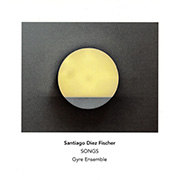
 Santiago Diez Fischer: Songs [Another Timbre]. Kept meaning to write about this one but it always seemed a formidable task. It starts out simply enough, with and your mouth is like the sound of many waters, a grave but mellow baritone sax tracing out a slow, looping line over atmospheric electronics; then it all goes to hell. The backing track stutters and breaks up, the sax barks back, then when everything has fallen back into place the music is a shadow of what it once was. The following pieces are even more disturbed, making poetry out of harsh, battered sounds; like a lovingly rendered and deeply-hued portrait of a bruised thumb. I had to double-check I was listening to the right record because this does not sound like an Another Timbre release. At its extreme, the poetically-titled under the redwood tree begins with an obtrusive noise floor and ekes out harmonics and partials from the hollow resonances obtained by grinding and striking metal objects against a pair of snare drums, punctuated by growls and bursts of static interference until it’s all taken up with the persistent buzzing from a prepared electric razor. The piece resolves, if that’s the right word, with muffled, wordless singing, without accompaniment. The description does not do justice to the sonic and evocative depths the musicians find in this hostile materiel. tres ciegos, an earlier work, keeps the sax and adds accordion, bowed student guitar and Tupperware containers of various sizes, making for a brooding study in low timbres that swells and ebbs away, the grain of the brass and reed rubbing up against the groaning sounds of bowed plastic and strings. The musicians also vocalise, thickening out a compound sound that threatens to become a tonal miasma but somehow retains definition. You start to realise Diez Fischer is composing in a grey zone somewhere between the arrangement of pitches and the pure timbre of noise, where the conventional elements of music are always present, however faint it may be at times, but complicated by the messy physical processes of producing sound. The Gyre Ensemble is the trio who play on all of the pieces here, showing enthusiasm and inventiveness as they tread the fine note-v-noise line laid out by the composer. rise in the sky to be a reminder of comfort says it’s for solo accordion and electronics but sounds at first like a duet for accordion and bowed cardboard, with lots of higher, purer-sounding reeds producing near sinelike tones from the acoustic instrument while the electronics get dirty. The two elements merge and then swap places, with more guttural sounds pitched against unsteady synthesised chords. The final trio, Sappho’s song, uses more complex forces including “voltage controlled fan preparation of student recorder” to evoke a submarine tableau of deep, wafting organic forms that slowly rise against the composer’s own voice.
 Magnus Granberg: Aus der Nacht [New Focus Recordings]. It’s always good to hear a new Granberg recording, especially when it provides a new perspective on his music. Most feature Granberg as a performer, with his open and indeterminate compositions typically heard as the result of his close working with the ensemble in rehearsal. Aus der Nacht, von den Wehen was composed for the Chicago ensemble a·pe·ri·od·ic for a concert in early 2023, with Granberg spending a week in advance preparing the concert with the musicians. Granberg is not heard here: usually his prepared piano acts like a kind of spine which threads its way through the variable events over the course of the piece. There is a prepared piano, played here by Nomi Epstein, but its role is closer to those of the other instruments – winds with cello and percussion, occasional sine tones. The flow is thus very different from his other pieces, as the instrumentation waxes and wanes in a comparatively dramatic fashion. The piece is structured in many short sections, a set of events (Moments if you’re Stockhausen) which allocates each performer a role but still allows for some flexibility and independence of mind in how to achieve it. Surprising details emerge, as when a group of winds suddenly merge to play a short ensemble figure, or a passage of added drama from a bass drum. A distinctive feature is the recurring high, long tones which appear throughout the piece, flute and voice with or without other instruments, which begin as a form of unusually sustained texture but gradually seem to bind the broader range of sounds together. I wonder how much of this is down to Granberg’s composition in this case or the approach taken by the ensemble, but the greater variety in overall density and texture from moment to moment in this piece makes the number of musicians and the scale of the piece seem larger than they really are.
Filed under: Music, Reviews by Ben.H
Tags: Magnus Granberg, Santiago Diez Fischer
No Comments »
Henrik Munkeby Nørstebø, Jashiin
Sunday 16 August 2026
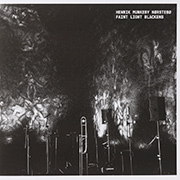 Henrik Munkeby Nørstebø: Faint Light Blackens [Psychic Liberation]. Less of a performance and more of a piece from Nørstebø this time, compared to his 2023 release Dystopian Dancing. Paradoxically, this work in seven acts was “produced in a long form performance gesture, with no overdubs” or post-production (recoding dates are given as 10 and 11 October, so maybe it was an allnighter). Nørstebø’s instrument is the trombone, which he seems to use as a means to produce sound as much as he uses it as a brush to deploy those sounds where needed. The thirty-five minute piece maintains its coherence by brooding, essentially; the sounds are remote and fittingly sepulchral throughout. While focusing on shape and texture, maintained through a palette of intaglio greys, there are just enough inflections of colour and flashes of repressed activity (trombone is a recondite medium for noise music) to elevate the whole thing above po-faced complacency.
 Jashiin: Overflow [mainly slow organ music]. Like it says on the label, Huw Morgan is the master of mainly slow organ music, as heard in his many recitals, mostly in the west of England. Jashiin is a composer based in Istanbul; he describes Overflow as “a moment of charged calm, held for as long as I could manage to hold it”. So, long stretches of suspended chords transitioning from one to another and all the acoustic and psychoacoustic effects this can evoke, if done right. Morgan does it right, of course. Jashiin leaves matters of registration and dynamics largely up to the performer, so Morgan presents three interpretations of the piece: the first rich and full, with range and depth, the second all reeds and strings, creating clashing harmonics and beating overtones, the third soft and disembodied, floating in darkness.
Filed under: Music, Reviews by Ben.H
Tags: Henrik Munkeby Nørstebø, Jashiin
No Comments »
Soundscape Summer
Sunday 9 August 2026
 Manja Ristić: lights shimmered like whispers in the depths of the trees; Miska Lamberg: stillness in their isolation; Dylan Kerr: Pas de la Demi-Lune; Michael Pisaro-Liu: anabasis (1) [Sawyer Spaces]. Sawyer Spaces is a sub-label of Sawyer Editions, focused on soundscapes, pretty much: their albums are either field recordings, or make use of field recordings, or are otherwise defined by the particular location in which they were created or recorded. Ristić presents a pair of montages, made up of recordings made around Portugal, Austria and Croatia. There’s a lot of autobiographical and genealogical subtext behind both pieces, but Ristić seeks to convey the meaning through ambience without resorting to allusion or narrative. The open-air sounds are deep and nuanced without being overtly suggestive, which also lets you work out for yourself that you’re hearing a composition and not raw documentation; you feel validated when the instrumental sounds appear. The thing about ambience is that you really need to be in the place itself to be certain you truly feel anything that place has to tell you. With music, the best you can do is take it on trust and sympathise with whatever the musician is trying to convey. Also, any time I heard cicadas I assume it’s a reference to Presque rien. The Lamberg also presents two pieces, or one piece in two movements. The sounds are those of urban ambient hum, the constant nagging drone of traffic and air conditioning (If only! gasps the European audience). Both tracks generate a negative presence through layered industrialised white noise, not pleasant but not actively unpleasant, just intrusive. Lamberg recommends playing it soft (I didn’t) so it presumably works as a compounding, or confounding effect on the noise you’re already dealing with, but I’m not sure if the intended effect is amelioration or alienation. I played both these albums on a sunny afternoon and dozed off to both.
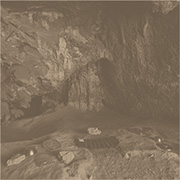
Kerr’s Pas de la Demi-Lune is a different deal; composed for a performance in a cave, and recorded here in a performance in a different cave, this is a straight-up musical piece, albeit one entirely shaped by environment. Kerr plays computer-generated sine tones that build up high, complex harmonics by following lattice processes devised by James Tenney. Transducers are attached to metal bowls and trays, causing them to vibrate and rattle sympathetically with the sine tones. Organ pipes are blown, selected and tuned to the frequencies created from the harmonies generated by the sine tone processes. It’s a rough-sounding work, suitably harsh and craggy for the landscape in which it was created, with interference patterns cutting across organ and sines and bolstered by agitated metalwork. Not the easiest of listening nor the most lucid of sonic phenomena, suggestive of the way nature conceals more than displays the principles upon which it operates. Evocations of rituals aside, what is interesting is the way Kerr uses his methods as a sort of armature for nature, with his instruments acting as a representation of the natural surfaces and features, without the need for analogies.
anabasis (1) was composed by Pisaro-Liu in 2013; this performance was made in London in 2024. It’s a sectional score – 72 parts – for five musicians using materials assigned to four categories: sand, wind, tone and wave. The musicians here (I recognise James Creed and Mia Windsor) use a prepared reed organ, electromagnetic pick-ups, pedals, a fan, microphones, a giant sail, digital processing, various objects and, of course, sand. Is this site-specific? I suppose it is. On the first listen it sounded like documentation of a rather busy performance which you probably needed to be an audience member, if not a performer, to fully appreciate. It’s all a bit wild and woolly, with no conceptual elegance immediately observable as in some other Pisaro-Liu pieces. This can be a strength or a weakness in performance, depending on the musicians, the venue, your mood. The second time I heard it, something clicked. The busyness meant that things kept happening over its 72-minute duration; you’d think you had a feel for how the piece was progressing and then it suddenly takes off in a new direction. The second time, every new angle or development sounded fresh and spontaneous. The second time, I wondered how they were all coming up with so many sounds. The second time, I forgot that it was recorded indoors.