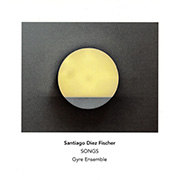
 Santiago Diez Fischer: Songs [Another Timbre]. Kept meaning to write about this one but it always seemed a formidable task. It starts out simply enough, with and your mouth is like the sound of many waters, a grave but mellow baritone sax tracing out a slow, looping line over atmospheric electronics; then it all goes to hell. The backing track stutters and breaks up, the sax barks back, then when everything has fallen back into place the music is a shadow of what it once was. The following pieces are even more disturbed, making poetry out of harsh, battered sounds; like a lovingly rendered and deeply-hued portrait of a bruised thumb. I had to double-check I was listening to the right record because this does not sound like an Another Timbre release. At its extreme, the poetically-titled under the redwood tree begins with an obtrusive noise floor and ekes out harmonics and partials from the hollow resonances obtained by grinding and striking metal objects against a pair of snare drums, punctuated by growls and bursts of static interference until it’s all taken up with the persistent buzzing from a prepared electric razor. The piece resolves, if that’s the right word, with muffled, wordless singing, without accompaniment. The description does not do justice to the sonic and evocative depths the musicians find in this hostile materiel. tres ciegos, an earlier work, keeps the sax and adds accordion, bowed student guitar and Tupperware containers of various sizes, making for a brooding study in low timbres that swells and ebbs away, the grain of the brass and reed rubbing up against the groaning sounds of bowed plastic and strings. The musicians also vocalise, thickening out a compound sound that threatens to become a tonal miasma but somehow retains definition. You start to realise Diez Fischer is composing in a grey zone somewhere between the arrangement of pitches and the pure timbre of noise, where the conventional elements of music are always present, however faint it may be at times, but complicated by the messy physical processes of producing sound. The Gyre Ensemble is the trio who play on all of the pieces here, showing enthusiasm and inventiveness as they tread the fine note-v-noise line laid out by the composer. rise in the sky to be a reminder of comfort says it’s for solo accordion and electronics but sounds at first like a duet for accordion and bowed cardboard, with lots of higher, purer-sounding reeds producing near sinelike tones from the acoustic instrument while the electronics get dirty. The two elements merge and then swap places, with more guttural sounds pitched against unsteady synthesised chords. The final trio, Sappho’s song, uses more complex forces including “voltage controlled fan preparation of student recorder” to evoke a submarine tableau of deep, wafting organic forms that slowly rise against the composer’s own voice.
 Magnus Granberg: Aus der Nacht [New Focus Recordings]. It’s always good to hear a new Granberg recording, especially when it provides a new perspective on his music. Most feature Granberg as a performer, with his open and indeterminate compositions typically heard as the result of his close working with the ensemble in rehearsal. Aus der Nacht, von den Wehen was composed for the Chicago ensemble a·pe·ri·od·ic for a concert in early 2023, with Granberg spending a week in advance preparing the concert with the musicians. Granberg is not heard here: usually his prepared piano acts like a kind of spine which threads its way through the variable events over the course of the piece. There is a prepared piano, played here by Nomi Epstein, but its role is closer to those of the other instruments – winds with cello and percussion, occasional sine tones. The flow is thus very different from his other pieces, as the instrumentation waxes and wanes in a comparatively dramatic fashion. The piece is structured in many short sections, a set of events (Moments if you’re Stockhausen) which allocates each performer a role but still allows for some flexibility and independence of mind in how to achieve it. Surprising details emerge, as when a group of winds suddenly merge to play a short ensemble figure, or a passage of added drama from a bass drum. A distinctive feature is the recurring high, long tones which appear throughout the piece, flute and voice with or without other instruments, which begin as a form of unusually sustained texture but gradually seem to bind the broader range of sounds together. I wonder how much of this is down to Granberg’s composition in this case or the approach taken by the ensemble, but the greater variety in overall density and texture from moment to moment in this piece makes the number of musicians and the scale of the piece seem larger than they really are.