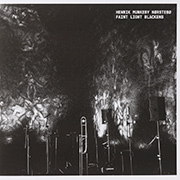
 Henrik Munkeby Nørstebø: Faint Light Blackens [Psychic Liberation]. Less of a performance and more of a piece from Nørstebø this time, compared to his 2023 release Dystopian Dancing. Paradoxically, this work in seven acts was “produced in a long form performance gesture, with no overdubs” or post-production (recoding dates are given as 10 and 11 October, so maybe it was an allnighter). Nørstebø’s instrument is the trombone, which he seems to use as a means to produce sound as much as he uses it as a brush to deploy those sounds where needed. The thirty-five minute piece maintains its coherence by brooding, essentially; the sounds are remote and fittingly sepulchral throughout. While focusing on shape and texture, maintained through a palette of intaglio greys, there are just enough inflections of colour and flashes of repressed activity (trombone is a recondite medium for noise music) to elevate the whole thing above po-faced complacency.
 Jashiin: Overflow [mainly slow organ music]. Like it says on the label, Huw Morgan is the master of mainly slow organ music, as heard in his many recitals, mostly in the west of England. Jashiin is a composer based in Istanbul; he describes Overflow as “a moment of charged calm, held for as long as I could manage to hold it”. So, long stretches of suspended chords transitioning from one to another and all the acoustic and psychoacoustic effects this can evoke, if done right. Morgan does it right, of course. Jashiin leaves matters of registration and dynamics largely up to the performer, so Morgan presents three interpretations of the piece: the first rich and full, with range and depth, the second all reeds and strings, creating clashing harmonics and beating overtones, the third soft and disembodied, floating in darkness.
Filed under: Music, Reviews by Ben.H
Tags: Henrik Munkeby Nørstebø, Jashiin
No Comments »
Noise versus Noise
Sunday 14 May 2023
 I thought something had gone wrong. I’ve been taking a little noise holiday, away from the likes of Jürg Frey for a bit, and figured it was time to get around to the first compilation issued by Party Perfect!!!, another one of these composer collectives who take their irreverence seriously (see website for details). PP-01 begins with an untitled work by Michelle Lou: I know her stuff, right? Finely observed electroacoustic phenomena, that sort of thing. Instead my ears got blitzed with a barrage of harsh electronic noise that made me initially think I had a corrupt file or put on the wrong track. Turns out that Lou’s untitled is a four-part digital electronic suite of ruthlessly clipped and distorted audio that gleefully assaults the senses for forty-seven minutes. Parts of it sound like when you try loading a non-audio file into a media player to see what happens, and I’d like to think some sections are precisely that. When you get past the initial shock, you start to notice the details carved into this brutalist sound scuplture which, together with performative flourishes of bravado, sustain the piece beyond the deadening effect of relentless sonic bludgeoning (cited as an inspiration in the accompanying booklet). After Lou’s piece, there’s another two hours worth of electronic compositions by Stefan Maier, Michael Flora and Other Plastics, each just as abrasive and confrontational. The booklet includes recipes, too; they’re vegetarian, but one is for a barbecue sauce so…
 Trombonist Henrik Munkeby Nørstebø has produced a pair of works on Dystopian Dancing that attempt to push solo performance techniques beyond the defined constraints of the instrument. The first was recorded in 2019 and exploits the close amplification of his trombone with air and microphone artifacts to produce unstable constructions that haphazardly flip between pitch and noise. Oversaturation and use of plastic mouthpieces and mutes add to the quasi-electronic atmosphere but in the second half it reverts to an improviser’s comfort zone of exploring extended low-end snorks to play for time. The second piece was made about a year later and projects material from the first into an electroacoustic collage that stays lively for longer, particularly when normal brass sounds re-emerge towards the end, commenting on the chaos with a queasy mock fanfare.
 Noise of a completely different kind comes from Jacques Puech’s cabrette. A cabrette is a small French bagpipes, for when regular bagpipes aren’t irritating enough. Gravir / Canon pairs compositions for the instrument by Guilhem Lacroux and Yann Gourdon respectively. In the former Puech overdubs himself with constantly ascending scales at different rates over a steady, clacking rhythm that resembles a kind of folkloric take on James Tenney’s For Ann (Rising), but with the cool psychoacoustic effects replaced by a manic exhilaration that’s both uproarious and a little scary, especially as it just keeps on going. In Gourdon’s Canon Puech is joined by four other cabreteers to play overlapping patterns in a staggered formation as suggested by the title. The gestures are more relaxed here but even so it shares with Gravir the same dogged, obsessive pursuit of a compositional idea until the excessiveness becomes the point. That, with the massed nasal timbre of the pipes creates a bracing, febrile work that you can get a high out of if you’re in the right mood while simultaneously driving your housemates up the wall.