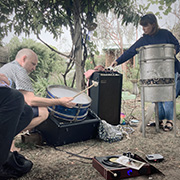
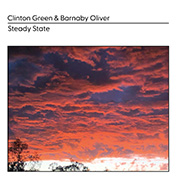
 Clinton Green & Allanah Stewart: Yarrow and Clinton Green & Barnaby Oliver: Steady State [Shame File Music]. Two more collaborations from tireless improvisor/innovator/label mogul Green. Yarrow collects two outdoor improvisations with Allanah Stewart from early 2023, using found objects, derelict electrical goods and homemade doodads of various kinds. Both live recordings are further demonstrations that authenticity as an aesthetic value is not enough by itself. There is murk, as promised in the blurb. The crunchy, grungy vérité of the performance is swathed with the grey grot that pervades all recordings made in suburban backyards, which casts a pall over the proceedings. Green and Stewart are working with recondite instruments and at times are audibly stuck trying to make something happen. It’s realism with all the dull bits left in, for all the good that does. My attention wandered and I suspect I would have been even more distracted at the event itself, seeing someone else’s backyard. Green’s work with Oliver on Steady State is more explicably musical, continuing from their earlier collaboration The Interstices Of These Epidemics. In the first of two pieces, Oliver solos on a piano in a way that’s both floaty and earthy at once, while Green fills in an atmospheric wash of stuck and bowed gongs. As with the following track, the duo improvisation is greater than the sum of its parts. For the second piece, Oliver switches to banjo, employing the instrument’s vinegary sound to complement the gongs in often confounding ways. Somewhat ambient, somewhat exotic, but always prickly enough to keep you alert, exploring sounds to hugely effective ends.
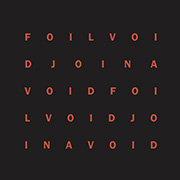 Eamon Sprod: FOIL VOID JOIN AVOID [Aposiopèse]. There seems to be a crucial difference in the way that Australian musicians handle field recordings, compared to European counterparts. The British, for example, always seem to be searching for something essential in the sounds, much like in their frequent reversions to folk music. Australian field recordists seem no less earnest, but are always ambivalent about how much they can claim as authenticity. This can manifest itself in various ways; in the case of Eamon Sprod, FOIL VOID JOIN AVOID is one of the most comprehensive, oblique, and sophisticated statements of that ambivalence. Sprod, who’s previously recorded under the name Tarab, works with field recordings and the sounds of non-musical objects. With this new work, about a hundred minutes long, he has successfully produced an example of anti-field recordings, in which source, context and place are irrelevant. Each section is marked by fast cutting, with an emphasis on percussive effects created by short interruptions, strung together with empty moments of almost inaudible hum and, between sections, silences of arbitrary duration. It resembles some works by Luciano Maggiore, in that it all sounds deliberately incoherent on first listen, but on the second time around you can hear it’s cannily composed: I guess no coincidence that the two of them have discussed these very issues in their music (link is PDF). The large scale and employment of punctuated disinterest creates an overall impression of an elusive but compelling argument being made. The sounds could be nondescript in themselves but gain force through rapid juxtapositions which highlight contrasts; then again, the selection of sounds also turns out to be vast, suprisingly detailed and richly coloured. Further listening reveals compositional tension as elements move back and forth between the brief and the continuous, suggesting other layers that are yet to be discovered.
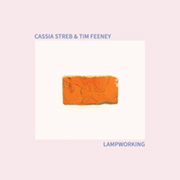 Cassia Streb & Tim Feeney: Lampworking [Kuyin]. Streb and Feeney were both part of Tasting Menu, reviewed here before. Improvisations on objects was the M.O. then, with the twist of using the recording space as an additional percussion instrument to be struck and scraped. Lampworking takes these basic ideas and develops them further, much to the better. Both pieces on the album are recorded live in a gallery, as part of an installation. Recordings of objects are played through spatialised speakers, sometimes filtered through other resonant objects, and then re-recorded in space with live performances on another set of objects. Complex means for simple materials lead to engagingly textured, site-specific soundscapes while still remaining open to alternate dimensions through the pre-recorded material. “Pasadena” adds rubbed wineglasses for musical drones draped over the percussion, “Chinatown” is more slippery, with sustained ambient resonances emerging during the middle sections before the intrusion of bass percussion from field recordings of fireworks.
Filed under: Music, Reviews by Ben.H
Tags: Allanah Stewart, Barnaby Oliver, Cassia Streb, Clinton Green, Eamon Sprod, Tarab, Tim Feeney
No Comments »
Strings enhanced: Alessandrini, Fusi, Cetilia
Sunday 22 March 2026
 Patricia Alessandrini and Marco Fusi: Proximity, Distance [Sideband]. I’m all about using feedback as a musical method, so I’ve been getting to grips with viola d’amore adept Marco Fusi‘s collaboration with Patricia Alessandrini. Alessandrini works with acoustic feedback and electronics, and has spent about the last five years on and off creating with Fusi an elaborate but lucid style of electroacoustic music. The two musicians’ respective instruments form a symbiotic relationship, with Fusi’s violin and viola d’amore acting both as resonant bodies and tone generators, each playing roles which can simultaneously generate and condition the feedback conditions in real time. Alessandrini makes use of amplification, including contact microphones, and the resonance of the recording space to introduce the feedback tones through the speakers. She has also built the “Feedbox”, a collapsible, portable wooden container with transducers fitted to it to act as a surrogate loudspeaker, large viol and small room all at once. Fusi and Alessandrini work together very closely, with a degree of interaction that shows up much live electroacoustic music as little more than a form of accompaniment. The thinking here is beyond instruments-plus-electronic processing, instead harnessing electroacoustic phenomena to create a mercurial compound instrument with a life of its own. The opening piece “Adjoining, Touched” shows this best, in that you quickly give up trying to distinguish one musician from the other as it misses the point. Each of the pieces maintains a serious mood for the album, even as the colour and shading is far from monochromatic; the focus is on producing varieties of tone. On “Squared, Boxed” percussive effects are introduced, either from the Feedbox or one of Fusi’s instruments magnified by amplification (both violin and viola d’amore are used throughout, with one often present passively as an additional resonator). In the later pieces some more obvious bowed and plucked sounds seem to emerge, but these are used as a means to an end, or as another coloration device to the overall sound: the title piece “Proximity, Distance” sounds like an ensemble transformed, while on “Fractured, Undone” the strings seem to function as triggers for different kinds of feedback oscillation. It’s a rare case of an album focused on demonstrating innovative techniques that both succeeds as a musical experience and wordlessly reveals a depth of insights into the ramifications of pursuing this technique. It also makes me sad that I won’t be able to get to Fusi’s solo gig in London this week.
 Laura Cetilia: gorgeous nothings [elsewhere]. It can’t be just me who’s thinking there’s been an awful lot of albums in recent years by female cellists who also sing a bit. Not quite as prevalent as solo albums by crossover-type composer-pianists, but still. This is why I initially balked at an album by just such a cellist with the title gorgeous nothings. Forgive me, I forgot she’s also a member of the ensemble Ordinary Affects, whom I’ve heard giving fine interpretations of works by Mangnus Granberg and Michael Pisaro-Liu. Her three works on this album are spare, thoughtful pieces: the title work is indeed for solo singing cellist, but the nothings alluded to are more John Cage than Taylor Swift. It’s a calm, sombre affair: bowed notes are slow, soft and translucent, but within a low, restricted range and in no mood to float. Cetilia’s voice provides harmonic overtones that resonate with or beat against the cello playing. I’d call it melancholy, but then the second piece is titled six melancholies, with Cetilia joined by fellow Ordinary Affects members Morgan Evans-Weiler on violin and J.P.A. Falzone on vibraphone; the percussion is often bowed, acting in a similar manner to Cetilia’s singing in the previous piece. It’s an introspective, self-effacing work, the three performers studying each note, chord or short phrase in isolation, treating each event with close attention before moving to the next. The longer piece soil + stone is a cello duet with Hannah Soren, Cetilia again adding voice very unobtrusively, as coloration and troubling the certainty of the cellos’ pitch. It’s not a heavy piece, neither a drone nor a drag, but it does not deal in trifling lyricism. The two cellists ground themselves with slow descending passages, taking the harder road. The gentle beauty that emerges from their playing comes through as a reward for their efforts, rather than assumed as a premise.
Filed under: Music, Reviews by Ben.H
Tags: Laura Cetilia, Marco Fusi, Patricia Alessandrini
No Comments »
Vestiges of tonality: Joseph Branciforte & Jozef Dumoulin, opt out
Thursday 19 March 2026
 Joseph Branciforte & Jozef Dumoulin: Iterae [Greyfade]. With its slightly fuzzy chimelike sounds and reverb, the electric piano (particularly the Fender Rhodes variety) has always struck me as a dreamlike instrument, always somewhat aloof from its context. It hadn’t occurred to me that there might be musicians who work with mutations of these instruments, but that’s just what Joseph Branciforte and Jozef Dumoulin have been doing independently for some time. Iterae puts the two of them together in a two-day recording session of manipulated improvisations. Their respective Rhodeses are treated electronically, both in their sounds and in how their playing is restructured, with real-time editing guiding how the unfolding music is shaped. With the use of distortion and filtering, the small amplified sounds of a Rhodes piano quickly lose their resemblance to the conventional instrument. The live editing consists of loops and processes that mimic tape delays, with elements repeating while being slowly transformed or effaced. Branciforte and Dumoulin thus make use of short gestures that provide both continuity and change, allowing large-scale developments to emerge out of small elements in near-stasis. The press release mentions “post-glitch” to save critics from having to risk it themselves, and indeed the album has the traits of that genre, including the association with ambient music. The emphasis is always on creating texture and atmosphere, with none on representing the improvisers’ chops, happy to explore one space without ever settling into a comfortable groove, then, little by little, events start to drift away from the familiar. Things start out hinting at melody and then gradually evolve into more complex atmospherics, but even in its crunchiest moments the musicians always retain suggestions of melody inherent in their instruments, without ever breaking into full-blown song or all-out noise. The two of them maintain this tenuous balance throughout, over four extended pieces that each fall into a two-movement form. That dreamlike quality is also present, in a shapeshifting, time-slowed-down way.
The blurb suggests the structure of the album is modular, by which they mean you can play the thing straight through as one large work or as four pairs of tracks. The physical media version emphasises this by packaging the set as five discs: one regular CD and five mini-CDs (remember them?). Vinyl collectors will be relieved to learn that the dust jacket comes with a wall-hanging tab already fixed to the back. It’s not out yet but they’re touring Europe right now.
 opt out: Geography_VII [Moonside Tapes]. The premise of this short album seemed intriguing from its brief blurb: pieces synthesised and sequenced in MaxMSP, built on some of Erv Wilson’s microtonal scales. Sadly it’s not so interesting to listen to. It isn’t a dour academic exercise, as many microtonal works can be, but the pieces are fairly rudimentary and don’t seem to particularly benefit from using Wilson’s tuning. Those two factors in tandem work to defeat the apparent purpose, producing a set of pieces with windchime-like repeating patterns with not much accompaniment or development, pleasant enough without demanding attention. The exception is the track “Presence_chamber”, which uses longer, strained notes with almost no melodic movement, making the astringent intervals themselves the musical subject and substance. It also reminded me that you can get Warren Burt’s classic Harmonic Colour Fields on Bandcamp.
Filed under: Music, Reviews by Ben.H
Tags: Joseph Branciforte, Jozef Dumoulin, opt out
No Comments »
Almost Nothing: Pisaro-Liu, Reinhard, Ullmann
Sunday 15 March 2026
 Michael Pisaro-Liu: Concentric Rings in Magnetic Levitation [Sawyer Editions]. Just last month I was carping that Fata Morgana, Pisaro-Liu’s collaboration with Niels Lyhne Løkkegaard, had both not enough and too much going on all at once, making for stultifying listening. This realisation of his 2011 composition, on the other hand, is the real stuff. It shows the profound difference between almost nothing and not enough, with much of the hour’s duration passing almost inaudibly. The near-silence is observed with intense concentration by the three musicians, and their concentration becomes infectious. The name of the ad hoc trio is Forming; they listen in to a cycle of almost imperceptible sine tones, articulating the presence of sound, if not always its manifestation. Andrew Weathers marks off tiny inflections with small piano notes, Ryan Seward’s cymbals augment the upper partials of the faintly humming air, Carl Ritger uses electronics and field recordings to compound the implicit hum that pervades the absence of activity. By the end of the hour, what had at first been inaudible has soaked into your consciousness, radiating sound. This recording captures a very special moment.
 Samuel Reinhard: For 10 Musicians [elsewhere]. I described Reinhard’s earlier piece For Piano and Shō as “tinting the backdrop of silence”. In For 10 Musicians the forces are larger but the music is even more intangible. Two pianists – Paul Jacob Fossum and Gintė Preisaitė – reiterate a single chord at their leisure, with some free interplay on a small gamut of single notes. They are circled by an ensemble of clarinets, violas, cello and double bass, who play as softly as possible at their discretion. There are faint developments that occur by chance, through small changes in colouration and harmony, keeping everything still but alive. The ensemble’s presence reminded me of the electronic treatments that shadow the solo pianist in Michael Pisaro-Liu’s Green Hour, Grey Future, but in Reinhard’s case the sound has greater depth and the form is more rigorous. There are four movements, each identical other than the pianos’ chord; as always, same but different, each resembling the other but cast under a different shade. It’s a large work which is always present but elusive, with the musicians and recording successfully transcending the music’s substance into the aether.
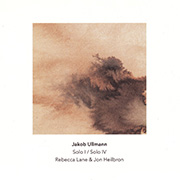 Jakob Ullmann: Solo I / Solo IV [Another Timbre]. Way back in 2013 at Huddersfield I heard the first (successful) performance of Jakob Ullmann’s Son Imaginaire III. It had a galvanising effect on me. “Again, a piece that hovered on the threshold of audibility, but in Ullmann’s case the music contained a faint but indelible richness, a mystery in how the sounds blended together in ways that couldn’t be understood, from one musician to the next and with ambient sounds in and outside St Paul’s Hall. Sitting there, attention focused on perceiving the music, you could lose yourself, your concentration on a sound so diffuse that your attention becomes a sort of dream state. Over a hundred years ago painters really started to pull apart the idea of what it meant to see something; we still don’t know what it means when we say we’ve heard something.” In a talk before the piece, Ullmann described his compositional methods, making use of a kind of palimpsest of overlaid pages. These translucencies partly reveal and partly obscure. In the Solo works, the musician accompanies themself with recordings of alternative interpretations, covering additional aspects of the suggestive score that cannot be realised in a single take. On top of this, pieces can also be played simultaneously. Rebecca Lane plays Solo I on quarter-tone flutes, Jon Heilbron double bass for Solo IV: both have a strong history and affinity for this type of sensitive handling of small sounds. Their combined performances produce superbly evocative sounds for compositions that expect the material to be kept at a level below perceptible, wide-ranging in timbre and register without ever seeming deliberate or intentional. Everything just seems to emerge and persist organically, creating an experience both indistinct and indelible.