 Huw Morgan: Melos [Sawyer Editions]. Life’s been a little crowded lately so I’ve been finding some breathing space. Huw Morgan’s Mostly Slow Organ Music recitals have been happening for a while now, featuring his own compositions amongst others. His Melos compositions have been spreading out across the country for ten years now: this album features organs from churches in Bristol, Dundee and Catford. They’re not exactly performances on the organ, but with the instrument; Morgan treats each iteration of the piece as a site-specific work, taking long samples of individual stops and composing them into a single chord that gradually transmorphs through electronic manipulation into a second chord. Extraneous sounds and impurities in the mechanism are preserved, and the sliding tones are too slow to be perceptible as the music’s subject. The result is a Zen-like drone, empty yet full, the well-composed sort that hold your attention without seeming to do anything. When you start to lock in on it you become fascinated by the near-imperceptible change in intonation and the multitude of sonic ramifications it brings about. Five versions are presented here, the shortest being eight minutes and the longest (twenty) being only an excerpt from a longer piece. Hopefully more recordings become generally available.
 Ben Richter: Dissolution Seedlings [Sawyer Editions]. The ensemble House on Fire consists of three musicians, at least in this instance; they play pianos, but also melodicas, a pump organ, percussion and a cello. Dissolution Seedlings is a nearly-hourlong work for this odd ensemble, divided into fourteen (“and a half”) movements. Offset against this information is the curious way the music dissipates its activity, marking out time more than passing through it. Richter speaks of rhizomes (more vegetal than anti-Oedipal) in his notes, but the piece struck me most as a way of finding music that endures past the point when all momentum has been exhausted. It reminded me a bit of Charlie Usher’s An assembly – a forty-five minute piece composed of a hundred-plus tiny fragments – but whereas that piece uses brevity as a means of negating substance, Dissolution Seedlings creates space and hesitates to fill it. Each movement is its own pause, where waiting is an end in itself. Small gestures emerge almost by default, and with each change of state from one section to the next, House on Fire does as much nothing as they can possibly sustain for the duration.
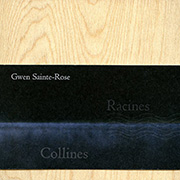 Gwen Sainte-Rose: Collines / Racines [By the Bluest of Seas]. No need for philosophising or head-scratching here. This is just Sainte-Rose straight up with a cello and a loop pedal. It’s bright and colourful and seems all so clean and simple, swear it’s all been done before but no direct comparison immediately comes to mind. That’s not the sort of thing you should be worrying about anyway when this is so pleasant to listen to. Sainte-Rose says she’s rhapsodising the Belgian landscape, but I think we can all invest these two long, drifty pieces with our own ideas of home.
 Marti Epstein: For Jack [Sawyer Editions]. The “Jack” referred to here is Jack Yarbrough, the pianist playing this long, solo work. Yarbrough’s been heard in a few other recent recordings, notably Timothy McCormack’s mine but for its sublimation, another work written for him. At that time, I wrote that “he has a gift for coaxing prolonged sounds out of his instrument”; that quality applied here too. Unlike the other pieces in this review, For Jack doesn’t exactly create mental spaces for contemplation, rather it crowds them out and then colours those spaces with its own, foreboding mood. For a long time, the piece dwells upon dark clouds of low chords, which ultimately burst out with sudden violence. Eventually, the mood breaks a little, opening into higher registers and more open sounds, but the chords are still dense and brooding until they finally fragment into slow counterpoint of higher single notes. My description makes it sound cheesy, but Epstein steers a steady course between cheap drama and cold process, making the progression seem intuitive and unforced. Yarbrough emphasises this with an interpretation which properly equates intuition with nature, merging the austere and forbidding with echoes of the pastoral.
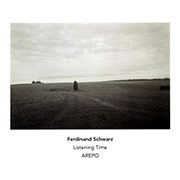 Ferdinand Schwarz: Listening Time [Another Timbre]. I don’t know anything about Schwarz and neither did the label proprietor before he heard this, it seems. A work for clarinet, electric guitar, accordion and cello, played by the AREPO ensemble, it’s an unexpectedly beguiling piece. Listening Time starts out self-effacing and innocuous but it grows on you after the first hearing. AREPO plays a single chord, its pace seemingly dictated by the clarinettist’s breath. Over each iteration, the chord spreads out a little but mostly it deepens, with subtle touches that hint at possible voice-leading. Without the need to “go” anywhere, composer and musicians settle into establishing where they already are and what that might entail. It’s a piece you need to listen into, much in the same way as the musicians of AREPO appear to. Schwarz describes as improvisation, petrified in time, and credits the AREPO musicians jointly with composition. The ensemble sounds perfectly matched to the piece, producing softly luminous sound as a single complex instrument, with the idiosyncrasies of the individual instruments sublimated into a greater whole.
Filed under: Music, Reviews by Ben.H
Tags: Ben Richter, Ferdinand Schwarz, Gwen Sainte-Rose, Huw Morgan, Marti Epstein
No Comments »
Pianos, etc.
Sunday 1 June 2025
 Timothy McCormack: mine but for its sublimation [Another Timbre]. (Don’t say Feldman don’t say Feldman don’t say Feldman) it’s an hour-long piece for piano with subdued dynamics that opens by obsessively interrogating a unresolved, ambiguous chord through changes in voicing and register and at first it seems a well-crafted study in tone and shading at least influenced, but more properly to say informed by… you know, that guy. As the piece progresses it takes on a greater character – independent, larger and more complex; perversely so as the musical continuity starts to break up. Pauses open up and resonances are allowed to linger until they start to become the material McCormack is working with. He understands that it’s not enough to preserve a mood through a piece’s entirety, but to sustain it in the listener’s mind by thwarting it, keeping things precarious. At several moments the music threatens to develop into something else, only to do so by falling away into near-silence. Chords are reduced to single harmonics, with sparse notes beating against the overtones. McCormack describes the work in terms of resonance, and in stages these resonances become more focused and sustained. The pianist is Jack Yarbrough, for whom the piece was written: he has a gift for coaxing prolonged sounds out of his instrument, with a pacing and a use of tonal colour that are deliberate without being calculating. Having achieved this state of otherworldliness, the piece goes further by stretching out resonance indefinitely, through the use of ebows on the strings; harmony condensed into an ominous, persistent hum. It all ends with a slow but brutal finality and I’m still knocked about by the way McCormack and Yarbrough have created a transformative piece out of chin-stroking acoustical considerations while also delivering an emotional thump.
 Bryn Harrison: Towards a slowing of the past [Another Timbre]. Harrison’s latest musical labyrinth comes with a twist. This forty-minute piece is for two pianos and comes out of the gate like a doubled version of his solo piece Vessels from way back when, but all too soon it suddenly rebounds on you in a psychedelic tape reversal. As if the unadulterated form wasn’t trippy enough. Each passage starts off afresh in what seems a call-and-response of pianos and backwards-pianos, but gradually the contributions from the electronics become more pervasive and insidious. The reversed resonances wash in from beneath the live pianists, always a bit lower and a bit slower, and then they start to take a shape of their own. By the second half, the reversed passages are calling the shots, leading the pianists into darker registers, slowed to a trancelike dirge. It’s a disturbing development, making explicit the seductive danger that has been implicit in Harrison’s previous works. The pianists here are Mark Knoop and Roderick Chadwick, both veterans at Harrison’s music and adept at pulling off the nimble counterpoint needed to make it work; for this piece they convey the image of two workers industriously tackling the job at hand, only to be sobered as the technical demands give way to something more oppressive.
 Ashlee Mack: green [Sawyer Editions]. I’ve been meaning to get around to the Sawyer Edition releases from early this year. Pianist Ashlee Mack plays four works by four composers, all of the quiescent school: each piece feels about the same in scope, regardless of length. Mack’s approach here highlights her interest in touch, using attentive dynamics and phrasing to say a lot, even where there could perhaps be more colour (might be down to the piano or the recording). Jeff Herriott’s piece green is passing seems made for such an interpretation, with its palette-dabs of single tones and small chords given substance as an abstraction, belying its relatively brief length. Eva-Maria Houben’s snow from 2023 is on the cusp between her just-enough and not-enough compositions, with a slow succession of single notes gaining a degree of momentum through each overlapping decay: Mack gives a nice sense of timing to lift the dry material off the page. Heard in this company, Marti Epstein’s Haven seems to owe too much to those preceding works; while it starts to add more to the mix to produce a certain expressive weight and dramatic shape, the effort is undermined by carrying on too long. The non-conformist in the pack is Ian Mikyska’s Distant bells; mist; stopping, which gets some slightly more robust dynamics and acts strangely by lapsing into periods of various ostinati. It could come across as fey if those gently reassuring moments didn’t come and go with such indifferent abruptness.
 Morton Feldman and Tobias Hume: Intermissions [Sawyer Editions]. I got instinctive prejudice against anything overtly “curated” so when I see an album that proposes a “dialogue” between Feldman’s early piano pieces and Hume’s pieces for viol circa 1600 I reflexively start cueing up individual tracks. The album begins with a silent track (30 seconds) and ends with one (60 seconds), with several other silent tracks in between. There are other pauses, at the start and end of tracks, too. Guy Vandromme’s interpretations of Feldman are nicely modern while still trying to be as small as possible; not timid, just not making a big deal of it, while keeping enough of the old capital-M modernist brittleness. Luciana Elizondo plays Hume on a viola da gamba and it all sounds fine to a rube like me. I don’t think we need to hear repeat performances of certain pieces, which are presumably sequenced in for the sake of continuity. As a whole, it passes along as a series of sporadic but consistent objections to the silence, which seems too mild an objective.