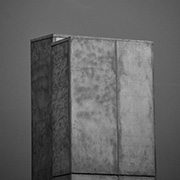
 Conner Simmons: any sense of where we were gone [Sawyer Editions]. A floaty, mild-tempered expanse of soft – but not always gentle – sounds; curiously, the free-form feeling gains from being sorted into a modular structure of five compositions: two string quartets to open and close, with a larger central work for unspecified instruments, which in this case is a larger ensemble including voice. The three pieces are unified into a single work by two short interludes for bowed prepared piano, composed a year later but also apparently heard as a whole from the first performance, which is the recording presented here. There are fairly subtle electronic treatments throughout, designed to emphasise lingering tones and after-images. The outer quartets are marked by a lack of movement, with most of the changes coming from a small amount of harmonic expansion and some ramping of dynamics. In the central piece, titled explain it to itself as wind, the improvisation allowed to the musicians emerges slowly, tentatively, each producing sounds individually that take care not to coalesce into a single image, for listening in the moment as opposed to coming away with a clear impression. Simmons alludes to all the pieces drawing upon “postmodern fiction, obscure geometry textbooks, and poems about time” and quotes from Cortazar’s Hopscotch; in short, it’s a synthesis, albeit one that steers clear of Delibes and Saint-Saëns, not to mention Rose Bob and Alix Alix.
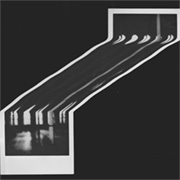 Wilson Tanner Smith: Perpetual Guest [Sawyer Editions]. Reflective solos on a harmonium, interspersed with some cello. The mood of cautious tranquility prevails throughout and Smith plays with simple, homespun diction. It’s the sort of thing we’re all sure we’ve heard somewhere before, not least because the music originates from a site-specific basis: “created in the abandoned Kreenholm Textile Factory complex on an island in the middle of the Narva River in Narva, Estonia, a stone’s throw from the Estonian-Russian border.” It’s the cosiest form of exoticism, with a hint of potential danger and sometimes with this kind of situational art it seems that one is hoping the situational pathos magically substantiates itself in the music – a form of implicit hauntology through psychogeography. None of that really matters though, as Smith’s approach to making music here is direct and unconcerned with intellectual justification. As such, the familiarity of it all locates this music securely within a nascent tradition of site-specific improv, where the practice and the craft take precedence over cleverness or subversion. Most importantly, Smith found the antique harmonium and restored it to working order himself, so it’s a perfect example of site-specific music and he’s earned the right to play whatever he damn well likes on it. Just as well his playing is studious and pretty.
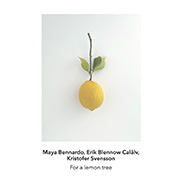 Maya Bennardo, Erik Blennow Calälv, Kristofer Svensson: For a Lemon Tree [Another Timbre]. You may remember Bennardo and Svensson teaming up with percussionist Etienne Nillesen for Improvisation on Āsthita, January 2, 2024. This time around, we hear Improvisation on Prakāśa, June 10, 2024, with Calälv on bass clarinet replacing Nillesen on drum; Bennardo and Svensson continue respectively as before on violin and kacapi (I looked it up, it’s a Javanese zither). Svensson has devised the distinct tunings used in each of these improvisation, on this occastion using 11-limit just intonation, a scheme that stretches outside the bounds of what Western ears would normally consider as “in tune”. The improvisers are set rules on what modes to play within the scale and an overall shape but are otherwise free to play as they wish. As with the earlier improvisation on Āsthita, its companion piece, the trio play within the mode more than upon it, but there are differences. The greater range and sustain of Calälv’s clarinet allows him to form the harmonic backbone of the piece, using the lower registers sparingly. Svensson’s muted zither plucks out tropes on the clarinet’s long tones, sometimes leading, other times elaborating, while Bennardo threads a translucent harmonic layer between the two. It sounds wonderfully composed, in either sense of the word, with each displaying an instinct for when to remain silent, giving the music greater definition beyond an ornate drone. To illustrate the point, the album begins with For a Lemon Tree, which is a distillation of their acquired technique into a formal composition.
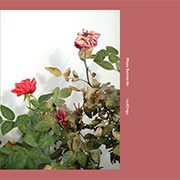 Maya Bennardo: rustlings [elsewhere]. The title could be a self-deprecating description of Bennardo’s style of playing, where she nudges her violin to the threshold of breaking up its tone into pure, whispering friction. Her two compositions here make use of this breathy style of bowing as a means of formal development, rising and falling between sounds that are nearly full of their pitch, to almost empty. The 23-minute dormant gardens i. is for violin and viola, played by the duo andPlay (Bennardo and Hannah Levinson). It resembles a horizon line cast with shadows in low sunlight, drawn freehand and rendered in long, feathered strokes. Small amounts of colouration and harmonising play over what strikes the listener as a single pitch which wavers and shimmers, establishing its presence through an apparent immobility that emerges through the constant microscopic activity. The work’s duration opens up the scale of this activity fom miniature to landscape, giving the small sounds greater seriousness. The 27-minute summer rustlings is Bennardo solo, the relatively dry acoustics exposing how little adornment there is to her playing other than through the sounds arising from within the instrument when subhected to her technique. On the microcosmic scale, there is plenty of technique to be heard. The piece falls into three sections with a coda: in the first she draws a line firm but pale, adding flecks of plucked strings to the constant, fragile bowing, figure and ground in the lowest possible relief. The second slowly breathes pitch into frail harmonics, nuilding up into fast arpeggios of high notes, still half whispered. The third is a long monophonic drone that then starts to generate a kind of internal polyphony out of the timbral changes in bowing technique, like a doubled voice. The coda is disarmingly simple. It’s a virtuosic work which impresses without feats of pyrotechnics or endurance.
Filed under: Music, Reviews by Ben.H
Tags: Conner Simmons, Erik Blennow Calälv, Kristofer Svensson, Maya Bennardo, Wilson Tanner Smith
1 Comment »
In Groups: Fiaschi, Faraglia, Bennardo, Nillesen, Svensson
Monday 21 April 2025
 Cosimo Fiaschi / Nicolò Francesco Faraglia: Variazioni [Superpang]. Here’s a funny one: a cycle of improvised duets for soprano sax (Fiaschi) and electric guitar (Faraglia), but it’s all structured by a serialist tone-row. The two musicians had worked together in this way for several years before making this recording, so have figured out a mutual language on “post-Webernian intervallic structures”. Not sure if that means it’s tighter or looser than Webern (it’s been eighty years), but it does sound different from any other improv set: besides the harmonic language, there’s a calm and steady approach to playing which prioritises those intervallic structures ahead of timbral diversity, to a certain extent. Twenty variations flit by in thirty-five minutes for a performance which resembles a modernist Konzertstück. You could also listen to each Variation as a self-contained vignette, but then they lose their affective punch and sound more geared towards inviting a post-facto musicological analysis. Other funny thing: it’s on Superpang.
 Cosimo Fiaschi: Wunderkammer [Granny]. Released one day earlier, Wunderkammer has Fiaschi attributed sole compositional credit: he assembled a septet of musicians to record several takes of his piece in one day. Although Fiaschi had worked with each of the musicians before, they had never worked together as a group. Similar in length to Variazioni, this work stretches out for long tones and static phrases, with the instruments (flute, saxophone, accordion, cello, double bass, percussion) embellished with preparations and “objects”. Not everyone plays at once, so that every slow-rolling moment expands the range of timbres and textures, with great variety of register building up a surprisingly deep listening experience without ever demanding your attention. Fiaschi’s composition evidently allows the musicians a certain degree of liberty, so it’s to their credit that they know how to make things colourful without losing focus and when to keep schtum, and to his credit that he appreciates the balance between “full” and “empty” sounds. This was apparently a deciding factor in favouring this take, but also a chance intervention by the weather makes the ending particularly beautiful.
 Maya Bennardo, Etienne Nillesen & Kristofer Svensson: For Violin, Snare & Kacapi [Kuyin]. Bennardo, Nillesen and Svensson’s fifty-minute Improvisation on Āsthita, January 2, 2024 makes for a nice companion piece to Wunderkammer, and for a study in how two works so similar in surface appearance and performance approach can be so different. The trio respectively play violin, snare drum and kacapi (I looked it up, it’s a Javanese zither); Āsthita is a Sanskrit term for a exotically-formulated just intonation mode devised by Svensson, so the music-making is free of any cod anthropology. More strangeness: the drum is played for its pitches, and forms the basis for the quasi-slendro tuning that underlies the piece. The snares aren’t heard, and the most percussive sounds come from Nillesen rubbing on the drumhead and Bennardo brushing her bow across the strings. The three of them tap into their inner immobility and play not so much upon the mode, but from within it. The piece slowly evolves through experience, each musician feeling their way through sound and silence, relying on their heightened senses for the right time to move on. In doing so, they establish a clear image of calmness, even though that image never settles into a single, fixed appearance.