Some associates of mine recently returned from a business trip to Moscow and brought back a box of what were allegedly, and thankfully turned out to be, chocolates. OK, so it’s not actually from the Ukraine; but it’s Russian, so it’s close – unless it was made in Vladivostok or one of the other ten time zones not next door to the Ukraine.
On the other hand, the writing on the wrapper may in fact say “Made in the Ukraine”. Attempting foods with labels and ingredients written in a foreign language is bad enough, but when you can’t even recognise the alphabet it gets particularly dodgy: there are no potential warning signs to deduce (TESTICALES CON LARDO!) and you start to worry that it comes from a culture sufficiently different from your own to consider tamarind pits coated in Vegemite a delicious treat.
Nor did the picture on the wrappers inspire confidence. Here is a typical picture of a child on a sweet wrapper from the rest of the world:

Note the smiles and general impression that the contents are good to eat. Now here is the picture of the child on the Russian Mystery Chocolate wrapper:

Three thoughts spring to mind:
Note the smiles and general impression that the contents are good to eat. Now here is the picture of the child on the Russian Mystery Chocolate wrapper:
Three thoughts spring to mind:
- The poor kid just ate one of the chocolates.
- This is as happy as a Russian child can get.
- ALLERGY ALERT: This product contains Slavic orphan parts.
In fact, the chocolates were rather nice, so if you can read Cyrillic, please don’t tell me what was in them.
(First posted 13 July 2005.)
Filed under: Stupidity, Travel by Ben.H
No Comments »
I’m setting up a committee to raise funds towards the construction of a giant talking brazen head of Pete Smith on Mount Dandenong.
Thursday 23 August 2007
Nothing to post today, sorry! Meanwhile…
- A heated discussion ensues at Sarsaparilla.
- Soho the Dog resolves the AC/DC Bon Scott vs Brian Johnson debate forever – with SCIENCE!
- Life in the Slough Lane discovers the wrong kind of Magic.
- Sterne realises Australians are getting weirder by the minute.
- Frankly, I Would Have Preferred the Sword loses her shoes. At work.
- I’m On Your Computer is on thine tapestrie.
- Straight from the Tated   is moving to a place without the luxury of context as prescribed by title.
- The Rambler has more death, which I know readers here can’t get enough of.
- The Supermercado Project is down right now so beats me what’s happening there.
Filed under: Self-promotion by Ben.H
No Comments »
The mummified corpse of Jeremy Bentham reads inter-office emails.
Tuesday 21 August 2007

Filed under: Stupidity by Ben.H
No Comments »
What’s on top of the pile?
Tuesday 21 August 2007
Bongwater, Double Bummer (w/ Breaking No New Ground)
Never mind Ann Magnuson, I got this just because they sampled The Fatal Glass of Beer on the opening track. Once that’s over I usually wander off to do something else and leave it playing. I think there are some other good bits later on in the following two hours. One day I might check which tracks those are on.
James Tenney, Bridge and Flocking (Thomas Bächli, Erika Radermacher, Gertrud Schneider, Manfred Werder)
Warren Burt, 39 Dissonant Etudes
Yeah, I’m a sucker for retuned pianos, be they endearingly dinky simulations on obsolete home computers (Burt) or the real deal carefully adjusted to a full complement of major and minor harmonies (Tenney). The Tenney has a resounding majesty to it, that from time to time weirdly melts from one set of sonorities to another; the Burt, well, rollicks.
Filed under: Music by Ben.H
No Comments »
Australia as a Picturesque Ruin
Saturday 18 August 2007
…the Dawn and Dusk Society lobbied to set up a committee for the erection of fake ancient ruins around Australia.
The above note is just a passing comment in an article on another subject, found in a 1960s issue of Meanjin. I wrote this down several years ago, while I still had the issue ready at hand, but didn’t note the author, article, or issue number, and the journal is now in storage at the other end of the world. This is the first mention on the web of the mysterious Dawn and Dusk Society, at least as far as Google is concerned.
The Society is mentioned in such a casual way that it appears to have once been assumed familiar enough to readers to need no explication. Did it have much in common with other forgotten booster movements like the Wattle Day League or the Who’s For Australia Campaign? Was it more of a club like the Royal Antediluvian Order of Buffalo? An Antipodean outpost of eccentricity like the latter-day Baker Street Irregulars? Or is it possibly a fictional entity from a popular story of the day?
As it was described, the Society’s motive was to inspire a sense of history heretofore lacking in Australians. As I recall, the reference to the Society was made in a gently mocking tone, for its misguided nature and unconscious ironies, but even at this point in time its forlorn wish would have seemed, on the surface at least, fairly straightforward in a way that is impossible now.
(Before dealing with the historical and cultural consequences of such a project, a more immediate cognitive problem springs to mind: without a historical context to set it against, how could you tell an honest fake was meant to be seen as a ruin, and not as a folly, a false fake?)
Even ignoring Australia’s long neglected indigenous history, the idea of concocting an ersatz heritage is one fraught with contradictions for all but the least reconstructed White Australians. The “sense of history” created would of course be a denial of history, of Australia’s colonial past. But if this true history were successfully erased and overwritten with the shiny new ancient fictional extended remix, what new mythology would we have of ourselves? I can’t imagine that modern Australians would be more confident and assured of their place in the world, having grown up surrounded by symbols of a glorious past now irretrievably decayed. We have had a hard enough time adjusting to the starkness of the Australian landscape as it is, without it being additionally littered with evidence of our failures.
We don’t have to ask if the heritage the Society had in mind was British – in one aspect, the plan is but one more transplanted artifact from the Old Country – but how far back would the grand project extend? Would we find a Roman bath in Balranald? A Viking ship part-buried in Vaucluse? I like the idea of a large network of pseudo-academies springing up across the country, like those of the Creationists, dedicated to reconciling these fantastic absurdities to the real world.
As successive waves of immigrants have found their place in Australia, would they get to make their own contributions in turn to the collection of fake national relics? If the plan had succeeded, we could now enjoy shattered Doric columns beside fallen pagodas, and vine-covered colonnades topped with minarets. As a nation still reluctant to admit to one invasion, Australia would now happily affirm a multitude of colonial incursions in its past, even though most of them were fictional.
Perhaps it is time for the Society’s design to be revived, albeit in a more subtle and insidious form. Throughout recorded history, societies have expressed a belief in a golden age before their own, from which their contemporaries have descended and declined. The historical reminders we erect should manifest our faith in the values of better times preceding ours. Monuments to whistling milkmen, statues of doctors making house calls, and shrines to schoolkids who walked sixteen miles to school each day, immortalised in bronze in a pose of deference to an elder. An obelisk to those who left their homes unlocked. A plaque to a policeman older than you.
Amid these reminders we could go about our business confident that times are bad and will get worse, but once there was a better life which we have abandoned. And beneath these thoughts still lies the double truth we carry in our heads, of what we would like to believe our country to be, and what we know it really is.
Filed under: Art, Writing by Ben.H
No Comments »
More Stained Melodies and Gratuitous Noise
Friday 17 August 2007
I was going to put up some new music I’ve been working on, but I’m at that awkward stage where everything’s so close to being finished that it all sounds ghastly. In the meantime, here are mp3s of a few old pieces I still don’t entirely dislike.
Stained Melodies Nos. 3, 11, & 17.
Three more from the series of 24 short piano pieces written a few years back. Each one of these pieces was written using the same method, so they share a similar overall sound and feel, but the method allows each piece to develop its own distinctive character. Number 11 is the emptiest, and most contemplative in the set; whereas Number 17 is the most crowded and frenetic. Number 3 manages to be almost a blues number.
I mentioned before that the flipside to the semi-listenable cassette Disposable Guitar Play Once Throw Away was a guitar piece that did away with guitars altogether. The music on the B-side was created by a crude feedback oscillator made from a chain of borrowed guitar effects pedals. Instead of plugging a guitar into the setup I decided it would be simpler to plug in the last pedal’s output jack, thus making a closed circuit and initiating an continuing quest to systematically rip off every idea David Tudor ever had.
Shortly after recording the cassette (direct to tape in a single, half-hour improvisation) I made a digital copy, divided the track into four sections of equal length and plonked them on top of each other. The resulting arbitrary mashup, with some minor tweaks, became the piece Ola-R, which I think got played once at the old Musicians’ Club in St Kilda, and a few copies popped up in a slightly different form on CD-Rs. Since that time I have been working toward making more sophisticated use of the principles of feedback oscillation, that I first learned when making this crude tape.
This mp3 file keeps the original’s dynamic range and stereo separation, so it may not come across well if you’re listening through built-in computer speakers.
Filed under: Music by Ben.H
No Comments »
30 years on, Leo Sayer is still alive
Wednesday 15 August 2007
Perhaps it’s the steady rain outside that’s making me more melancholy than usual and thinking about Melbourne, but I kind of wish I was around the Melbourne Cemetery to see what odd little ceremonies the faithful are up to around the Elvis Memorial right about now.
I remember where I was when I heard that Elvis had died. I was at home and my mum mentioned it. I’d never heard of Elvis before so I just mentally substituted the name of the first pop star I could think of.
Filed under: Music, Stupidity by Ben.H
2 Comments »
What did I get for my blog’s third birthday? I got it a bloody search engine at last.
Tuesday 14 August 2007
It’s in the right column somewhere. It’ll also appear on the main site pages too once I figure out the coding.
Filed under: Self-promotion by Ben.H
1 Comment »
More about the view out my toilet window.
Monday 13 August 2007
The Millennium Dome has started lighting up at night again. Until 11pm or so it glows portentously over Greenwich, as if about to disgorge Michael Rennie in an alfoil suit. In fact, it’s just hosting Prince’s series of 3,121 concerts or however many it is.
The sight of its ring of lights from across the ridge is uncannily reminiscent of being back in Brunswick, overlooking the Moonee Valley Trots.
Filed under: The Bunker by Ben.H
No Comments »
I am the passenger
Thursday 9 August 2007


Filed under: Art by Ben.H
No Comments »
All about Hugh de Wardener
Wednesday 8 August 2007
Hugh de Wardener is regarded as the single most influential nephrologist produced by the UK in the 20th Century. He qualified at St Thomas’ Hospital in 1939 and joined the Royal Army Medical Corps. He served with distinction, was interned by the Japanese, and was awarded a military MBE.
After the war, he returned to St Thomas’ as a lecturer and started work on renal physiology, salt and water balance, and acute renal failure. During this time, he wrote his internationally famous book, ‘The Kidney’, which described renal physiology and disease with exceptional clarity.
In 1962, he was appointed Professor of Medicine at Charing Cross Hospital, and remained in this post until his retirement in 1981. He continued to work on the role of salt and water in relation to blood pressure and, in particular, investigated natriuretic hormones and performed early work on the use of renal biopsy in the diagnosis of glomerulonephritis. He was also responsible for the introduction of maintenance dialysis at Charing Cross and in expanding this service across the UK.
(Hello to the person or persons persistently googling this site for Hugh de Wardener over the past few months! Hopefully you now won’t have to leave here empty-handed. In the next day or two, more funtastic posts plus some more photos and music. If you’re lucky, I might even update the indices and install a search engine.)
Filed under: Journalism by Ben.H
2 Comments »
Only French airport security officers are so precise.
Thursday 2 August 2007
In most ordinary airports, train or bus stations, if you leave your luggage unattended it will be removed and maybe destroyed; but at Paris Orly airport, it will be removed and systematically destroyed. None of that feckless, willy-nilly destruction for the French – they can leave that to the British luggage handlers.
Speaking of British randomness: security at London City airport consists of passengers and staff wandering back and forth through a metal detector, sometimes with two people going through in both directions at once, and someone from the cabin crew flipping through your passport just as you board the plane.
Filed under: Stupidity, Travel by Ben.H
No Comments »
Placard Condensed
Wednesday 1 August 2007

As you can see, my Paris gig really knocked people out. This was the first time I’d been able to observe the effect a long version of String Quartet No.2 has on listeners, held more or less captive by their headphones. There’s enough in the piece to hold people’s attention for a long time, and several listeners reported some nice 60s-style hallucinatory effects which, being too close to the source material, I am unable to enjoy. Fortunately, I had access to the tone controls on the mixing desk, which I used to enhance some of the overtones generated during the piece.
My girlfriend said it was nice, but she didn’t understand it.
I’ve made a recording of the long version, which I might upload if there’s enough interest and the file compression doesn’t cruel the details in the sound too much. The short, differently-performed version is here. I think some kind of archive of most of the weekend event is here.
Notes for future reference: if you’re playing a headphone gig, make sure you have access to a pair of the audience’s phones so you know they’re hearing the same thing you’re hearing (several performers over the weekend listening directly to their own kit didn’t realise the broadcast signal was too loud and distorting). Also, if you habitually use a mouse on your laptop and then don’t bother to connect it for a gig, make sure you’ve figured out how to disable the default “tap = click” setting on the keyboard touchpad so you don’t keep clicking random stuff by mistake – unless you happen to like that setting (nobody likes that setting).

Filed under: Music by Ben.H
No Comments »
Post Placard (one-hour jet lag)
Tuesday 31 July 2007
Frankly, I Would Have Preferred The Sword has a few photos from the Placard gigs on Sunday, including one of me looking fit and active while playing my piece. No time to write up the event right now, so here’s a peformance view of Katharine Neil’s rather awesome Viderunt Omnes 3D.

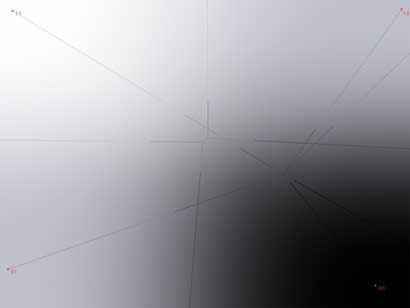
And, in case you’re wondering what I had to look at on the screen, here’s a screenshot taken during my gig. It’s a very zen-like use of AudioMulch‘s metasurface feature – the fewer knobs and buttons for me to fidget with, the more I can pay attention to the music.
Filed under: Music by Ben.H
No Comments »
Look here, we’ll draw you a chicken.
Friday 27 July 2007
No more posts for a few days, so in the meantime check out ANABlog, which has been posting even more incredible music lately than they usually do. Two of my favourite pieces, Pauline Oliveros’ I of IV and John Cage’s Indeterminacy are currently available, so hear them while you can. Both are pretty much a perfect union of conceptual cleverness with stunning musical results.
They’ve also just posted some music by the still-underrated Lucia Dlugoszewski, and if you don’t like that, well, they have some Roxette too.
For the past three months I’ve posted nothing to Flickr except Trellick Tower and vans, so here’s a boxing Paul Keating puppet taking on all comers around my former local in Hackney.