I’m beginning to get a sense of the shape of the year in London. The year truly begins with the concurrence of the composer weekend at the Barbican and the world darts championship on the telly. For various reasons I’m giving the Barbican a miss this year, but I still look in on the darts now and then.
… it dawned on me that I was watching one of the great endangered species of popular culture, a type of television that the next generation of children will never know: the professionally-produced, relatively major television event that is completely unphotogenic. I cannot imagine that in ten years’ time a large, Western television network will be making any shows where fat, balding men in polo shirts and sovereign rings are watched by a clubhouse full of attentive smokers.
In fact it lasted only one more year; the smoking ban introduced last summer took care of that. Now instead of anxious women huddled next to their kids with a fag in one hand and a pint in the other, you see anxious women chewing furiously and dashing in and out of the hall between legs.
The fat blokes with the gold bracelets and prison tatts are still on camera offering their insights into the game while standing in the middle of what is obviously a bar; but if the reports that the game’s popularity has never been higher are true, then the homogenising influence of corporate money cannot be far from banishing them and their world.
Speaking of the photogenic new face of darts, I would like to apologise on behalf of my country for the hairstyle of this year’s Australian finalist, Simon Whitlock. He can’t help it, he’s from Queensland.

Filed under: Television by Ben.H
3 Comments »
Last year’s new year’s resolution, or Is Music Art?
Saturday 12 January 2008
Someone reminded me that it’s Morton Feldman’s birthday today, so here’s a little bit from a talk he gave in San Francisco in 1986, ruminating on whether or not music is really an art form. (5’58”, 2.5 MB, mp3)
Filed under: Music by Ben.H
1 Comment »
Please Mister Please
Friday 11 January 2008
Carl Stalling, “There They Go Go Go” (1956).
(5’24”, 3.49 MB, mp3)
Filed under: Please Mister Please by Ben.H
No Comments »
He’s not going away in a hurry
Thursday 10 January 2008
Jodru at ANABlog imagines how Stockhausen would describe riding the subway in New York:
“Through a process I invented of experimenting with the New York City subway system, I have discovered a new borough called Queens.”
What follows is a useful introduction to the peculiar musical and theatrical world of Stockhausen’s LICHT, complete with photos and musical examples. A world still shrouded in mystery.
Despite being chock full of astonishing music, the ultimate strangeness of the staged opera obscured the continuing quality of Stockhausen’s writing. If Gesang der Junglinge, Hymnen and Mantra were wrapped into some cosmically trashy concept album (say, Kilroy Was Here), their aura would certainly dim.
Filed under: Music by Ben.H
No Comments »
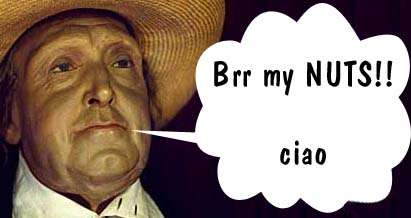
The mummified corpse of Jeremy Bentham reads inter-office emails.
Thursday 10 January 2008
Filed under: Stupidity by Ben.H
No Comments »
I have a feeling we’re not in Crouch End any more.
Wednesday 9 January 2008
Soon after arriving home from Australia I caught a few minutes of a TV show on one of the more obscure digital TV channels available in London. An American couple were walking lost around some empty streets in – a town. (I’m tempted to say an inner suburb, but even that statement is too revealing.)
According to the story, the couple had just been married in America and had come over to London to spend their honeymoon in Crouch End – you know, the same way tourists flock to New York to go sightseeing in Queens. Even though this was one of those cheap TV programs which always frames the actors’ heads as tightly as possible, and even though I’ve only been to Crouch End once, and then at nighttime, I instantly recognised where these two were; and it wasn’t Crouch End.
They were in Melbourne. North Carlton, to be precise. My girlfriend’s from south of the river and so thinks it was Middle Park, but I’m feeling cocky and reckon it was around Station, Fenwick, and Canning Streets. Something about the houses, the light, the width of the streets, immediately made the place unmistakable, even when partially glimpsed in the background.
I wonder if anyone in Britain would have been fooled by the substitution? No Londoner would have, even if they had never been near Crouch End. It’s possible, however, that they might assume it was filmed somewhere else in England. An American wouldn’t have a chance in picking this deception.
In time you come to know a city the way you come to know a face. It’s not just in the skylines, or the streetscapes, but in the way the people inhabit their space. On another TV show years ago, an Australian documentary, a friend and I watching immediately called out “Melbourne” when the film cut to a brief shot of a group of people walking down a street. The narration later proved us right: it was something about the way they were casually drifting off the pavement onto the street itself that couldn’t happen in any other large Australian city (except Adelaide, but that city always gives itself away.)
With the increase of Hollywood-funded filmmaking in Australia, these places have been turning up more and more often, the streets and buildings as actors, playing a fictional role. Sometimes they play disguised under heavy make-up – I once watched a corner of the University of Adelaide transformed into a Parisian street for a TV commercial – but often they appear as they are, expecting the viewer to mentally substitute the fictional location for the real (or is it the other way around?)
For the non-Australian majority, these urban locations act effectively as generic Western cities, shot without any readily identifiable landmarks in sight. Their acting function is less as a supporting role, and more as an extra, faceless and interchangeable. If Peter Jackson made New Zealand a stand-in for the otherworldly, then Australian cities have been made a stand-in for the real world.
Filed under: Film, London, Television by Ben.H
No Comments »
Vaucanson’s Duck
Sunday 6 January 2008

Back to Melbourne again for a moment: while I was there I got to see the opening night of Vaucanson’s Duck, a sound installation and music series at Bus gallery. Three of the four rooms in the gallery were filled with a diverse array of automatic instruments built by Ernie Althoff, Robbie Avenaim, and Dale Gorfinkel. The instruments were built out of deconstructed musical instruments and found objects, powered by repurposed record players, cassette recorders, and other electric motors.
The opening night of the exhibition became a three-hour performance, with the musicians switching instruments on and off, making small adjustments, transforming the exhibition into something between an enormous sound sculpture and a spatialised orchestra of automata. Over the course of the exhibition, each day ended with an evening performance in which a guest musician was invited to duet with the installation – sometimes acoustic, sometimes electronic, sometimes beyond category.

This is what I miss about Melbourne’s music scene. While it can be incestuous and isolated (it’s a financial and logistical hassle to get in a visitor from another state, let alone another country,) it consciously maintains a vitality that often seems lacking in London. At times London feels too complacent, a victim of its size and its history.
What’s notable about Vaucanson’s Duck isn’t just the intensity and commitment demanded by the program (a different gig each night for two straight weeks!), it’s the attempt to present a season of new music with no easily identifiable genre. While London new music events so often evince a need to identify with a tradition in folk, free jazz, or classical music, the musicians in the Melbourne program typically work in ways that transcend typical stylistic boundaries – as shown in the web discussion. I’m familiar with most of the musicians in the series, and yet I could not predict what kind of performance some of them would give on the night.
This is by no means the only time such a series of events has been staged in Melbourne in recent years; nor are these events typically attached to any large, public institutions. I’ve made a sort of new year’s resolution to seek out more obscure gigs in London to find out whether this city truly lacks such an eclectic new music culture, or that it has simply managed to elude me for so long.
Filed under: Art, Music by Ben.H
No Comments »
Magic happens.
Saturday 5 January 2008
Another year, another Magic 1278 Listener Advisory Board Survey. Visit their home page and click on the Advisory Board link in the bottom right corner to join in the fun.
The golden rule still applies: one dud song amongst a sea of gems, including Lobo’s “Don’t Expect Me To Be Your Friend”, which is just about the most Magic-esque song in the world. This month seems to have a sub-theme of semi-forgotten cover versions.
Gypsy Woman – Brian Hyland*
To Whom It Concerns – Chris Andrews*
Clap Your Hands – Beau-Marks*
Blueberry Hill – Fats Domino
Theme From “A Summer Place” – Percy Faith*
But I Do – Clarence “Frogman” Henry
Young Love – Tab Hunter*
Guantanamera – Sandpipers*
Nowhere Man – The Beatles
Yesterday When I Was Young – Roy Clarke*
What The World Needs Now Is Love – Jackie DeShannon
It Takes Two – Marvin Gaye & Kim Weston
Happy Birthday Baby – Tony Christie*
(Your Love Keeps Lifting Me) Higher & Higher – Rita Coolidge*
Room Full Of Roses – Mickey Gilley*
Don’t Expect Me To Be Your Friend – Lobo**
Clancy Of The Overflow – Wallis & Matilda*
Here You Come Again – Dolly Parton
Emotion – Samantha Sang
Route 66 – Natalie Cole
Saving All My Love For You – Whitney Houston
Ebony Eyes – Everly Brothers*
Forever Autumn – Justin Hayward
Lay Back In The Arms Of Someone – Smokie*
Montego Bay – Bobby Bloom
Filed under: Music by Ben.H
No Comments »
Please Mister Please
Friday 4 January 2008
The Go-Betweens, “People Say” (1978).
(2’40”, 2.63 MB, mp3)
Filed under: Please Mister Please by Ben.H
No Comments »
Winter Music
Wednesday 2 January 2008
It’s not that I like summer; it’s just that I still can’t fully commit to the idea of winter happening at this time of year. Give it another year or two and the seasons will change back the way they always were, my brain keeps saying.
In an attempt to get into the mood, I’ve offered up a piece to Daniel Wolf at Renewable Music, for his Winter Album, a collection of short compositions for piano. Also featured are pieces by Dennis Báthory-Kitsz, Jon Brenner, Steed Cowart, Elaine Fine, Hauke Harder, Jeff Harrington, Aaron Hynds, Lloyd Rodgers, Jonathan Segel, and Charles Shere – most of whom have probably got a better handle on this whole “winter” concept than I have. I wonder if I still lived in Australia, whether I would, or should have contributed at all!
My piece, Redundens 6i, is the latest in an ongoing series of works I return to every now and then. This new instalment seemed brief, static, and cold enough to fit the Winter bill. I’ve started a short page about this piece, and the series in general, which might get expanded over the next few months.
They’re saying it might snow tomorrow.
Filed under: Music by Ben.H
No Comments »
Until next year (actually, I could do with a Coopers now)
Monday 31 December 2007

Finally, here are the five most popular songs played on Magic 1278 in 2007, as voted for by listeners like me. And what a fine list it is too, except maybe that last one.
- “Then He Kissed Me” by The Crystals
- “Ramblin’ Rose” by Nat King Cole
- “Spicks & Specks ” by the Bee Gees
- “El Paso ” by Marty Robbins
- “The Air That I Breathe” by The Hollies
And the least popular song? “Please Don’t Ask Me” by Johnny Farnham. Looks like the listeners’ advisory committee is doing its job.
Please start the new year by enjoying the above location shot of the venue for the Brisbane gig. More photos and music are on the way.
Filed under: Music by Ben.H
No Comments »
A Man in Love with the Past: the year in retrospect
Friday 28 December 2007
Last December Georgina wrote in Sarsaparilla about her books of the year:
Instead of naming a book that was released this year, how about we name a book that was our ‘one’ of the year, regardless of when it was published. Perhaps you might have read something that was particularly pertinent, perhaps you finally got around to reading something that really stood out from the bedside pile. Perhaps you read nothing of note.
I haven’t written nearly as much about books this year as I wanted to, so here’s my chance to make it up a little.
Book of the year: For me, this was William Gaddis‘ The Recognitions, a novel whose 950 pages I finally read after finding an ex-library copy in Melbourne’s Grub Street Bookshop years ago (thanks, Macrobertson Girls’ High!) Taking up from where Wyndham Lewis left off, it’s one of those books which has just grown more and more relevant to our world with each year since its first publication 50-odd years ago. Its double-edged dissection of the dearly-held belief that art reveals truth is set in a society whose slippery duplicity is probably more familiar to us than to Gaddis‘ contemporaries. The book’s unique written style was later echoed by Pynchon, De Lillo, and others, but I’ve never read anything so uncompromising or sinister in its relationship with the reader.
Runner up: As is all too typical, I became interested in Gilbert Sorrentino just after his death. I’d lazily pigeonholed his novel Mulligan Stew as one of those faddish, would-be cult novels from the 70s, based solely on its dogged recurrence in those little bookseller’s ads at the backs of yellowing paperbacks, with the inevitable trite comparisons to Joyce, Vonnegut, and Moorcock which publishers used interchangeably back then. In fact, it’s one of the funniest literary satires written, especially for people who sometimes grumble to themselves that they’ve read too much to really enjoy books any more. Best of all, it never lets up on the gags to explain the philosophical and emotional core that its facade attempts to conceal. A book that’s worth it for the first page alone.
Literary discovery of the year: Ronald Firbank. From dilettante and fin-de–siecle also-ran, to cultish outsider, to the inventor of modernism. It’s those jokers you have to watch out for.
Reverse-Humiliation: Apart from The Recognitions, I finally knocked Jealousy and Life: A User’s Manual off my to-read list.
Music gig of the year: Even before his death, my thoughts about music kept coming back to the February performance of Stockhausen’s Trans. A student orchestra, some dramatic lighting, and not just Stockhausen’s imagination, but his boldness and self-assuredness when making something new; all came together to create an uncanny experience which leaves people bandying around expressions like “otherworldly” and “life-changing”. There’s no other piece of music quite like this; nor, in all likelihood, will there be.
Music recording of the year (any type): Special thanks are due to Different Waters, for uploading a complete version of La Monte Young’s long-deleted masterpiece The Well-Tuned Piano.
CD of the year: It was a year in which I avoided CDs and vinyl in favour of foraging for downloadable music, so you might blame my limited range of discs for my choice; but honestly, I don’t think I could have possibly heard anything more surprising than Paul McCartney’s Memory Almost Full album. An elderly ex-Beatle makes a CD for Starbucks, and instead of cobbling together a lazy cash cow he finally makes his first album in, well, forever, that embraces all of his strengths (brilliantly crafted songwriting and arrangements, brought off with a disarming informality) and almost entirely rejects all his weaknesses (complacency, bombast, second-guessing, ill-judged whimsy).
Music discovery of the year: Zygmunt Krauze, whose piece Folk Music I heard thanks to The Rambler’s fascinating description of Polish “Unism“, a home-grown movement of minimalist art and music that emerged in the 1960s.
Art event of the year: Too much new art that I saw in London looked like high-falutin‘ tchotchkes created for investors with at least one eye on the auctions. My personal highlight was a visit to the Groeninge Museum in Brugge and seeing renaissance Flemish masterworks by the likes of Memling, Van Der Goes, and Van Eyck, the same artists I’d just been reading about in The Recognitions. Looking at this art you can understand what Ezra Pound meant when he said that Western culture went wrong somewhere in the 17th century.
Public art event of the year: After a mysterious extension to its intended stay, Mark Quinn’s Alison Lapper Pregnant finally came down from the fourth pedestal in Trafalgar Square. Honestly, it looked like the sort of thing Coldplay would turn out if they were paid to make a sculpture.
(Crossposted at Sarsaparilla.)
Filed under: Art, Music, Writing by Ben.H
No Comments »
Filler by Proxy LVII: Things Ain’t What They Seem
Thursday 27 December 2007
Because it’s that time of year, I’m working up a short list of best-ofs for 2007. It’s the fashion. Last December Georgina Hibberd posted at Sarsaparilla her list of books for the year, with the twist that the books did not necessarily have to be published in the past 12 months. In fact, it was preferable for them to be older. It’s such a good idea I’m going to steal revive it for a follow-up article posted on Sarsaparilla in the next day or two. Gilbert Sorrentino will be mentioned.
Because it’s that time of year, It’s A Wonderful Life has probably been on a telly somewhere near you. It’s the tradition. While it’s fresh in your head, you might enjoy Sorrentino’s brief, but thorough, demolition of the illusion that movie strives to portray.
Capra’s greatest film, It’s a Wonderful Life, is a curious example of a work that means precisely the opposite of what it seems to say. Its true message is, in the context of Capra’s oeuvre, a surprising one: Money is everything. Although the film is usually read as the pinnacle of the Capraesque ideal of grassroots optimism, I would argue that its subtext calls this optimism into serious question. In effect, the film encapsulates a disgust and anger with modern American life that are barely hidden, and often glaringly foregrounded.The final scene of the film is ambiguously eerie, and its strangeness is emblematized in George Bailey’s near-maniacal grin, one that is equally composed of shame, fear, gratitude, and self-loathing. It is a grin that, once seen, can never be forgotten. Money is everything is what that grin says, what the scene says, and what the film says. In this final moment, the truth of the film strikes at us with metonymic power through the stilted images of celebration and victory and joy….
Filed under: Filler By Proxy, Film, Writing by Ben.H
No Comments »
Please Mister Please
Thursday 27 December 2007
Yoko Ono/Plastic Ono Band, “Greenfield Morning I Pushed an Empty Baby Carriage All Over the City” (1970).
(5’39”, 5.44 MB, mp3)
Filed under: Please Mister Please by Ben.H
No Comments »
It is, after all, a time for giving.
Monday 24 December 2007
 Congratulations to Kipper, the lucky recipient of the pair of Qantas travel socks once owned by ABC radio personality Julian Day. That should make the harsh, northern winter a little easier to withstand.
This seems like a good time to remind readers that we still have some remaining items from the mid-year Julian Day toiletries auction. In particular, the toothbrush and shaving equipment are still available to the hygiene-conscious Fine Music fan: click here for pictures, descriptions, provenances, and reserves.