The Caffe Nero in Theobalds Road is obviously a money-laundering front.
Filed under: Art, London by Ben.H
3 Comments »
EXPERIMENT?
Saturday 8 May 2010
Sorry for the delay – volcanic ash in the computer.
Before the concert, Frederic Rzewski announced that he was trying to write music that didn’t make sense. He also said that his piano playing was getting worse with age, which was Nature’s way of telling him to start practicing. He played us the latest instalment of his series of Nano Sonatas – exercises in compressing as much musical content and variety into as little time as possible. Despite drawing their inspiration from nanotechnology, the sonatas’ freeform weirdness of apparently disjointed ideas spilling out over each other were reminiscent of Beethoven’s late bagatelles. As the bagatelles have been the boundary marker for the limits of musical meaning for 150 years, it seems that Rzewski’s campaign for nonsense is making progress.
This was all part of the London Sinfonietta’s series of concerts last week of ‘experimental’ music, somewhat inappropriately titled EXPERIMENT! and rather oddly divided up into Americans one night, British the next. The American gig was uniformly excellent, the highlights being Rzewski’s performance, the chance to hear some more of Christian Wolff’s music, and one of Morton Feldman’s lesser-known works. The programme said the Sinfonietta would be playing Feldman’s Four Instruments (1975) but the musicians goofed and played the 1965 piece with the same title by mistake. It’s strange how music which seemed so abstract and remote from emotional expression at the time, is now played with an umistakeable mood, a sense of introspective melancholy.
I’m wondering if a lot of Wolff’s music can only be appreciated live, with the listener there in the presence of the musicians interpreting the score on the spot with a combination of individual decisions and group consensus. The Sinfonietta’s performances made sense to both the head and the heart, with Exercise 16, played on violin and cello, sounding even beguiling. That’s an adjective I’ve never applied to Wolff’s music before.
That first night ended with Rzewski’s old warhorse Coming Together, which still packs a musical and dramatic wallop. My only quibble was that the reciter’s performance was a little ripe for my taste, with some minor but distracting miming of writing activity. Perhaps he was employing histrionics as a test of the reactions of others. I suppose he gave a vivid portrait of an incarcerated thespian.
By contrast, the second concert lived up to the usual stereotypes of the British being more reserved, modest, and using self-deprecating humour to undermine the seriousness of their intent – a trait which can be both good and bad. A more telling contrast, unmentioned by the programme notes, was a greater presence of more recent pieces by the British composers. It’s great to have newer music by living composers, but it revealed the fallacy of the concert’s presumed theme of “the experimental tradition”. The worst example was the choice of a section from Michael Nyman’s 2003 piece Exit No Exit to end the gig. Nyman’s written some interesting – and experimental – music, along with hours and hours of forgettable aural wallpaper like this piece. It was (perhaps inevitably?) a spinoff from an occasional piece, which may explain why it sounded less like music and more like a branding exercise, for composer and commissioner alike.
British self-effacement is all very well when it’s applied thoughtfully (as with Howard Skempton, whose Clarinet Quintet was played) but at other times it produces music which seems compromised, as though the composer didn’t have enough faith in the music’s premise and began pulling punches. The result thus often sounds derivative. John Lely’s All About The Piano had an interesting idea – piano playing recorded in real time then played back over various recording devices – white-anted by a couple of factors.
First, the title, with the sort of naff wordplay that seems strangely endemic amongst composers and real ale brewers, rendering both equally unappealing to normal members of the public. Secondly, the music itself wasn’t distinctive enough to make itself heard above the theatrical business with the various recording media. To be fair, I doubt that anything could upstage the acoustic, hand-cranked cylinder recorder that occupied front centre stage.
The British evening’s highlights were a small-scale production of Gavin Bryars’ classic The Sinking of the Titanic, and Cornelius Cardew’s Autumn ’60. Bryars’ piece is extremely effective in the disarmingly naive way it becomes both a memorial and an evocation of the event it commemorates, through its focus on the musical and sonic aspects of the tragedy. I’d never heard Autumn ’60 before, and this was a grand performance, with John Tilbury conducting the Sinfonietta and Howard Skempton sitting in on accordion. Cardew’s piece showed it’s affinities with the music of Christian Wolff and Earle Brown, but struck its own path in achieving an openness of interpretation that the New York School had advocated but taken years to get the hang of. Autumn ’60 makes its variety of textures, dynamics and colours seem effortless, while guiding the musicians through a coherent structure that still allows great flexibility. If the British concert concentrated on older pieces like these, it may have been as strong as the American programme.
Filed under: Music by Ben.H
2 Comments »
Masons In Distress!
Thursday 6 May 2010
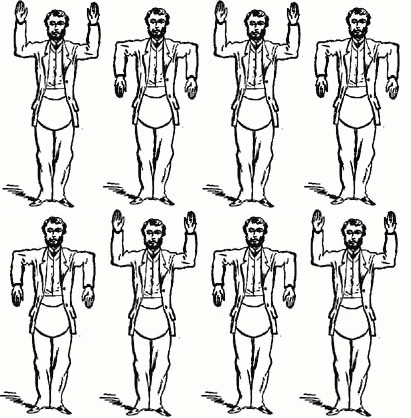
Unscheduled computer maintenance. Today’s blog post is sure to appear tomorrow.
Filed under: Stupidity by Ben.H
No Comments »
Please Mister Please XCVII
Monday 3 May 2010
Luv’d Ones, “Up Down Sue” (1966).
(2’05”, 2.85 MB, mp3)
Filed under: Please Mister Please by Ben.H
No Comments »
The Slips, with added sound
Monday 3 May 2010
Before the weekend, I went to the somewhat misnamed EXPERIMENT! concerts by the London Sinfonietta. If I sound a bit downbeat about the gigs when I write about them tomorrow, it’s because when I left the second one it was pouring with rain and I got soaked.
In the meantime, I’ve dug up an audio excerpt from The Slips. This isn’t a recording of the actual performance, but a simulation made from overdubbing the backing tapes used in the performance. Not ideal, but it gives you an idea of how the piece sounds when it’s read. Hopefully I can get a better recording made this year.
Ben.Harper – An excerpt from Slips 1
(4’20”, 6.34 MB, mp3)
Filed under: Music by Ben.H
No Comments »
John Cage’s difficulty, according to Frederic Rzewski
Thursday 29 April 2010
When asked tonight why his description of Cage’s ideas seemed to contradict Cage’s own essays, Rzewski replied: “Cage was not a master of language. He obfuscates. If people have been playing his music badly for decades then it’s his own fault for being so unclear.”
Filed under: Music by Ben.H
Tags: Frederic Rzewski, John Cage
No Comments »
John Tilbury and the Smith Quartet play Morton Feldman
Monday 26 April 2010
Piano and String Quartet, at King’s Place last Thursday. How little you need to make something beautiful, elusive; not just the material, the subject, but how it is articulated. It takes so little from each instrument to keep the music alive.
“Timbre and range are the same problem, and both are more important than pitches. When one knows exactly the sound he wants, there are only a few notes in any instrument that will suffice. Choosing actual pitches then becomes almost like editing, filling in detail, finishing things off.”
This isn’t minimalist music – it isn’t making the most of limited means. It’s music composed with the richness of a certain set of timbres and instrumental sounds, for which only certain pitches will suffice.
Playing this softly, this slowly, the sustained chords of the piano seem to chime on forever against the string instruments.
Hearing it live, you notice how the musicians are living within the piece, so large are its dimensions. Two thirds of the way through you can feel them tiring, getting a little faster, a little louder; then someone attacks a note with a little frailty and the mood changes and a sense of quiescence returns. In its small way, a gentle climax has been achieved.
Tilbury’s playing seems more constant in his approach than other times I’ve heard him play Feldman, but on those occasions he was playing solo. Balanced against the quartet, the two forces alternate between sound and silence for the opening section of the piece, each framing the other. By the end the quartet is playing constantly, with the piano disturbing the otherwise still surface of the music.
The fatigue, the compromising of styles to accomodate others: to what extent did Feldman anticipate the frailties of musicians when writing this music?
Filed under: Music, Reviews by Ben.H
Tags: Morton Feldman
1 Comment »
The Theremin Cello: I want one.
Thursday 22 April 2010

Another great thing about the Varèse 360° gigs was the performance of Ecuatorial with two Theremin cellos in the ensemble. Ecuatorial is the only piece specifically written for this incredibly cool instrument, and up until a few years ago it could only be performed with a pair of ondes Martenots substituting, as the only two existing Theremin cellos are now in museums.
The story of the reverse-engineered and newly rebuilt Theremin cello, and its role in Ecuatorial, can be found here. Some more info and a better photo of the new instrument here.
Filed under: Music by Ben.H
No Comments »
Varèse 360° Full Blown
Wednesday 21 April 2010
Hearing all of Edgard Varèse’s music in three concerts over two nights was too good an opportunity to pass up. It shouldn’t be such a rare event. “We believe it deserves to be done at least once a year,” conductor Paul Daniel enthused at the end of the final concert. A bit gushy, perhaps, but by that time I could see his point. The experience had confirmed, expanded, and partly confounded my understanding of the composer.
This is exacting music for the performer and the listener. Varèse has a reputation for attempting to blast his audience into submission, but heard in these circumstances the music didn’t make its demands through bullying and bombast. A remarkable manipulation of scale comes into play, by Varèse’s use of stark, densely packed details condensed into brief structures with little room for repose. Each piece forces the listener into a relatively short, but intense, burst of concentration. It’s hard to believe a work as vast as Ameriques is over within 20 minutes. As with Webern, Nancarrow and Ustvolskaya, Varèse’s music is bigger than its durations suggest.
The opening performance of Ionisation by the London Sinfonietta beautifully emphasised the skill with which Varèse shaped the levels of ferocity projected by his percussion ensemble. Musically, the execution throughout the concerts was technically dead-on and interpreted in an intelligent and opinionated way. We got to hear Varèse the composer’s music of the future, not Varèse the polemecist’s manifesto for a music of the future, as it is too often presented.
The only sticking points (besides the programme and the visuals) were a Density 21.5 that came across a bit fusty to me, and Déserts, which my friends found clunky but I really enjoyed. They dug the rough, lo-fi sound of the taped segments but thought the live bits suffered in comparison, as a piece struggling with then-emerging technology whose reach exceeded its grasp. I was fascinated by the way in which Varèse had written for percussion and brass as though they were electronic, able to be stretched, spliced and mixed like so much tape. It was the way Stockhausen and his contemporaries began to write music after they’d worked with tape recorders. Varèse seems to have been working toward that style for years.
For the final concert the massive forces of the National Youth Orchestra of Great Britain played the equally massive Arcana and Amériques, the latter in its even more over-the-top original orchestration. Their performances were less groomed than others, and slightly feral, which doesn’t hurt this music in the least. They packed a hell of a punch without ever losing control or resorting to untermpered noise.
This concert was neatly bookended by a choreographed version of Varèse’s fragmentary goof Tuning Up as an icebreaker at one end, and an encore of Debussy’s Prélude à l’après-midi d’un faune at the other. The relative sweetness of this piece didn’t obscure its important role as the instigator of so much 20th century music, not least because, as we were reminded, it was this music that inspired Varèse to dedicate his life to music.
It had been several years since I’d seriously listened to any Varèse and, like all good concerts, the weekend made me want to hear more. Of course, tragically, there isn’t any more than those 16 pieces. Contrary to the thoughts of some late 20th century critics who thought Varèse would be remembered more for his historical role than his music, it is music that invites repeated listening, and explorations of the man’s ideas flow from the curiosity piqued by hearing it. Listening to the crude but self-assured sounds of Poème électronique distributed through the space of the hall, you wonder what other music you’ve missed out on, for want of a few more dollars, a little extra time.
Filed under: Music by Ben.H
Tags: Edgard Varèse
No Comments »
Varèse 360°: but first, a rant.
Tuesday 20 April 2010
 On the weekend I was blown away by the Edgard Varèse 360° gigs – yep, three tight little concerts of the complete works of Varèse. Awesome.
I want to write some nice things about it, so I’ll get this out of the way first. Enough with the crappy video projections, already. Nobody likes them. Critics don’t like them, the punters don’t like them, nobody’s bought a ticket to your gig to look at insipid video art, they’re there for the music and your ill-conceived attempts at visual decoration are a distraction at best, an embarrassment at worst. You’ve been trying this crap on for years and it hasn’t gotten any better. Give up. The people coming to your gigs are savvy enough about culture to know that your visuals just don’t cut it for a professional outfit. You may think you’re getting down with Yoof but if The Kids are lured to one of your concerts they’re already switched on to video and recognise crap when they see it. Stop it – you’re only hurting yourselves. It undermines the concert experience for the regulars and it convinces the newcomers that it’s as lame as they feared.
Filed under: Art, Music by Ben.H
Tags: Edgard Varèse
2 Comments »
Please Mister Please XCVI
Sunday 18 April 2010
Ernie Gallagher, “The Cambridge Whistler” (1989). Version for 2 records.
(1’11” 1.1 MB, mp3)
Filed under: Please Mister Please by Ben.H
No Comments »
My weekend, so far
Sunday 18 April 2010

Filed under: Art by Ben.H
No Comments »
Plus-Minus Ensemble at Kings Place
Thursday 15 April 2010
For an insight to what going to one of these types of concerts is like, you must read the review at Notes From A Defeatist.
They played Xenakis’ Dikhtas and Evryali, two pieces which have been decking audiences for over thirty years and need no further praise from me right now. There was also Vermillion, a trio for clarinet, cello and electric guitar by Rebecca Saunders, a composer whose work I’m just starting to get familiar with. But Vermillion was a disappointment, a tentative and awkward piece made moreso by the clumsy and self-conscious use of the guitar.
I was tempted out to hear this mostly because of the interview with Bryn Harrison at The Rambler – Harrison’s lengthy Repetitions in Extended Time made up the second half of the programme. Harrison’s music gets described as a combination of Morton Feldman and Brian Ferneyhough, a sort of hybrid of the American and the European strains of the refined avant-garde. Repetitions in Extended Time certainly bore a superficial resemblance to late Feldman, with its ambiguously shifting patterns repeated with subtle changes.
For a while the piece was intriguing, in the way that it picked up on one technical aspect of Feldman’s music and made something new from it. (So much music written since Feldman’s death, such as Vermillion, seems so timid, as if overawed by the implications of making any sound at all.) By the latter stages, however, the music’s unvarying surface and mood became familiar, whereas Feldman’s music never loses its strangeness.
I haven’t heard enough of this music to know whether it is in fact an attempt to square the circle, to rationalise Feldman’s musical language with academic theories. Remembering it now, I wonder if the future will be kind to it, and whether what sounds fresh and innovative about it now will be just the things that later strike us as derivative and compromised.
Filed under: Music by Ben.H
1 Comment »
Drinking beer and watching Jon Rose and Chris Cutler
Tuesday 13 April 2010
I’m sitting in Cafe Oto thinking about why I’m too busy thinking to really pay attention to what Jon Rose and Chris Cutler are playing. I’m telling myself it’s good that I can listen without having to worry about paying close attention, and just let it fill the air around me, but I might need some convincing. I like the way there’s plenty of activity, both visually and aurally, but it’s all meshing together in a variegated carpet* of sound, not a pair of competing virtusosic showoffs – Barthes’ “petty digital scramble”*.
Nobody’s trying to impress me with how difficult it is to do whatever it is they’re doing, and even the most raucous sounds are giving room for me to think.
Filed under: Music by Ben.H
1 Comment »
The Slips
Sunday 11 April 2010
More details about The Slips can be found here. Audio excerpts and other documents will be available soon, once I’ve cleaned them up a bit.
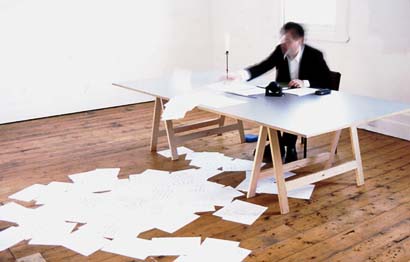
Slips 1 and Slips 2 were written in March 1999 and revised in November 2002. They are two of several works I have written using musical compositional techniques to produce texts; in particular they are inspired by the formalist poetry of John Cage and Konrad Bayer. Unlike my previous texts (A Walk Around the Lake (1994-95) and An Austrian Automaton (1996- )) Slips 1 and 2 were written particularly with spoken performance in mind.
The matter for both pieces is taken from the slips of paper – Zettel – the philosopher Ludwig Wittgenstein kept in a box, in no particular order, which was discovered after his death. From this collection of short texts I have taken only the words and phrases written in quotation marks: examples of language, hypothetical speech, “things”, rather than the thoughts that connect or discuss them. A list of some 650 phrases or words was thus obtained.
Both works are one hour long, for two voices. For Slips 1, each minute was allocated a certain number of phrases, between zero and twelve, for each speaker to say. Apart from some specified timings, the speakers are permitted to say their phrases at any time within the designated durations. As well as speaking, the performers are instructed to write out specified passages while they say them. The number of phrases spoken, the selection of phrases from the list, the timings and designated written passages, were all determined by chance using Andrew Culver’s computer program ic, an I Ching simulator. With the exception of a small number of chance-selected phrases, the parts for the two voices in Slips 1 are almost identical, differing only in their timing and passages designated to be written out.
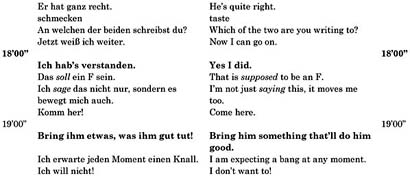
Slips 2 uses the same compositional method as Slips 1, but instead of complete phrases only a restricted number of words are selected from the given phrases. At first these words are extracted from the text for Slips 1, and after this material is exhausted newly-selected phrases from the list were subjected to this process. The parts for the two voices in Slips 2 do not differ at all, apart from their timings and designated written passages.
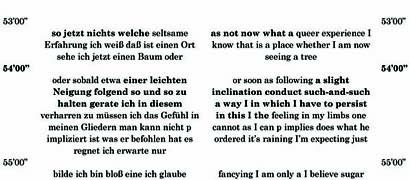
The two works may be performed separately, or with Slips 2 following Slips 1. Each work may be performed by two live speakers, or one live speaker with a recorded voice. As the text gives the original German and parallel English translation, each piece may be read out in either language, or a mixture of the two.
Two important aspects of The Slips in performance are the prevalence of silence (absence of consciously-produced sound) and the sense of time passing. One final point is the requirement for additional music to play very quietly sometime during the middle third of each piece. Other events may occur simultaneously with the performance.

The first complete performance of The Slips was given by myself at Clubs Project Inc. in April 2003. I performed both works twice, once reading each part, with a recording of myself reading the other part. The performance was entirely in English. To emphasise those two important aspects mentioned above, all the windows in the venue were left open throughout the afternoon of the performance, and the last of the four readings was times to conclude at sunset. During the second performance of Slips 2 the shadows lengthened across the room, and the candle on my table that I had lit at the start of the afternoon finally asserted its prominence as the only light source within the room.
At certain moments during the day, excerpts from my NSTNT HPSCHD PCKT MX (2002) for fourteen virtual, out-of-tune baroque harpsichords would play softly in another part of the venue, its presence more noticeable in its disappearances.
Other, smaller-scale pieces have been made from the same source material as The Slips. The most notable of these is Wandering Split (2002), an audio-only piece that was essentially a condensed version of Slips 1, spoken simultaneously in English and German, with a specially composed musical soundtrack acting as a third voice mediating between the two. Wandering Split was first presented as part of a sound installation in the group multimedia exhibition Gating, curated by Michael Graeve at West Space Art in 2002, and subsequently issued on the exhibition CD. Since then, the piece has enjoyed a few outings at sound art gigs in Austria.