 Eva-Maria Houben & Harmjan Roeles: given [Sawyer Editions]. The last time I reviewed something by Houben I called her composition style as “on the cusp between just-enough and not-enough”, but her collaborations can often go in unexpected directions. In given, she plays a neat little portable pipe organ as part of a trio with Harmjan Roeles on double bass and the producer Roeland van Niele – yes, they describe their practice as involving all three. I don’t see any recording venue or dates on this album so the circumstances of the perfmormance(s) heard here are for conjecture, but the sleeve notes refer to it as an “exercise in breathing”, presumably with the producer providing outsourced mindfulness. In the first part they are susceptible to mood swings, with Roeles’ bass growling in the lowest registers while Houben’s organ is unsettled and flighty, with occasional florid outbursts. They gradually centre themselves, until by the end of the first part and throughout the remaining two they achieve near-immobility. The two musicians occupy a strange space in which timbre and pitch start to blur into a single quality, making as little overt action as necessary to produce sounds in which bow on string matches air through pipes, clear tone meshes with overtones. While working their way down to almost nothing, they never lapse into stasis; rather they feel their way through the piece moment by moment. Lasting over an hour, they seem to achieve a reductive endpoint by about a third of the way through, yet by extending far beyond this apparent limit they keep finding new places to explore with increasing attention and refinement.
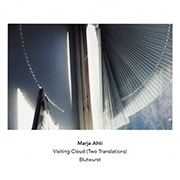 Marja Ahti: Visiting Cloud (Two Translations) [Another Timbre]. This is the first solo work by Ahti that I’ve reviewed, and it consists of two electroacoustic compositions from around 2019-20 that were repurposed for the all-acoustic Blutwurst ensemble, featuring Cristina Abati, Marco Baldini, Luisa Santacesaria et al. Laurence Binyon’s aphorism “slowness is beauty” is the watchword here: these new arrangements are about twenty minutes each, somewhere between two to three times longer than the originals. Which I haven’t heard, so I can’t make comments on the tempo. What I do hear is that Chora is stately and sumptuous, rendered as a slow series of chords that gradually fill out an existing harmonic idea rather than follow any form of development or process. The ensemble plays viola, trumpet, cello and double bass, bass clarinet, accordion and harmonium, offering a rich palette of sounds from relatively small forces. In Fluctuating Streams the progression is more linear, starting with unvoiced sounds that slowly morph into monotones, then begin to take on simple harmonisations. Once again, Ahti and Blutwurst prefer not to build up but to detail a single musical image, reaching a certain stage of completeness and then examining its effects at length, creating a piece with a strangely sinuous aspect to its languor.

Leave a Reply