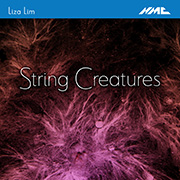
 Liza Lim: String Creatures [NMC]. I’m just back from vacation and feel like apologizing for not writing about this album as soon as it came out last month. Even for listeners familiar with Liza Lim’s work, String Creatures is a revelatory and at times astonishing insight into her transformative music. The four pieces presented centre on perfomances by the JACK Quartet in Melbourne last year and were composed between 2014 and 2022. The title work that leads the set is a large quartet that would seem to dominate the album, at first: it grabs your attention from the first moment with its opening violin aria played in a sour and resonant baritone, an uncanny effect achieved by tuning the bottom string an octave lower. Lim has fashioned a unique and remarkably coherent language for string instruments, achieved through a synthesis of eclectic influences and empirical experimentation. Extended techniques are likely as not to be drawn from other cultures such as folk fiddling (Hardanger and Bluegrass) as from the postwar avant-garde. The most extraordinary thing about String Creatures is that, even with its dazzling array of new sounds and extremes of colouration, it always feels like the effects are a natural means to an end, producing a complex expressive statement on the relationship between physical activity and emotional need: a Romantic disquisition made through a renewed, corporeal language.
On that corporeality: I remember many, many years ago attending a public workshop of Lim’s early string quartet Hell. After the first run-through, she told the musicians they were playing the notes too well. Where her score called for notes to be played hard, or faint, or off-pitch, she really wanted the physical impact to be heard and felt, removing the quartet from being a sophisticated ensemble and towards becoming an organic complex, all sound as a product of friction and breath. With the JACK Quartet, Lim pushed this line of thinking much further: “Lim asked the players to learn rope tricks and to literally tie each other’s hands to their instruments, exploring the sounds that resulted as the musicians struggled free.” Having learned the music inside-out, as it were, it follows that JACK’s playing of these challenging pieces is entirely fluid and eloquent, speaking in strange intonation, nasal falsetto and harsh gutturals with a discursive flow as though it were their mother tongue.
So there are strings and there are strings: JACK cellist Jay Campbell plays solo on an ocean beyond earth, on two instruments; or rather between two instruments. Each string on his cello is attached by a rosined thread to a string on a retuned violin; pulling on a thread sets off faint resonances between the two instruments. It’s a still, otherworldly work that finds portent in its quietness, fitting the subject matter that inspired it, of interpreting a signal received from space. The perception is clear even as the outline is diffuse. The brief The Weaver’s Knot is a string quartet which compresses the activity of its argument into a single movement a little over five minutes long – it’s short but not small. For the final work, The Table of Knowledge, JACK is joined by Rohan Dasika on double bass. The deeper pedal tones play off against odd harmonics, creating a queasy, distorted form of exotica. The knowledge Lim alludes to can be discerned from the titles of each movement: Datura, Belladonna, Henbane, Cannabis. It’s a heady mix of the alluring and the repellent which has underlaid her music all the way back to her early chamber piece Garden of earthly desire, an embrace of the uneasy relationship between the physical and the spiritual that makes her otherwise esoteric idiom so compelling. The long final movement, “Flying”, transcends what has gone before it with a strange solo by Dasika, playing bass while holding a taut thread in his mouth, attached to the bass’s top string. His mouth acts as a resonator, producing a kind of overtone singing multiplied by the sympathetic vibrations of the instrument. As a final transformation, he music floats somewhere between bowed string and voice, never fully one nor the other, at once more than and less than human.
Filed under: Music, Reviews by Ben.H
Tags: Liza Lim
No Comments »
Sarah Saviet, solo violin: Spun and Every Strand of Thread and Rope
Friday 4 August 2023
 I was treated to a live performance by violinist Sarah Saviet at the All That Dust launch, playing Soosan Lolavar’s solo suite Every Strand of Thread and Rope. It’s a rough and hairy piece, even in its most delicate sections. The four movements were added over the last few years, as part of an exchange between Lolavar and Saviet, with Lolavar applying her experience of Iranian santūr music and tuning to new ideas, and Saviet responding by retuning her violin down a minor sixth, slackening the strings and altering the timbre and intonation. Saviet uses Lolavar’s score to dive into the textural potential of the looser strings, the softer tone of the lowered pitch modulated by guttural buzzing, thickened timbre and faint rattles. The presence of unpitched sounds get cranked to 11 in the final movement (‘Chainmail’), made out of repeated, hacking patterns of double-stops, to the point it dominated my memory of the piece until I heard the recording and rediscovered how lightly the effects are used in the gentle (but still hairy) ‘Fibres’ that precedes it. The All That Dust release is a binaural recording, a stand-alone download.
 Every Strand of Thread and Rope turns out to be a suitable entree for Saviet’s full album of solo works, Spun, just released on Coviello Classics. Exotic timbres abound throughout, beginning with Liza Lim’s 2018 piece The Su Song Star Map. It’s also a piece written for retuned violin and exploits the possibilities of colouration, albeit in a less obsessive way. Saviet moves easily between the light and bright melodic passages and the thornier timbral shadings Lim calls for, sometimes only for fleeting moments or in transition from one tone to another. It’s a lovely sample of Lim’s more recent style, embracing directly florid melody but grounding it in denser and darker patches of complex sounds to cast the solo in a more sophisticated perspective; Saviet fuses both of these tendencies in her interpretation, with one highlight being the blaze of contrapunctual harmonics near the work’s centre.
The sleeve notes make repeated references to ‘throaty’ and ‘digging in’, reinforcing Saviet’s relish for the lower strings. Even Lisa Streich’s Falter, made out of feathery apreggios, is occasionally anchored by a barking low note. The most aggravated case is Evan Johnson’s Wolke über Bäumen, a piece from 2016 which shows this composer’s use of extremes to particularly stark effect. The piece demands gut strings, played with a baroque bow, but the idiom is blasted and barren, using techniques that eke out the strange and sour in the organic inconsistencies of the physical materials. To hear the intricacies in each of the faint wisps of sound, you must also accept being battered by the sudden outbursts of violent noise; as a pastoral, it depicts nature in its harshest light. Arne Gieshoff’s spun is also discontinuous, but in a more capricious way, flitting from pizzicato glissandi to double-stops, trills to smeared and heavy bowing. The final work, Lawrence Dunn’s Habitual from 2017, works here as a kind of bookend to Lim’s piece. A deceptively simple patchwork of brief melodies, Habitual creates a formalised unselfconsciousness. Dunn stipulates just intonation be used, making the tunes sound both natural and personal, as though played without an audience. Patterns never quite settle into a regular grid, or even settle at all, and the structure you anticipated hearing at the outset unspools into an unhurried soliloquy of thoughts not yet fully formed. Saviet maintains a warm but contemplative mood throughout, even when the music turns unexpectedly sprightly.