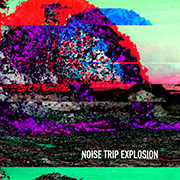
 Nolan Hildebrand: Noise Trip Explosion [Redshift]. The five compositions presented here sound like pure anarchy, so I like it; they seem to just happen rather than follow any organisation or pattern, which is good. They’re all electroacoustic works, so Hildebrand – working with liver mixer feedback, data-generated noise and interactive electronics – and his acoustic musicians are all to be commended for the unbridled anal expulsiveness they display as they whip up one huge sonic mess after another. There’s a perverse glee to their noisemaking as they try to be as grating, abrasive and hyperactive as possible and the pleasure is infectious, in a way that is so often promised by the hip kids but seldom delivered. Hildebrand as a composer appears to see his task as goading the musicians into fresh extremes as much as setting any parameters or restraints for them. For nearly an hour, nothing pauses for breath or takes so much as a moment to look back on what havoc has been wrought, it just relentlessly plunges forward at full tilt. It’s exhausting, but in a satisfying way, and yes you will listen all the way through. Strike another blow against the myth of Canadians being polite.
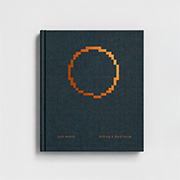 Josh Mason: Kicking A Dark Horse [Greyfade]. The latest in Greyfade’s folio series, which combines an album with a hardcover book. The nine tracks were composed on modular synthesizers fed into digital data processors, exploiting the mismatches between the two systems to create distortions, errors and discrepancies (see cover art). The book is a free-form, fragmentary collage of poetry and diary that makes for “a nonlinear travelogue of the states [sic] of Florida”. The two are intended to form an emergent artwork, each illuminating the other – discontinuity something something simulacra etc. – which will take more time to see how it pans out, so I’ll focus on the music. Warm analogue sounds warped by electronic artefacts, with a cool ambient vibe throughout. Old heads will immediately hark back to the fin de siècle avatars of Oval and Pole, and this music seems to combine the sound of both: nervous stutters and crackling tension over an impassive surface. Mason comes by this sound honestly, detailing how it’s the result of working with unfamiliar and recalcitrant equipment to achieve a serendipitous travesty. He keeps the drama implicit, anticipated rather than felt, which enhances the wary mood maintained throughout. They’re evocative but ambiguous landscapes, or rather, keeping with the concept and the fin de siècle fashion, a soundtrack to the book.
 Hunter Brown: Stoppages Vol. 3 [Party Perfect!!!]. I was all stoked about Brown’s Stoppages Vol. 1 [∞] and then skipped Vol. 2, so here’s me getting stoked all over again over Vol. 3. Like I said last time, Brown takes a David Tudor-like approach to glitch, interrogating the principle upon which the digital error operates and then applying it as a compositional method. The effect is transcendent. On this outing, he exploits the noise floor algorithms used in audio systems to distinguish signal from background noise; by reducing the audio level until it merges with the background, the system merges the two into a hybrid data bit. The results then have to be cranked up again to make them audible. For source material, Hunt subjects tracks from the two previous volumes to this process, creating pieces somewhere between variation and trope. It’s less immediate in brute force than Vol. 1, but more complex and sophisticated in its intricate sounds while equally rigorous in its conception and execution, with a concomitant inscrutable logic in structure and form. Why didn’t I mention Vol. 2 until now? Because I lost my copy. Guess I’ll have to go get it again.
 Laurent Güdel: State Music [Insub]. There’s a book with this one, too. Güdel has toured the venerable bastions of electronic music – EMS Stockholm, Columbia University, etc. – and produced a disquisition on the relationships between cultural and political power located inside 20th Century institutions dedicated to music research. It’s an exercise in poking through the leftovers of history, with the six pieces presented here composed on location on vintage Buchlas, Serges and EMS Synthis. The essay follows suit, raking over the past with an (ironically, academically popular) ethnocentric assumption that the Cold War was created in a vacuum and fought entirely on one side. It’s light on the pseudo-Marxist analysis and more of a verbal conspiracy board, using vague syntax to assert a link between synthesisers and fascism, eugenics and other maladies including, inevitably, the Jewish Menace. With chapter titles like “Vladimir Ussachevsky: Agent and Target of US Imperialism” it recalls pleasant memories of the shitkicking the American avant-garde got up to in the 70s with varying degrees of earnestness. The music? It’s strange, and for the most part unlikeable, possibly by design. Each piece gathers a wide array of timbres, textures and effects and throws them together one after another as though Güdel is impatient or dissatisfied, making each piece sound more like a demonstration reel for the instrument than actual music. The exception is the last piece, made on the non-functional RCA Mark II synthesizer, which Güdel uses as a resonator, antenna and resistor to transform field recordings and ambient sound. It’s a transformative work which shows creativity and insight into the relationship between sound and technology in a way that is not evident in the preceding tracks.