John Zorn, “Etude #33” from The Book of Heads (1978). Marc Ribot, guitar.
(1’22”, 0.99 MB, mp3)
Filed under: Please Mister Please by Ben.H
1 Comment »
Countdown to Eurovision starts a little early this year
Sunday 10 February 2008
Will no-one save the hallowed Eurovision Song Contest from encroaching irony and smirking self-awareness? In a move that combines Lithuania’s 2006 tribute to the power of positive thinking with the perennial favourite “My Lovely Horse“, one of the songs on the shortlist for Ireland’s entry for this year’s contest is “Irlande, Douze Points” by Dustin the Turkey. I’m not sure if having a turkey represent Ireland counts as a Fine Cotton or not.
The Telegraph had the news item which turned up first on Google:
Dustin’s song sung in a North Dublin accent urges the contest judges to “give douze points to Ireland.”
Which sounds like a wasted effort, given that it’s all decided by telephone voting now. Rather wonderfully, a subeditor pads out the slim news article in time-honoured style:
Should Dustin be chosen as the Republic of Ireland’s entrant, it will be the first time that a turkey in the form of a glove puppet has represented a nation.
I wonder how long it took them to fact-check that sentence. Also included is a YouTube link to Dustin “doing Riverdance”.
Filed under: Music, Stupidity by Ben.H
1 Comment »
Filler By Proxy LX: So it’s come to this again (brought to you by Roomba)
Saturday 9 February 2008
I’m moving house again, so when I get a rare chance to go online I’m less inclined to write a new post than just quietly surf around and think deep thoughts.
Filed under: Filler By Proxy, Stupidity by Ben.H
No Comments »
Visible cracks, real and illusory
Wednesday 6 February 2008

As has been proved many times before, it is foolish to pass judgement on a work of art before seeing it for yourself. I finally saw Doris Salcedo’s Shibboleth at the Tate Modern.
There has been plenty of discussion about the artwork since it was first installed – what it means, how it was made, whether or not it’s any good – so much that it is impossible to not be aware of its existence, nor of what the work consists of. (It’s a crack running the length of the floor in the Tate’s Turbine Hall, growing wider and deeper as it descends from one end to the other.) You could picture the entire installation in your head, except for one little detail that I’ve never heard mentioned when people discuss their visits to see it. At close range, the crack is revealed to be an obvious fabrication, with no attempt to conceal the wire forms embedded in the concrete.

For the weekend crowds peering inside its depths, or hopping back and forth over it, Shibboleth may as well be invisible if its success depends on the interpretation given to it by the artist and the museum:
In particular, Salcedo is addressing a long legacy of racism and colonialism that underlies the modern world. ‘The history of racism’, Salcedo writes, ‘runs parallel to the history of modernity, and is its untold dark side’. … In breaking open the floor of the museum, Salcedo is exposing a fracture in modernity itself. Her work encourages us to confront uncomfortable truths about our history and about ourselves with absolute candidness, and without self-deception.

Even ignoring the fact that the history of racism runs parallel to the history of everything, it’s hard not to read this as a fatuous piece of funding-speak. You don’t have to doubt Salcedo’s personal background and beliefs that support her art to see that her public interpretation of her own art reduces Shibboleth to a one-liner, simplistic and ineffectual. The installation is as much a tourist attraction as the building that houses it. Salcedo may be “keen to remind us” of “the existence of a huge socially excluded underclass”, but Shibboleth, in this context, utterly fails to fulfil her intention.
(Strangely, for all her talk of schisms and exclusions, the only interpretations I’ve seen of the formative mesh in the crack have been either abstractly structural or overly symbolic. I would have thought it made an obvious point that apparently natural divisions in race or religion turn out under closer scrutiny to be artificial, human constructs. Then the art could at least function in its own way as a neat little metaphor, if little more.)
In fact, Salcedo makes out her installation to be less of a work of art than it really is, although its true power may be of a type she did not intend, or even recognise.

The immediate image conveyed by Shibboleth when seen plain, beguilingly forging its path of destruction through the crowds inevitably wandering the Turbine Hall, is not one of division but of entropy. Starting almost undetectable at the high end of the hall, it is allowed to progress, or rather deteriorate, along the floor unchecked until it has opened up into a real tripping hazard for visitors. The image of a cultural institution whose foundations have been permitted to shift, and so decay, is potent; but in the Western World of the early 21st century it speaks to a different dilemma than the artist intended.
The Tate’s claim that the crack “encourages us to confront uncomfortable truths about our history and about ourselves” isn’t exactly true. In truth, its presence embodies our culture’s current readiness to doubt itself, and to question its own origins, validity, and integrity – with little or no outside encouragement. The entropy was built into the system. This self-examination and picking apart of the social assumptions that underpin our culture could lead to renewal, or to disintegration. For a jaded society of sophisticates, the threat of destruction and disaster is extremely seductive. (As one reviewer says, “Salcedo’s cut is always varied and pleasurably violent. I’m not sure the pleasure is intended.”)

Salcedo’s professed aim to expose the dark side of modernity began within modernism itself in the immediate aftermath of the Second World War. In 1949, Charles Olson reflected on the inability of modernism to cope with the fragmentary nature of reality – it is no coincidence he had invented the word “post-modern” the year before – and wrote in his poem “The Kingfishers”:
When the attentions change / the jungle
leaps in
even the stones are split
they rive
Filed under: Art by Ben.H
1 Comment »
Overheard on the DLR (Heron Quays Station)
Wednesday 6 February 2008
“So she’s not coming in today either. She called in sick yesterday then went shopping and broke her leg falling out of a taxi.”
Filed under: London, Stupidity by Ben.H
No Comments »
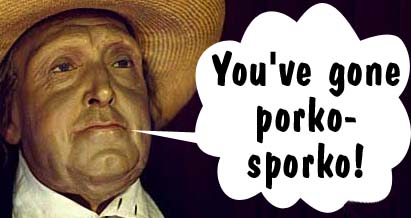
The mummified corpse of Jeremy Bentham reads inter-office emails.
Tuesday 5 February 2008

Filed under: Stupidity by Ben.H
No Comments »
Please Mister Please
Sunday 3 February 2008
Severed Heads, “Guests” (1984).
(5’29”, 4.71 MB, mp3)
Filed under: Please Mister Please by Ben.H
No Comments »
Filler By Proxy LIX: Pli Selon Pli
Saturday 2 February 2008

Boulez, according to all known biographies, did not have a childhood. Not in the Michael Jackson sense of “He never got a chance to play with little boys because he was recording ‘Ben'”, but quite literally: Boulez actually materialized one day in Messiaen’s class at the Paris Conservatoire. Some say that he walked out of a forest in the Rhône one day wearing white dress shirt and black tie. (I believe Peyser’s book adds that he was trailed by a pack of wolves over whom he had a sort of psychic power.) …Needless to say, he was already balding.
For peace of mind, I will assume that I’m not alone in being willing to overlook the most egregious failings in my heroes. Let’s see, there’s Ezra Pound’s anti-semitism, John Cage’s flirtation with Maoism, Cornelius Cardew’s wholehearted embrace of same, William Burroughs shooting his wife in the head (accidentally! so that’s not so bad, is it?). And then, of course, there’s Pierre Boulez’s combover, which I like to pretend simply isn’t there whenever I see a photograph of him. I wonder how easy it is to ignore if you meet him in person?
Tears of a Clownsilly has shaken up my consciousness by offering a history thus far of the great conductor and composer’s relationship with his fast-receding hair, how it has influenced his music, and the strain it has placed on his dealings with fellow musicians.
Filed under: Filler By Proxy, Music, Stupidity by Ben.H
No Comments »
British, up-and-coming
Tuesday 29 January 2008
So I saw something about a call for live electronic music for a gig opening for Christian Marclay and Elliott Sharp this Thursday; so I quickly sent off a piece; so they say no thanks to the gig offer, but would I like something of mine on a compilation CD they’re handing out on the night, “showcasing up-and-coming British artists”? Yes! I said. I’m British! I’m up-and-coming! I’m an artist (Macquarie University once said so)!
It says on the website they’re giving the CDs to punters at the end of the night. Is that to incentivate the punters to hang around to the end, or to prevent the punters from frisbeeing them at the talent?
Note to self: name on the door? or risk getting turfed out into the cold streets of Kilburn?
Filed under: Music by Ben.H
1 Comment »
Dear University of Wales Press,
Monday 28 January 2008
If you really want my permission to use a photo of a statue of Jeremy Bentham in one of your books, don’t ask me to reply to a nonexistent email address. Also, if you really want me to find out what said book is about, don’t direct me to a placeholder web page written in Welsh. Yrs, etc.
Filed under: Art, Stupidity, Writing by Ben.H
No Comments »
The Magic Listener Advisory Board Top and Bottom 5 for 2007, as voted for by people like you. Well, me really.
Sunday 27 January 2008
If you’re on the New Magic Listener Advisory Board, you’ll have had the chance to rate over 300 easy-listening, MOR, AOR, mouldy oldie, and long-forgotten novelty hits. As suggested before, Magic listeners have excellent taste in judging what people really want to hear, not what dickhead hipster ironists think people want to hear.
The Top 5:
1. “Runaway”, Del Shannon
2. “Then He Kissed Me”, The Crystals
3. “Ramblin’ Rose”, Nat King Cole
4. “Spicks & Specks”, The Bee Gees
5. “El Paso”, Marty Robbins
2. “Then He Kissed Me”, The Crystals
3. “Ramblin’ Rose”, Nat King Cole
4. “Spicks & Specks”, The Bee Gees
5. “El Paso”, Marty Robbins
Anyone who would not be stoked to hear any of these five songs on the radio is an enemy of music. Bonus points are in order for bigging up a Bee Gees single the rest of the world would find hopelessly obscure.
The Bottom 5:
1. “Since I Fell For You”, Kate Ceberano
2. “Jolene”, Olivia Newton-John
3. “Ben”, Michael Jackson
4. “Please Don’t Ask Me”, Johnny Farnham
5. “Route 66”, Natalie Cole
2. “Jolene”, Olivia Newton-John
3. “Ben”, Michael Jackson
4. “Please Don’t Ask Me”, Johnny Farnham
5. “Route 66”, Natalie Cole
It’s not explained whether this list is counting up or down, but still a clear picture emerges of what your average Magic listener does not like: ageing pop stars trying for second careers as lounge singers, off-brand cover versions, or pedophiles singing about rats. Take that, ironists.
In these troubled times, at least one corner of the world is in safe, sensible hands.
Filed under: Music by Ben.H
3 Comments »
Please Mister Please
Saturday 26 January 2008
Conlon Nancarrow, “Study for Player Piano No.36 (Canon 17/18/19/20)” (1965?-77?).
(3’49”, 3.29 MB, mp3)
Filed under: Please Mister Please by Ben.H
No Comments »
Brockley Nocturne with Effect of Dormobile
Saturday 26 January 2008

Filed under: London by Ben.H
No Comments »
“The Age Demanded” (forgotten post from December)
Monday 21 January 2008
Difference between London graduate art show and Melbourne graduate art show, 2007. Neither were hugely interesting, but for different reasons. The art presented by Melbourne students was sketchy, unfinished: they were still working through concepts rather than making fully-developed work. The British students were showing artworks which were complete, finished objects, but which functioned mostly as decoration or superficially imitated other artists’ ideas.
Nowadays peripheral countries like Australia are artistically affected less by the isolation from the circulation of cultural ideas, than they are by the isolation from the circulation of money.
Filed under: Art by Ben.H
No Comments »
The mummified corpse of Jeremy Bentham reads inter-office emails.
Monday 21 January 2008