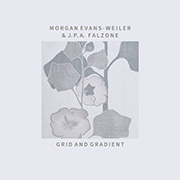
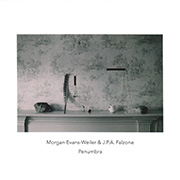
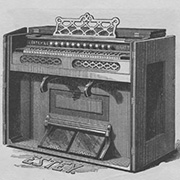
 Morgan Evans-Weiler: Grid and Gradient [Kuyin]. Morgan Evans-Weiler & J.P.A. Falzone: Penumbra [Another Timbre]. J.P.A. Falzone and Morgan Evans-Weiler: Ascending Music [Sawyer Editions]. Can’t believe I haven’t yet written anything about the collaborations by Morgan Evans-Weiler & J.P.A. Falzone, two musicians and composers who make a virtue out of abstemiousness and rigour. I was going to say simplicity, but there’s nothing particularly simple in the way the two of them do much with little. Evans-Weiler plays violin, as sparingly as possible; Falzone plays keyboards. In Penumbra, recorded in 2024, the prepared piano takes the foreground, augemnted on occasion by celesta. For each of the four pieces, Falzone establishes a reticent, contemplative mood, picking out notes gently while leaving plenty of space for Evans-Weiler to add the faintest colouration, wisps of bowed violin or an occasional low, electronic hum. On Ascending Music, the keyboard is a reed organ, recorded in a stairwell for additional reverberation. The textures are therefore more homogenous, playing out as a set of chorales in light, sustained tones. Both musicians’s playing may sound quite a bit freer than on Penumbra, but their meticulous approach is apparent through the delicate changes in colouration they both achieve in each piece, emphasising the style of musical mindfulness they used to record each of the five pieces here. The opening and closing title works on the album are credited jointly: they do more than just ascend, but there is greater pitch movement in these two works, with Falzone using electronics and slide whistle to pair off against Evans-Weiler’s slow glissandi. The three middle tracks are by Falzone, using cycling permutations of pitches with close attention to intonation and reflecting upon the resonant frequencies of the recording space. 22nd Century Music is a short work referencing Joseph Kurdika referencing Laurence Crane.
The new album on Kuyin is Grid and Gradient, an open-score composition by Evans-Weiler performed by the duo on violin, quarter-tone pianos and celesta with electronics. Besides the microtones, this comes across as a more developed performance by the two – more complex in thought, though not in surface activity. Bearing a superficial resemblance at first to Penumbra, both musicians play in an equally restrained manner, the violin’s presence still discreet but more of a counterpart to the pianos. It’s a long work that falls into six stages, each working within a different set of musical conditions, leaving the performers to find their way in maintaining the atmosphere. The methods and the processes are more obscure than before, but this allows for a greater depth of expression in the music, even as its substance remains elusive. The impression it makes is susceptible to small but profound changes, much like the rare introduction of unexpected sounds that open up new perspectives on what you’ve just heard.

Leave a Reply