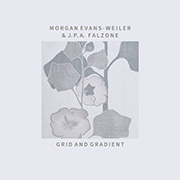

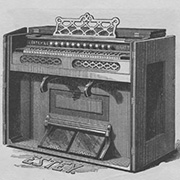
 Morgan Evans-Weiler: Grid and Gradient [Kuyin]. Morgan Evans-Weiler & J.P.A. Falzone: Penumbra [Another Timbre]. J.P.A. Falzone and Morgan Evans-Weiler: Ascending Music [Sawyer Editions]. Can’t believe I haven’t yet written anything about the collaborations by Morgan Evans-Weiler & J.P.A. Falzone, two musicians and composers who make a virtue out of abstemiousness and rigour. I was going to say simplicity, but there’s nothing particularly simple in the way the two of them do much with little. Evans-Weiler plays violin, as sparingly as possible; Falzone plays keyboards. In Penumbra, recorded in 2024, the prepared piano takes the foreground, augemnted on occasion by celesta. For each of the four pieces, Falzone establishes a reticent, contemplative mood, picking out notes gently while leaving plenty of space for Evans-Weiler to add the faintest colouration, wisps of bowed violin or an occasional low, electronic hum. On Ascending Music, the keyboard is a reed organ, recorded in a stairwell for additional reverberation. The textures are therefore more homogenous, playing out as a set of chorales in light, sustained tones. Both musicians’s playing may sound quite a bit freer than on Penumbra, but their meticulous approach is apparent through the delicate changes in colouration they both achieve in each piece, emphasising the style of musical mindfulness they used to record each of the five pieces here. The opening and closing title works on the album are credited jointly: they do more than just ascend, but there is greater pitch movement in these two works, with Falzone using electronics and slide whistle to pair off against Evans-Weiler’s slow glissandi. The three middle tracks are by Falzone, using cycling permutations of pitches with close attention to intonation and reflecting upon the resonant frequencies of the recording space. 22nd Century Music is a short work referencing Joseph Kurdika referencing Laurence Crane.
The new album on Kuyin is Grid and Gradient, an open-score composition by Evans-Weiler performed by the duo on violin, quarter-tone pianos and celesta with electronics. Besides the microtones, this comes across as a more developed performance by the two – more complex in thought, though not in surface activity. Bearing a superficial resemblance at first to Penumbra, both musicians play in an equally restrained manner, the violin’s presence still discreet but more of a counterpart to the pianos. It’s a long work that falls into six stages, each working within a different set of musical conditions, leaving the performers to find their way in maintaining the atmosphere. The methods and the processes are more obscure than before, but this allows for a greater depth of expression in the music, even as its substance remains elusive. The impression it makes is susceptible to small but profound changes, much like the rare introduction of unexpected sounds that open up new perspectives on what you’ve just heard.
Filed under: Music, Reviews by Ben.H
Tags: James Falzone, Morgan Evans-Weiler
No Comments »
Electric Guitar: Jon Catler, Cristiàn Alvear
Sunday 7 June 2026
 Jon Catler: The Young Mountain of the East [Chaikin]. If the title doesn’t tip you off, the Jung Hee Choi cover art will: this is an homage to La Monte Young. Catler is a veteran of Young’s Forever Bad Blues Band and Choi’s own Sundara All Star Band, with a long history of playing microtonal electric guitar across a range of genres. As an homage, The Young Mountain of the East is a well-informed and constructive extension of Young’s legacy, more than any derivative or sound-alike “tribute”. Catler takes the opening chord of Young’s The Well-Tuned Piano and builds upon it, extending the paired intervals beyond Young’s imposed limit om harmonic complexity into even finer gradations (to get technical and quantitative, Young’s composition sticks with pitches relatable to the first seven harmonic overtones – Catler’s goes as far as thirteen). Written as a double quartet for overdubbed fretless guitars, Catler produces rich but translucent sonorities made of e-bowed strings in esoteric tuning. The generated harmonies of the chords are very tasty, with the signature sound being the use of sliding tones to resolve from one set of intervals to another. The piece is organised into twelve sections, each of precisely equal length, suggesting the formal rigor beneath the music’s superstructure. While there is a logic to the piece as it progresses from one set of intervals to the next, it also allows development and further apparent flexibility to emerge as a consequence of the process – from one section to the next things get more complex, until reversing and resolving back to the initial stability of the opening section. Catler uses the complexity to extrapolate rhythms out of the beating frequencies in the centre of the piece, breaking the prevailing gloss of the sustainer guitars, and even cuts loose a little with some melismatic soloing before stability reasserts itself. It’s a different beast from Young’s own works, as you would hope, while sharing some of the same qualities: interrogative study, self-discipline, a devotional approach to expression, an immaculate surface. It does not, however, make demands on the listener’s endurance.
 Cristiàn Alvear: Sin título #30 – Singularidad #1 (Carrasco – Astaburuaga) [Insub]. Alvear is a guitarist who brings a necessary attitude somewhere between patience and bloody-mindedness to pull off pieces composed out of the slenderest means with an absolute rigor and austerity. He makes each of these works inexorable and inevitable, without ever seeming machine-like about it. The composers here for these two solo works are Nicolás Carrasco Santiago Astaburuaga, both of whom I’ve heard Alvear play before. Each piece sounds either antecedent or precedent to the respective previously recorded work. Carrasco’s previously heard sin título #26 is a study in stasis, as is this sin título #30. Over half an hour, Alvear begins by ringing the changes on harmonics and then settles into a repeated, chiming chord. In terms of form, it’s the skeleton of a James Brown jam slowed down about ten times, staying on it until over halfway through when the harmonics briefly come back before resuming as before. Well, not quite as before, as the chiming chord is now a single low note that broods at length before suddenly cutting out. Astaburuaga’s Singularidad #1 is about half as long but works on a similar scale. As with the Carrasco, it’s a puzzling, oblique non-sequitur of a piece, beginning with Alvear slowly picking out a loose, repeating riff disturbed by occasional off-kilter bursts of electronic chaff. A field recording interrupts, leaving us with some audio verité while the guitar grumbles with bass reverberations until it eventually rebuilds into a slow, indecisive vamp. A few other intrusions occur before everything just breaks off. As observed last time, “Time passes in a dreamlike state, with no logical connection or momentum, and so will either soothe, frustrate or disturb you.”