 Teodora Stepančić: Transparent Duo [Cloudchamber Recordings]. I dismissed Stepančić’s O A | F G as “precious”, accusing it of “silences, hushed tones, reverential playing and exquisite delicacy”. Transparent Duo reveals her bravado and commitment to this seemingly unrewarding aesthetic by producing a work of forbidding harshness and austerity, even as it is almost imperceptible. Composed for two string instruments with field recordings and written on transparent paper, the score’s pages either indicate towards a direction and length of glissando, or otherwise towards bowing style. The two sets of instructions may therefore combine to form an ephemeral but definite structure and substance. The realisation here is for two cellos, played by the n/ether duo of Laura Cetilia and Hannah Soren, heard recently in Cetilia’s own soil + stone. If you expect this combination to produce a warmer, fuller sound than the meagre materials suggest, you will be disappointed: Stepančić’s score admits that the glissandi played will be “mostly inaudible”. What is heard is whatever seeps through, however faintly, almost by accident; tentative silences open up and then persist, and as they do so become harder to dispel. The sounds lightly scratch upon the ear, as though carried by wind. This sensation is matched by the interludes of field recordings, open air with distant rural sounds. It’s all incredibly sparse, but it is not precious; it’s saved by the heiratic formality that arises from the piece’s conception, where raw but unconfronting sounds are studiously interspersed with silence, human and natural sounds separated, all arranged through impersonal, non-hierarchical means. The two cellists of n/ether exemplify concentration and seriousness of purpose in the extreme reticence with which their playing may be heard; as though to hammer the point home, the unyielding strictness of this realisation produces what sounds like a recapitulation at end.
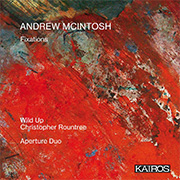 Andrew McIntosh: Fixations [Kairos]. McIntosh, who composed A Moonbeam Is Just A Filtered Sunbeam and who we recently heard as violist on Ian Power’s Brace and various bits of Jürg Frey, returns with three compositions for strings, without electronic processing, extended techniques or field recordings. The strings are retuned throughout, in just intonation. Besides the inherent resonances of the tuning McIntosh makes the perceptual tension, between our brains hearing it wrong while our ears hear it right, integral to the fabric of his music. The title work, a thirty-minute string octet, alternates between brief melodic passages on individual instruments with passages of stillness where a couple of harmonies float back and forth irresolutely. They act on the piece’s supposed momentum as though time were suspended, but that suspension of time and lack of movement becomes the subject. As observed in Moonbeam, “either the time is filled with greater complexities of tone and colour, or even less happens than before, depending on the attitude you take while listening”; Fixations has a more defined structure and as such those complexities arising from apparent insensibility become the focus of attention, more than the moments of activity. In other words, these pieces have a curious effect on the listener, being indisctinct but tough. The musicians are an ensemble called Wild Up, including McIntosh himself on viola and Erika Duke-Kirkpatrick on cello. Duo for viola and cello, with any number of violins features the duo tracing out faint patterns against an even fainter halo of the higher strings in shallow relief. All play in a similar range, rising up gradually until the soloists reach harmonics. The patterning is vague and subtle enough to make you forget the notes as such and remember only the translucent timbre of the work, until a sudden flourish of rapid, elegant arpeggios towards the end. The opening track is a brief amuse-oreille titled 434.6, played by the Aperture Duo of Adrianne Pope on violin and Linnea Powell on viola. A small secret is revealed here, as to how McIntosh uses his melodic material: the phrases are blunt and even simplistic, but played with great delicacy and refinement. To keep things suitably oblique, the booklet doesn’t contain notes on each work but a transcript between McIntosh and Cassandra Miller, which begins with the former questioning the latter.

Leave a Reply