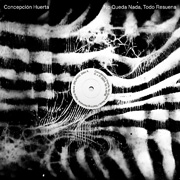
 Concepción Huerta: No Queda Nada Todo Resuena [Signal Noise]. Oh yeah, thinks me, a nice do-over of Mikrophonie I, all these metallic roaring rumbles with scintillating partials coruscating over the top as the microphone magnifies all these small abrasions on a resonant surface. Then, hold the ‘phone, oh yeah! This ain’t percussion at all, it’s all analogue electronics: Huerta was feeding sound from a vintage Buchla synth onto tape, then pingponging it back and forth on cassettes to create this pair of ruins from the future. The first, No Queda Nada, starts out dirty with fat noisebands and filtered static, but eventually starts to reveal the clinical origins of the sounds when the signals cancel themselves out with neat, eerie fadeouts into complete silence. The use of analogue tape and particularly cassettes acts as another set of filters, which become increasingly aggressive in their instability with each reiteration, making the whole piece come alive in its unpredictability. There’s a process at work, even though it cannot be heard, which gives both pieces a lean form and structure even as the sounds sprawl out and forwards with relentless intensity. No Queda Nada follows the process to steadily filter itself into ringing frequencies, Todo Resuena reveals the non-physical origin of the sounds by dissolving into strange loops and phases of feedback, before suddenly cutting off dead. Huerta cites Daphne Oram as her main influence (and source for the title), discussing entropy and information theory in a kind of metaphysical way. I’d add to this by citing Ron Nagorcka’s “the very essence of electronic media is distortion” and saying that these two pieces reminded me more of early Pauline Oliveros, so I like it.
 Ben Carey: Inventions [Hospital Hill]. Carey has also been playing with vintage synth gear, with these six tracks making a compilation of his globetrotting adventures in studios around Europe, North America and Australia. The striking feature that unites these pieces is the depth and the detail, and the abstract flow of large and small sounds contains a wealth of elaborate, but never dense, counterpoint with a great variety of character. The thing about attention to detail like this is that it suggests taste is the primary operating method at work, rather than any conceptual integrity to hold the work together. To a certain extent, this might be true on Inventions, but Carey does have some philosophy to back him up (via Gilbert Simondon), to treat the electronic processes in his equipment as organic functions, and so lets the instruments speak to discover where they may lead his compositional thinking. It works, largely due to Carey’s sensitive handling of the instruments and willingness to listen: moments that seem flashy will titillate the ear without dominating the overall piece, nothing stays still for long and yet never feels like Carey is trying to push things into activity for its own sake. With each successive piece, the presence of an internal logic appears to be more evident, even if this is an illusion. You think you’ve got a bead on his aesthetic and then halfway through the album things suddenly get very crunchy, forcing you to recalibrate. The last track is what I always imagine Autechre should sound like.
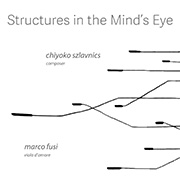 Chiyoko Szlavnics: Structures in the Mind’s Eye [Populist]. It’s been too long since I heard anything by Szlavnics. Structures in the Mind’s Eye is a composition from twenty years ago but given new life by Marco Fusi, who plays a viola d’amore for this interpretation. The instrument’s sympathetic strings add another layer of electroacoustic resonance while Szlavnics adds spatialisation to the sine waves that play against Fusi’s bowing. It’s a precise work, with Fusi’s own precision enhancing the complex of real and imagined sounds, produced both directly from their respective sources and indirectly by their interactions. A peculiar transformation takes place, as in the latter half Fusi has his viol subsumed by the pure electronic sounds; his playing takes on the role of activating the inert sine waves and modulates them, adding a ghost to the machine’s cool industrial humming. It’s also strange how this piece never really sounds austere, despite the slow, deliberate motions and discrete phrases neatly separated by silences. This is a binaural recording so use your earbuds not the phone speaker when you play it on the bus.